
Worthington chamber CEO says ICE surge led to fear, economic disruption
Go Deeper.
Create an account or log in to save stories.
Like this?
Thanks for liking this story! We have added it to a list of your favorite stories.


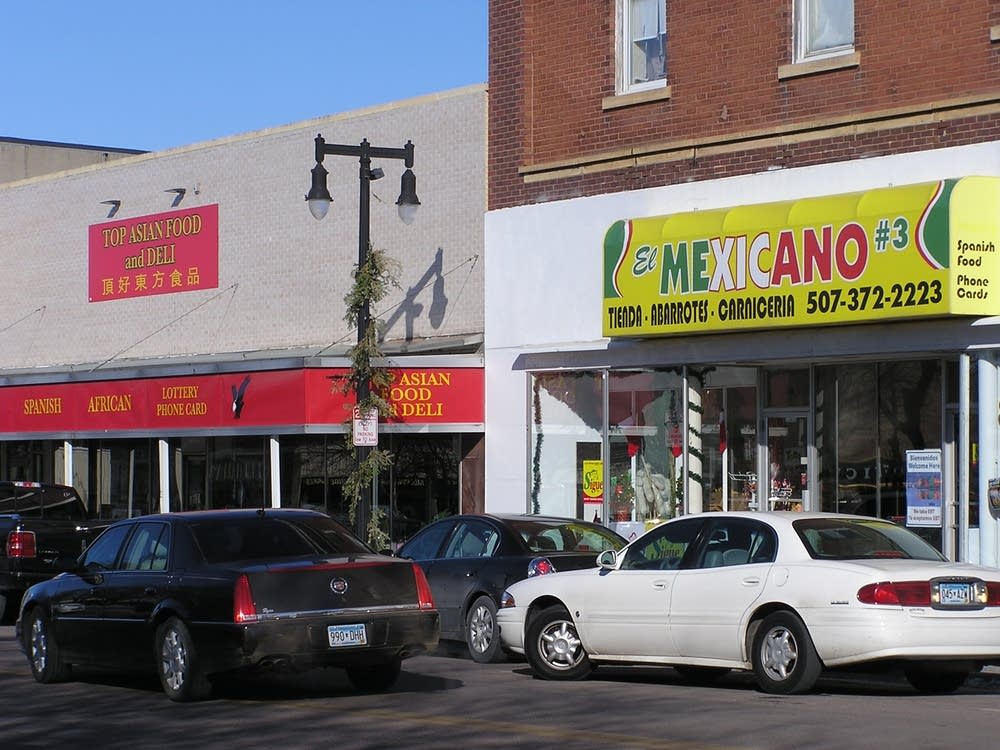
One Minnesota city looking towards recovery from the ICE surge is Worthington, in southwestern Minnesota. According to census data, 45 percent of the city’s population is Hispanic or Latino and 28 percent are foreign born. And the city has several immigrant-owned businesses.
Jaime Salinas is the CEO of Forward Worthington, which is the city’s chamber of commerce. He spoke to Minnesota Now host Nina Moini about the impact of ICE on the community and on local business.
Use the audio player above to listen to the full conversation.
Subscribe to the Minnesota Now podcast on Apple Podcasts, Spotify or wherever you get your podcasts.
We attempt to make transcripts for Minnesota Now available the next business day after a broadcast. When ready they will appear here.
Turn Up Your Support
MPR News helps you turn down the noise and build shared understanding. Turn up your support for this public resource and keep trusted journalism accessible to all.
Audio transcript
Joining me now to share about the business impact is Jaime Salinas. He's the CEO of Forward Worthington, which is the city's Chamber of Commerce. Thanks for your time this afternoon, Jaime.
JAIME SALINAS: Yeah, thanks, Nina. Appreciate being on.
NINA MOINI: I wonder from your perspective, what you have been seeing and hearing over the past couple of months. What did ICE enforcement look like in Worthington?
JAIME SALINAS: It really started as-- with the attitude, if it's-- it's not if, but when they would make an appearance in Worthington. And there was a lot of fear in anticipation. Citizens were taking up-- forming smaller, little informal watchdog groups, if you will, to try and stay in communication, report anything unusual that maybe they may be seeing or if they flat-out identified or noticed any unusual law enforcement efforts. And at the very beginning, it was a lot of, I said, just not if, when, just a lot of preparation, but still a lot of fear that went along with that.
Since then, after we did eventually get a visit from federal agents and such, and again, a lot-- just a lot of fear, a lot of fear, a lot of fear went along with that.
NINA MOINI: Would you say that fear carries on? As we are hearing about the drawdown and less agents in the area, how do you feel residents in your area are processing that?
JAIME SALINAS: I feel like there is still some fear. We've heard about the drawdown, but it's one almost an attitude of we'll believe it when we see it or maybe don't see them. But yeah, there is still a little bit of just trying to wait things out. How long-- how long do we not go out? How long do we just go to work and then come back home? There is still there is still some uncertainty that's going around here.
NINA MOINI: And the fear, uncertainty you're describing, obviously, it translates into how businesses can operate. As we've seen in many different areas of the state, people scaling back hours or closing down altogether. How has this couple of months impacted businesses? Are you hearing personal stories from people who are maybe close to shutting down, or how deep has this affected people?
JAIME SALINAS: I wouldn't say that there were many that were looking to possibly shut down, but they were making efforts to try and protect their clientele. There is or there was a grocery store that's attached to a Mexican restaurant owned by the same person. And they took the steps of locking their doors-- locking their front doors and manning them by staff to let people in one at a time, as those folks came up. There was a couple of those businesses. We have a local immigration law office that also took those measures as well, in order to protect their clientele as well, in the event.
As far as that, that's really the steps that have been taken to try and protect not only themselves, but their employees and their customers. Not a lot were saying that they were going to be shutting down, and that's something that we really haven't seen.
NINA MOINI: I think people wonder about dollar amount. If your role with the chamber, if that's something that you're trying to collect or where you might be looking for relief at this point. Where are you looking?
JAIME SALINAS: You know, we're keeping our eyes open or keeping our ears open. We do have relationships with some businesses here and trying to see if they'll share that kind of information. I'm sure this will be a work-in-progress, really. And once things have really-- once everybody really kind of feels like, OK, things are really are kind of dying down now, we can go to some sense of normalcy, I think more of that information will come out around here.
NINA MOINI: And for people who aren't familiar with Worthington, it's striking to hear about an area with almost a third of people are foreign born. Can you tell us the short version of just how this came to be in Worthington, and how critical and integral these immigrant-owned businesses are to the area?
JAIME SALINAS: Myself, I'm not a Worthington native. My wife and son came to Worthington in 2008. Before that, I've heard stories from other friends about how slowly the immigrant population slowly rose to what we have it here today. And as you mentioned at the beginning of our interview, many of Latino descent, many Mexican, many other South American, Guatemalans, Salvadorans, A real mixed pot of Latino nationalities.
We're also starting to see some Asian nationalities, as well. We're starting to see more Lao folks coming into Worthington. Even starting to see some folks from Haiti that are starting to venture our way, as well.
So, for me, I love it. I am not afraid of it. Everybody brings their own piece to the story and everything of Worthington. And I think we're-- as a city, I think there are some that may need to get maybe not as quite as excited about it, but I believe as a whole, the Worthington community, we're really happy with how things are moving forward here.
NINA MOINI: But it also seems dependent on these businesses doing well when the population is that large.
JAIME SALINAS: Yes. Yep, that is correct here, too. For example, just off the top of my head here, our local Walmart, especially on Sundays, it seems that much of the Latino community comes out on Sundays to do a lot of their shopping, especially over there. But other smaller businesses downtown as well, just relying on all of our immigrant friends that are here, that are trying to make a life for themselves and make Worthington what it is.
NINA MOINI: Are there any local efforts? Is it kind of like we've seen a lot in the Twin Cities, neighbors helping neighbors, small businesses helping one another out. Are there funds being set up, or where can people go for anything like that in Worthington?
JAIME SALINAS: Those are things that are kind of slower to being developed. Most of them are ideas or just getting together and saying, hey, what can we do? And like that. So as time moves forward, those programs or even just neighbors helping neighbors will get more established. There are some things that I've heard that we've been-- I rely a lot of information from the Minnesota Chamber of Commerce, here, too. So a lot of that information we'll see more flowing in here.
NINA MOINI: So you're seeing just community efforts and people who still have fear, but are looking forward to getting back to a sense of normal. Jaime, thank you very much for coming by Minnesota Now. Appreciate your perspective.
JAIME SALINAS: Thank you very much.
NINA MOINI: Jaime Salinas is the CEO of Forward Worthington.
Download transcript (PDF)
Transcription services provided by 3Play Media.

