
Minnesota-raised author describes history of region's racism in 'Cruelty of Nice Folks' book
Go Deeper.
Create an account or log in to save stories.
Like this?
Thanks for liking this story! We have added it to a list of your favorite stories.


Following the murder of George Floyd, many asked the question: “How was Minneapolis, of all places, at the center of a global racial reckoning?”
For Minnesota-native Justin Ellis, it wasn’t surprising. And now, the journalist is out with a new book that lays out Minnesota’s long quiet history of racism to help answer that question.
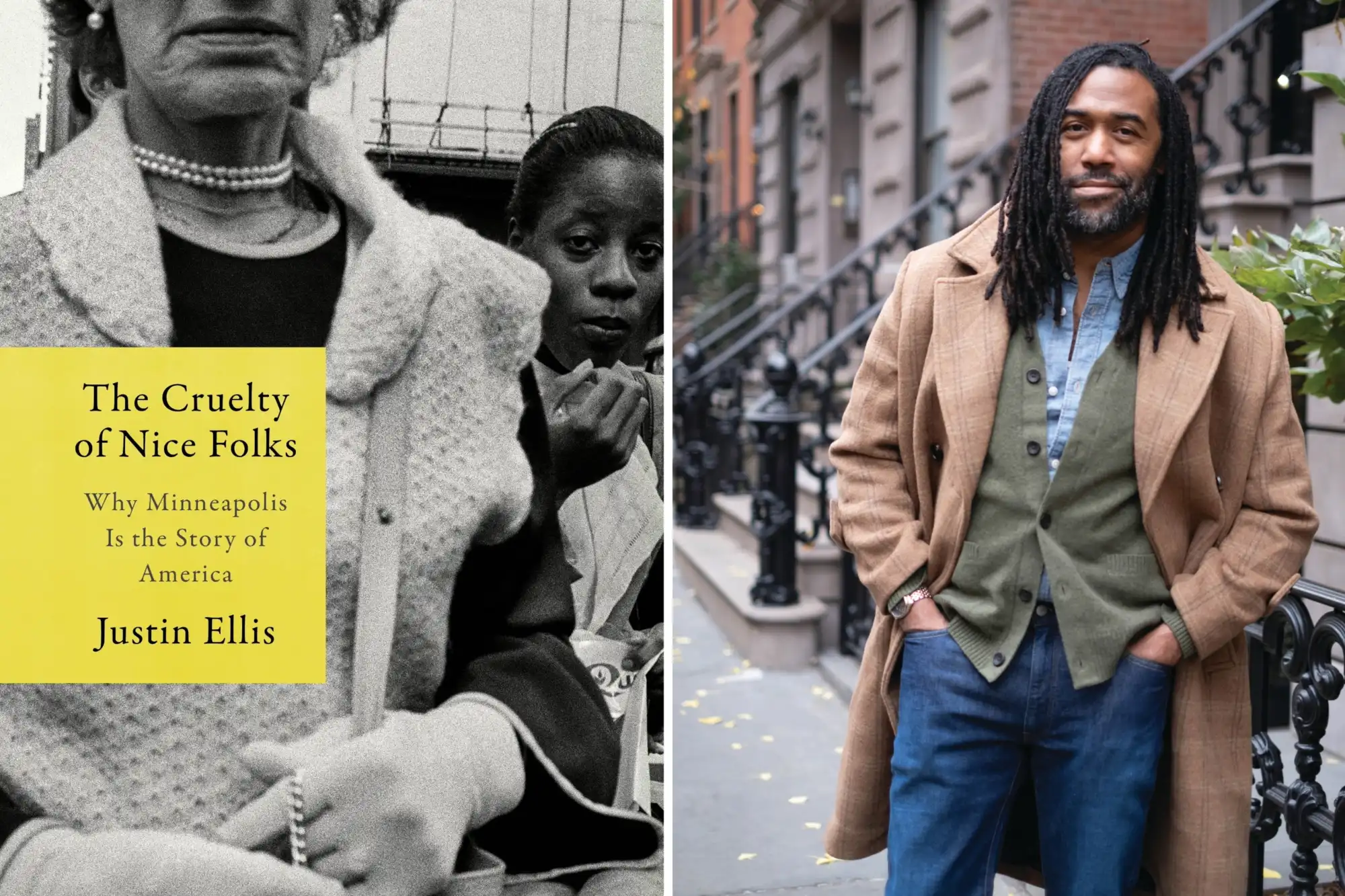
The book is titled “The Cruelty of Nice Folks: Why Minneapolis Is the Story of America.” Ellis joined MPR News host Nina Moini to talk about it.
He’ll host a reading and discussion of the book June 30 at 7 p.m. at Moon Palace Books in Minneapolis.
Use the audio player above to listen to the full conversation.
Subscribe to the Minnesota Now podcast on Apple Podcasts, Spotify or wherever you get your podcasts.
We attempt to make transcripts for Minnesota Now available the next business day after a broadcast. When ready they will appear here.
Turn Up Your Support
MPR News helps you turn down the noise and build shared understanding. Turn up your support for this public resource and keep trusted journalism accessible to all.
Audio transcript
The book is titled The Cruelty of Nice Folks, Why Minneapolis Is the Story of America. And Justin joins me in the studio. Thanks so much for being here.
JUSTIN ELLIS: It's lovely to be here, Nina.
NINA MOINI: Your book goes back more than a century in Minnesota history. Why did you feel like you needed to go back that far in history to understand how racism took root here?
JUSTIN ELLIS: There is two parts to that, really, one of which was to do the thing, I think, that so many of us who grew up here have to do, which is interrogate what you think you know and to take a look at the cycles that have happened over and over, whether it is police violence, whether it is the kind of institutional and structural inequality that we've seen in schools, that we see in housing.
You have to look at where the tracks for all those things were laid down. And so in this case, it meant going back to Zebulon Pike. It meant going back to how this place was founded. Like so many of us, I went to Fort Snelling for field trips growing up. And during those days, you didn't really hear a lot about Dred Scott.
And so it was important for me to take that step back and see what it is that I think I know and then, from that, build out not just the parts of history that have been lost or purposefully erased, but to take a look at the ways that the myth of Minneapolis and Minnesota has been built over time in a purposeful way.
NINA MOINI: So with that in mind, how do you think that changed for you when you started to dive in? How were you processing all this while you were growing up here versus now?
JUSTIN ELLIS: Well, growing up here-- and I should say, I grew up in the '80s and the '90s. And the feeling that I remember most is, one, that there was so much that had already been settled, that there was so much that was already in the past. Going to Minneapolis public schools, for example, that was the time when people could say, well, the district went through this desegregation process for about a decade.
We had these battles, and we've come through to the other side. In the '90s, there was the court battles over the public housing projects on the north side. And so there was this sense, I think, over and over again, that these are things that were in the past and that Minnesotans had worked together to overcome them and that they didn't really have any bearing in the present.
And I think that's a way of whistling past really hard conversations. But at the same time, it's this ways in which not dealing with these things kind of creates this erasure of the ugly parts of the past and, frankly, the Minnesotans whose lives don't really seem to count over and over again.
NINA MOINI: And the book dives into your personal family history too. What was that like?
JUSTIN ELLIS: Yeah, that was a surprising process because I think, like so many of us, you grow up hearing a lot of family stories and tales about where we come from. And I think, for me, the thing that was sort of revelatory is that there is only so much you can learn, I think, especially-- this isn't surprising to many Black Americans, but our stories aren't as chronicled as other families.
I spent a lot of time not that far from here, over at the history center and the library that they have there, the fantastic archives. And very often, when I go to search for the names of my great-grandparents, the Ellis family, there's a lot of results that came up, but they were a lot of wealthy, white families, different captains of industry marrying off their children and things like that. And so you realize that there's only so much that you can find out, that you have to piece together through these other things that are available.
And fortunately, something that we do have here is this wealth of archives of the Black newspapers that have existed, the Spokesman-Recorder being one of them. And so things like that were really, really useful to me. But in terms of my own family's history, I think the thing that I struggled with is the ways in which, in this country, we see that you can think that the story of your family, maybe, is not as remarkable if all that people did in your family was try to take care of each other, try to have a good job, try to live up to that opportunity that they were told they could have here.
And to me, that, I think, for a long time, I really struggled with saying, how noteworthy is this? And it's absolutely noteworthy. It's absolutely a celebration. It's the kind of resilience that we see not just from Black families, but from so many people that come to a place like Minnesota, that says, you can have a life here. You can have something that is more inclusive. You can have something that's not like wherever you fled from-- and the fact that so many families have to just get up day by day and live with the inequality that's just invisible here.
NINA MOINI: So you dove into history. Tell us about how you processed the time in more recent history, after the murder of George Floyd. It sounds like, one of my takeaways, was that you were feeling like there was a lot of action and movement directly after and then a falling back to the status quo, if not worse. How did you process that time?
JUSTIN ELLIS: Yeah. I think, in some ways, that there was something that happened that was maybe slightly unfair to Minnesota and Minneapolis. This is one of the few times I might say that. But the attention of the world, I think, puts so much weight on to everything that already happened and something that was just devastating and horrific, the murder of George Floyd, and the way that was weighted down with this being a massive racial reckoning for the state and then for America and perhaps the rest of the world.
It can't be overstated how much people said that in the time afterwards. You had all these proclamations for companies that were going to do better, that were going to put money where their promises were. And I think that what we saw was that there was an arc that played out that, I think, to many people, felt like it was sort of a tidy story.
You obviously had Derek Chauvin being convicted, which was obviously historic in and of itself. The city of Minneapolis has the policing referendum that fails. And to me, that was the moment where the rubber band of the status quo snapped back and saying that we had this moment that so clearly crystallized the problems that existed not just in the police force, but the anger, the mistrust, the mistreatment that has been a part of the lives of marginalized families for so long, and people saying, we need to get on with our lives. We need to get back to some sort of normal.
And that basically set the stage for the ensuing years. You've seen so little that's happened around George Floyd Square. You've seen so little that's happened around policing, as you were just discussing earlier today. The Minneapolis Police Department is spinning its wheels and now going through yet another big change.
And the mayor and the city council are continuing to have these sort of clashes over how to deal with this legacy, to say nothing of dealing with the structural inequalities that exist in the city. So yeah, there's a part of it that makes you feel a little bit hopeless when you look at it through the entrenched power structures that control so much of our lives.
NINA MOINI: But you chronicle it anyway because it's important to, you're saying, understand history, to understand the present, to make sure history doesn't repeat in certain ways. And this book just came out. And so it doesn't include a lot about Operation Metro Surge, but you felt the need to do an epilogue where you were talking about Operation Metro Surge. How did you process that in the context of the rest of the book and the idea of Minnesota nice?
JUSTIN ELLIS: Yeah, that's a good question. I mean, I think for so many people, looking at what happened initially with the death of Renée Good and then the death of Alex Pretti, it felt like you were seeing these things in history repeating themselves and in real time, people killed by the state, people trying to mourn, and having that being pushed and pulled upon by law enforcement, I should say, federal law enforcement in this case, but also this arm's reach from some of the, again, politicians, the power structures who are willing to say these bold proclamations about, these things can't happen here.
But what was different this time, obviously, was that there was so much more communal action and response. I think that, to me, again, we saw a lot of that during Floyd. But I think people took a lot of those lessons and sharpened them and, I think, turned them into something that felt much more robust this time around.
When it comes to being able to make sure that your neighbors are fed, that their kids can get to school safely, to me, that feels like you're trying to run your community in absence of government, in absence of the things that are supposed to take care of you. And so I am hopeful that that kind of energy can continue and that people will put that towards making the-- again, I keep talking about these power structures.
But these are the things that actually changed our lives in meaningful ways. And I think there's a frustration that they don't act fast enough, that they aren't robust, that they aren't meeting where the minds and the hearts of people are right now.
NINA MOINI: You're saying, trying to see if these types of efforts can be sustained and incorporated into systems over time. Justin Ellis, thank you so much for coming by Minnesota Now. Congratulations on the book. Really appreciate your time.
JUSTIN ELLIS: Thank you so much.
NINA MOINI: Justin Ellis is a journalist and author of the new book, The Cruelty of Nice Folks, Why Minneapolis Is the Story of America. He'll have a reading and discussion next Tuesday at 7:00 PM at Moon Palace Books in Minneapolis.
Download transcript (PDF)
Transcription services provided by 3Play Media.

