
Tribal health experts gather to uplift traditional tobacco and confront commercial tobacco
Go Deeper.
Create an account or log in to save stories.
Like this?
Thanks for liking this story! We have added it to a list of your favorite stories.


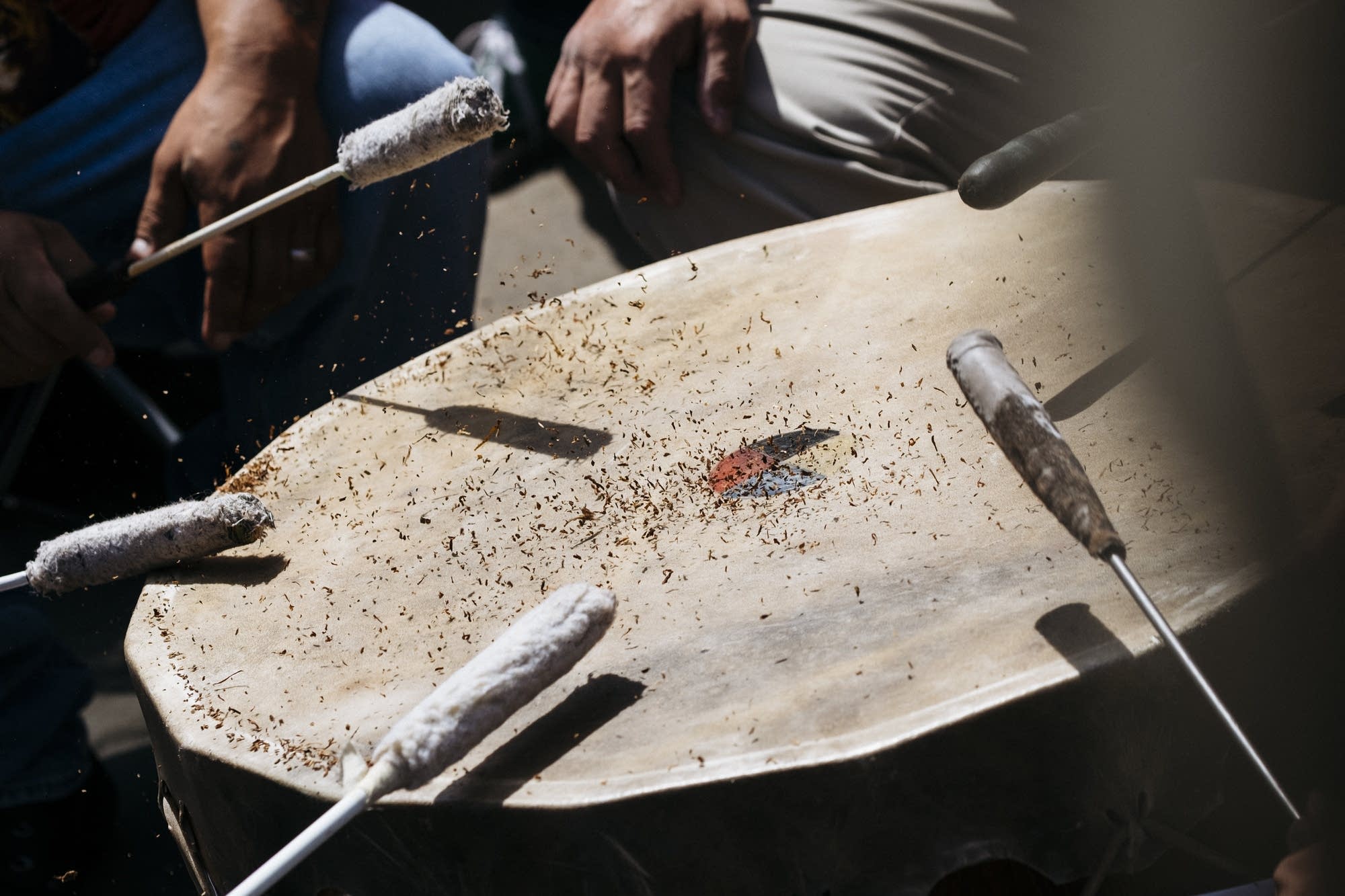
Traditional tobacco is at the core of many Native American cultural and spiritual practices. But commercial tobacco, packaged in cigarettes or vapes, contributes to higher rates of lung cancer among Native Americans.
Many of the people working with these two sides of tobacco are in Minneapolis for the National Tribal Tobacco Conference, held Tuesday and Wednesday on the University of Minnesota campus.
Mat Pendleton, otherwise known by his Dakota name Wakiyan Waste', is an enrolled member of Lower Sioux Indian Community and led prayer at the conference. Colin Welker works on commercial tobacco policy with the Public Health Law Center at the Mitchell Hamline School of Law and is presenting at the conference. They both joined MPR News host Nina Moini to talk about their work at the conference.
Use the audio player above to listen to the full conversation.
Subscribe to the Minnesota Now podcast on Apple Podcasts, Spotify or wherever you get your podcasts.
We attempt to make transcripts for Minnesota Now available the next business day after a broadcast. When ready they will appear here.
Turn Up Your Support
MPR News helps you turn down the noise and build shared understanding. Turn up your support for this public resource and keep trusted journalism accessible to all.
Audio transcript
Many of the people working with these two sides of tobacco are in Minneapolis right now. The National Tribal Tobacco Conference is happening today and tomorrow on the University of Minnesota campus. Mat Pendleton led an opening prayer earlier today. His Dakota name is Wakiyan Waste, and he's an enrolled member of Lower Sioux Indian Community. Welcome to the program, Mat.
MAT PENDLETON: Good afternoon.
NINA MOINI: One of the presenters at the conference is Colin Welker. He works on commercial tobacco policy with the Public Health Law Center at the Mitchell Hamline School of Law. Thanks for being here as well, Colin.
COLIN WELKER: Thank you so much.
NINA MOINI: So glad to have both of your perspectives. Mat, I'd love to start with you. I understand you ran tobacco prevention programs for Lower Sioux for years. I understand you donned another job, but you still do workshops and things like that. Can you tell me about what led you to this work?
MAT PENDLETON: So you'll hear tobacco first in our community because for Dakota, Lakota, Nakota people, our tobacco is cansasa. It's the inside layer of red osier dogwood. And we use that for everything. We put it in our pipes, we put it for our offerings. If we go ask for advice or if we go gathering or hunting or fishing, we put that offering out as a thank you to our relatives that's going to give its life. So we have life or whatever we're thankful for on that day. So it's just a main part of our way of life.
NINA MOINI: Yeah, and I understand you've been on the journey too of quitting smoking. How has dealing with that kind of made you understand this work, maybe on another level?
MAT PENDLETON: Yeah, I can remember as a kid crying to have my mom quit smoking commercial tobacco. And it was 2015. We were on a community walk against violence. And I was pushing my daughter and walking with my mom, smoking a cigarette. And I remembered crying to her to have her quit. And that was August of 2015. And I just made it a, I guess, a commitment to my daughter and myself to quit commercial tobacco.
And two months later, I got the position as the tobacco prevention coordinator for my tribe and really brought me back to the teachings of my elders and my mentors of our traditional tobacco, and led me on a journey of reconnecting to who I am as a Dakota man and really giving me that spiritual help to walk away from commercial tobacco and honor our traditional tobacco.
NINA MOINI: That's a beautiful story. Thank you for sharing that. Colin, you're not Native, but you've worked on these issues throughout your career as well. How did you become involved in this work?
COLIN WELKER: I studied public health in undergraduate school, and I started working for a tribe in Northern Michigan in their tobacco prevention department. And I just really fell in love with working with community and learning about the tribal stories like Mat just shared with us. And it's just I've continued on, and now I'm working in policy area and fighting the commercial tobacco industry. So it's just become a passion of mine throughout the last 10 or so years.
NINA MOINI: How do you think, Colin, that kind of fighting this fight is changing over time? There's different ways that people can access commercial tobacco now. How has it changed from maybe what a lot of people grew up with thinking about what smoking prevention was then versus now?
COLIN WELKER: Yeah, I think a lot of people think maybe smoking cigarettes is a thing of the past. We don't see it as much anymore. But the tobacco industry is always one step ahead of us and creating new products like vapes, nicotine pouches, synthetic nicotine products. So I think we still have a lot of work to do in tackling the tobacco industry, and they're still pervasive and targeting our communities, particularly our Native communities, with their deadly and addictive products. So I think it's still out there, and we still have to fight the fight.
NINA MOINI: Yeah. And Mat, for listeners who don't know, going back to the traditional tobacco, the US government banned Native American ceremonies from the 1880s to 1978. Not too long ago. What impact did that have on access to traditional tobacco?
MAT PENDLETON: A lot. Not having the ability to teach, learn freely, openly in the public kept families to keep it secret and sharing it to not everybody, [? the other ?] protection of those families because of what could have happened to them because of possessing our traditional ceremonial items. But there's been a big push to bring back those teachings and to really understand the difference between commercial tobacco and traditional tobacco.
There's 500 plus tribes in the United States, and a lot of us use different things to offer to Creator God as a vessel, as a way of offering, a way to give thanks for all the blessings that we have on a daily basis. And being able to share the teachings that were passed on to me. One of my teachers said, what are we doing today to be a better ancestor? Seven generations ago prayed for us so we could be who we are as Dakota.
So what am I doing today to be a better ancestor for those seven generations to come? And sharing what has been shared with me so generous with the love from my elders and mentors, to pass that on to the generations to come. So that's what gives me the passion and fire to share what I know so freely.
NINA MOINI: And Colin, it's important to have Mat and others in the conversation, right? Because as you alluded to earlier, public health experts have documented how tobacco companies have targeted specific communities and groups in their marketing. What have tobacco companies done in advertising and in the policy realm to increase the use of their products in Native communities? What does it look like?
COLIN WELKER: Yeah, I mean, the tobacco industry, like I said, is always one step ahead of us. And they have pretty extreme marketing tactics targeted at various demographics, but tribal communities are no exception there. We have lots of Native imagery on packaging.
Companies like American Spirit Try to blur the line between traditional and commercial tobacco, touting claims like their cigarettes are all natural. And again, blurring those lines. They create perceptions of authenticity and Native ownership of tobacco products, and again, that naturalness.
But I think it's so important that we have people like Mat and the folks at this conference here really tell their stories, because they're the communities that are impacted the most by commercial tobacco and have the most to lose and the most to gain when they celebrate their traditions around ceremonial tobacco.
NINA MOINI: Yeah, and it's constantly evolving, this battle with commercial tobacco, in a sense, because there's cigarettes, then vapes, now pouches. I know there's also environmental concerns. You're going to be leading some sessions on that, Colin, talking about commercial tobacco waste, cigarette butts, electric waste from vapes. But Mat, I'm curious to know, just in the minute or so that we have left, what you're most excited for the conference and this convening and bringing people together?
MAT PENDLETON: The Indigenous task force has a youth group that did a performance to open up after the prayer. Just seeing the young generation having space to express themselves and share their vision on how to honor traditional tobacco is what I really loved about this conference so far, and what great work is to come from the next generation.
NINA MOINI: All right, Mat and Colin, thank you both so much for your time. Really appreciate it.
MAT PENDLETON: Thank you.
NINA MOINI: Colin Welker is a senior policy analyst with the Public Health Law Center at Mitchell Hamline Law School, and Matt Pendleton is an enrolled member of the Lower Sioux Indian Community. The National Tribal Tobacco Conference runs through tomorrow.
Download transcript (PDF)
Transcription services provided by 3Play Media.

