State agriculture commissioner looks to strengthen North American trade amid tensions
Go Deeper.
Create an account or log in to save stories.
Like this?
Thanks for liking this story! We have added it to a list of your favorite stories.


From trade wars, to animal disease and high diesel prices, there is a lot going on in the agriculture world.
Minnesota's Department of Agriculture Commissioner Thom Petersen just returned from a conference where all of that was discussed with some of Minnesota's most important trade partners: Canada and Mexico.
Commissioner Petersen spoke to Minnesota Now host Nina Moini with more on what he learned 35th annual Tri National Agricultural Accord.
Use the audio player above to listen to the full conversation.
Subscribe to the Minnesota Now podcast on Apple Podcasts, Spotify or wherever you get your podcasts.
We attempt to make transcripts for Minnesota Now available the next business day after a broadcast. When ready they will appear here.
Turn Up Your Support
MPR News helps you turn down the noise and build shared understanding. Turn up your support for this public resource and keep trusted journalism accessible to all.
Audio transcript
THOM PETERSEN: Absolutely. Appreciate the opportunity.
NINA MOINI: So many people are wondering how relationships are right now with these integral parts of our economy, as the United States and as Minnesota, these trade partners, these neighbors, Canada, Mexico, so we're thankful to have your perspective on it. This was the 35th Annual-- it's called the Tri National Agricultural Accord. Will you tell us broadly about the purpose of this annual conference and what it's about?
THOM PETERSEN: Yeah. I think it's a really important conference where commissioners like myself get together with our counterparts in Canada, the provincial leaders, and then Mexican ministers, two of their 32 states. And we were really lucky to have a record turnout this year, as you might imagine, with everything going on.
We had all 11 Canadian provinces, 30 states represented, and 10 Mexican states. And we get together and come up with a general sense of agreed topics that we can agree to go forward. And very important, I've been able to do this all eight years as commissioner and find it very helpful. Mexico and Canada are our two top agriculture trading partners right now.
They have been for several years. And really, the highlight right now is with Canada being there in this time when the president announced actions against Canada and Canada likewise. This is a tough situation to be in right now, so that was really helpful to sit down with those counterparts.
NINA MOINI: What was helpful about it? What conversations are you able to have? I mean, if the tariffs are in place, if the policies are put into place, how do you have conversations through or around that?
THOM PETERSEN: Well, trying to really understand and share the importance of the trade between the two countries. I'm not a big fan of tariffs. I'll tell you that right away. I think maybe they worked years ago, but we're a really connected economy right now, especially Minnesota and Canada, and reassuring our Canadian partners especially that Minnesota values that partnership.
We value the business and trade that we do with them. We're very integrated within the Canadian border. For example, we import a half a million to a million piglets a year. They spend time in southern Minnesota and may end up in Mexico as ham.
And so this is all really important to be able to connect all these dots. But also, the USDA was present there. They take back recommendations that we make. They hear our conversations. And hopefully, we can have some kind of impact on what's going on right now.
NINA MOINI: I'm reading here in my notes, 97% of Minnesota's turkey exports go to Mexico. All of these international companies that we have based here in Minnesota, your General Mills, your Cargill.
So the US is in this trade war with Canada. And I understand that a lot of this trade, though, is protected through the United States-Mexico-Canada agreement. Can you explain what that is? It replaced what many Americans know as NAFTA.
THOM PETERSEN: Exactly. We had NAFTA for many years. And in January of 2020, President Trump-- then President Trump-- ratified the current USMCA agreement. And for agriculture, that's been a great agreement. Most, if not all, agriculture groups in Minnesota support that agreement. Our companies do.
And that was one of the things we-- it was up for renewal this summer, and we wanted to see it renewed for another 16 years. That's something we talked about at this meeting. The administration chose to only renew it for one year.
But that agreement has been very useful in disputes we've had with our dairy with Canada or corn with Mexico. But only having it renewed for one year provides further uneasiness in all of this.
NINA MOINI: So you'll have to track what happens there. Well, thank you for sharing about what you all talked about at this gathering. I want to make sure while we do have you that we're able to talk about a couple other things, like animal diseases. A bird flu is back, unfortunately, and it's hitting commercial farms in Minnesota. What's the conversation like about that right now?
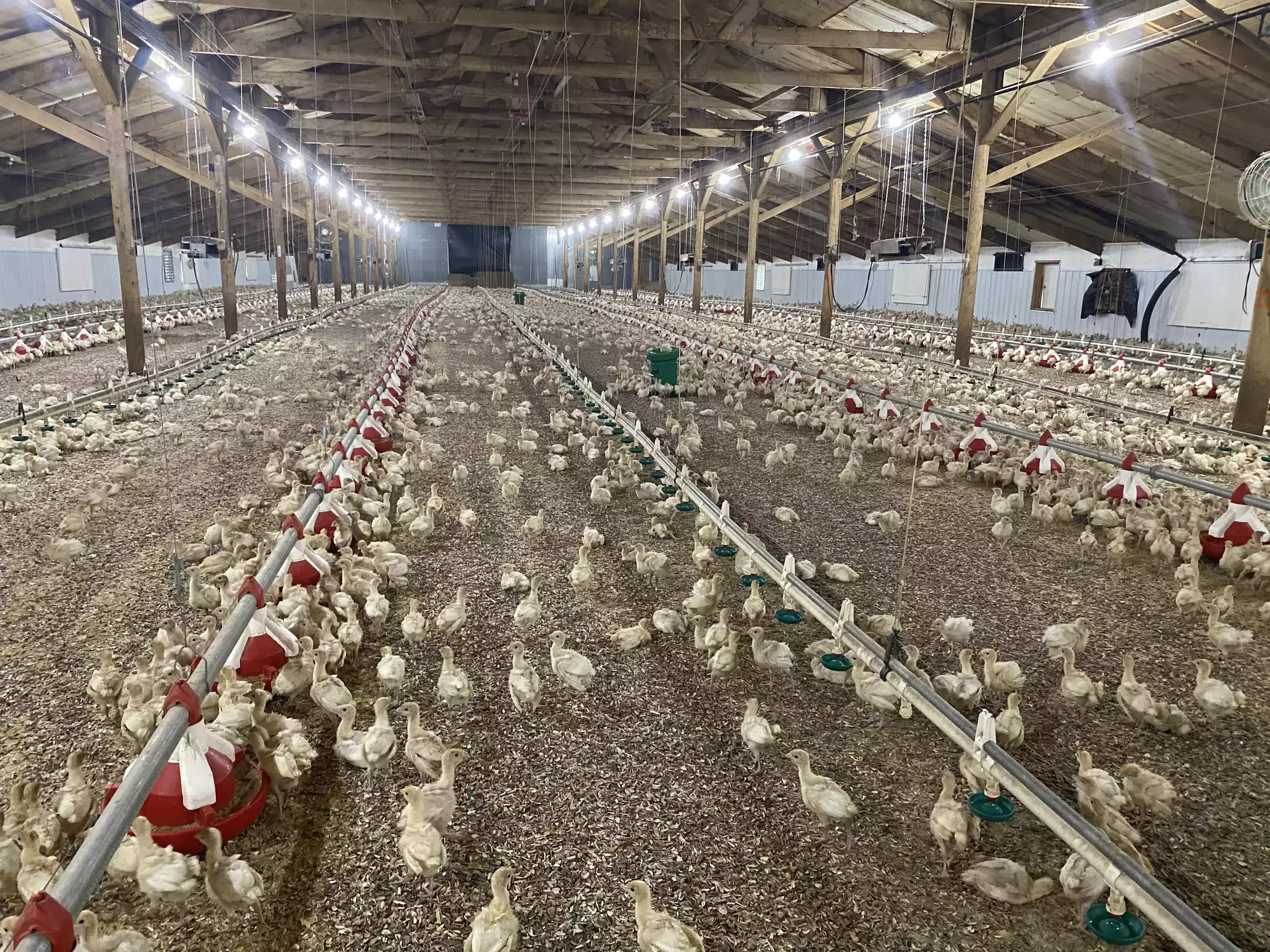
THOM PETERSEN: Yeah, that's a really difficult thing. Minnesota, as you just said, number one in turkeys, and also, 10,000 lakes. And right now, with the bird migration, we're just seeing a heavy set of cases, not just in commercial operations, but smaller backyard operations, too, as well.
We're also seeing the DNR is reporting it in the wild birds. And so that the virus is circulating as that migration is going on. Manitoba is also high in bird flu cases right now, too. And so that is a big concern. Unfortunately, Minnesota, we're also good at handling it, I think, and we're working with biosecurity with our farms and trying to get through this fall as quickly as we can with this. But it's a little tough right now.
NINA MOINI: Can you give me a quick sense-- is it worse than other years? Are you expecting it to get a lot worse?
THOM PETERSEN: It's on pace with-- not maybe our worst year, but our second or third year. It's a steady pace right now that is concerning, and that's something that we're paying close attention to. And always want to assure the public that properly cooked turkey or chicken is always safe to eat, and we're seeing continued strong sales of those products. But for some farms, this is a tough, tough situation.
NINA MOINI: Yeah. Let's talk about-- it looks like Mexico and border states are also dealing with screwworm, a parasite that impacts cattle. Is that something that you learned about in your travels?
THOM PETERSEN: It really is. And what a great opportunity. As I said, I was able to speak with Manitoba about avian influenza, but we also hear firsthand from Mexican officials what they're doing to stop and control screwworm as the border opened back up after it had been closed.
And they've shipped about 20,000 head of cattle through there trying to get relief into our markets-- but it's helpful to see how it could get here to Minnesota. We think, oh, we're a long way from Texas. But it did work its way up from southern Mexico to northern Mexico and now into New Mexico and Texas.
And we think it's possible it could hitchhike here on a dog or a pet or-- we just don't know. And so we're ever vigilant about that. They're working to control it and eradicate it. They've eradicated it before years ago, and so fingers crossed that decent controls are in place. And I felt better after visiting with those folks about what they're doing.
NINA MOINI: And just while we have you-- you know we're in harvest season. With the ongoing war in Iran, diesel prices just skyrocketing right now. A few weeks ago, they hit an all time high here in Minnesota. What are you hearing or working on on behalf of farmers right now in terms of relief?
THOM PETERSEN: Well, again, this couldn't come at the worst time. I just talked to a farmer a few minutes ago, and he told me he's paying $2.50 more a gallon this fall than he was last fall and just the pain that puts in to farmers. And already tough crop in some parts of our state where they've been dealing with drought or rain and other things and tumultuous prices.
And so the governor did do an executive order last week, that [AUDIO OUT] 10% over, really, for corn and soybean growers. Still have to have a special permit, but we know that saves the farmer a trip. Every 10 trips they take would be 9 trips, and so that is helpful. I've talked to many farmers that are already using that to try to help save some dollars.
We are looking at other options, governor-- we're going to meet later this afternoon with some of the agriculture groups. And we've considered other options, such as using colored fuel and things like that that's allowed on the farm. But Minnesota has certain statutes that make some of that more difficult, but we're always willing to try to see what we can do.
NINA MOINI: Commissioner, thank you so much for your time. We really appreciate it.
THOM PETERSEN: I always appreciate the opportunity.
NINA MOINI: That's Minnesota Department of Agriculture commissioner Thom Petersen.
Download transcript (PDF)
Transcription services provided by 3Play Media.