
Poetry collection creates 'sanctuary' out of author's pain and pride on Lake Street
Go Deeper.
Create an account or log in to save stories.
Like this?
Thanks for liking this story! We have added it to a list of your favorite stories.


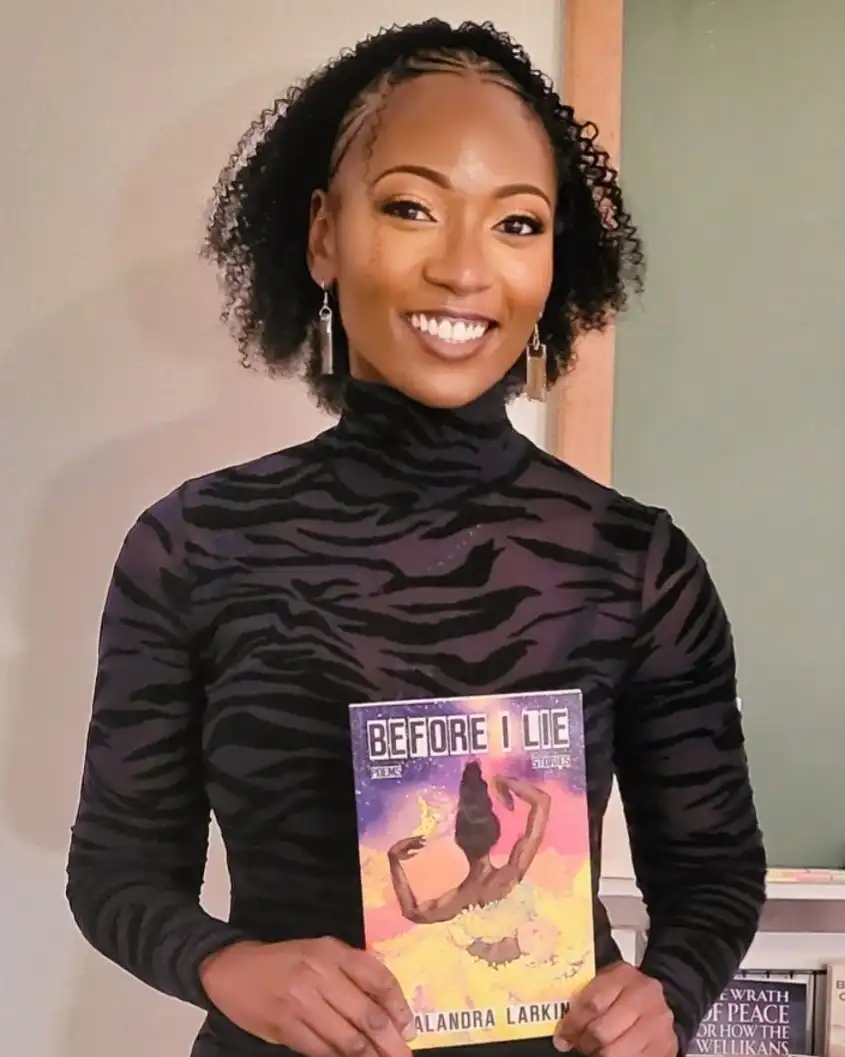
A Minneapolis spoken word poet is out with her first book of poetry, all about growing up on the south side of Minneapolis near Lake Street. The collection is called “Before I Lie.” Its author Dralandra Larkins joined MPR News host Nina Moini to talk about her identity in south Minneapolis and shared part of her poem called “I Am Black.”
Use the audio player above to listen to the full conversation.
Subscribe to the Minnesota Now podcast on Apple Podcasts, Spotify or wherever you get your podcasts.
We attempt to make transcripts for Minnesota Now available the next business day after a broadcast. When ready they will appear here.
Turn Up Your Support
MPR News helps you turn down the noise and build shared understanding. Turn up your support for this public resource and keep trusted journalism accessible to all.
Audio transcript
DRALANDRA LARKINS: Thank you for having me.
NINA MOINI: Huge congrats on your first book of poetry. How does it feel?
DRALANDRA LARKINS: Oh my gosh, it feels great, almost surreal. This has been my childhood dream since I was about 10 years old.
NINA MOINI: Wow. Amazing. And so I read that right around then-- you're talking about when you were 10 years old and when you were little, growing up over there near Lake Street, seemed like you really, really liked to go visit the area. Tell me a little bit just about your excitement for the neighborhood as a child.
DRALANDRA LARKINS: Yeah. So Lake Street has been my stomping ground since, again, since I was about 10 years old. My mother currently still lives on Lake Street. So growing up near Lake Street was always exciting because it felt alive. You could hear different languages on every block. You see murals telling our stories. You smell food from every culture. And it's just like this old world of itself.
As a kid, I didn't realize how much of that energy was shaping me. But now I see Lake Street as sacred ground and a place that taught me resilience, and creativity, and community. And so, again, Lake Street is home for me. It's where my mom still lives. It's where I spent so many pivotal moments of my life. And it's layered with both beauty, struggle, resilience, and culture.
And when I write about Lake Street, I'm really writing about survival and community-- the corner stores, the murals, the people who shaped me. So in Before I Lie, Lake Street shows up as more than just a backdrop. It's a character itself. It holds pain of what our neighborhoods have gone through and the pride of what it takes to get out of that. And so writing about it was my way of honoring where I come from, and also testifying the truth that carried those [? lies. ?]
NINA MOINI: Yeah. There's so much to balance in terms of, like you're saying, resilience, struggle, joy. And I think one of the amazing things about poetry-- and I'm certainly not a poet-- maybe everyone is in their own way, I don't know-- but is that you can marry all of those things. And I wonder if poetry was something you were interested in back then as a kid, or if it came into your life and into your voice later on.
DRALANDRA LARKINS: So poetry came to me as a sanctuary. Unfortunately, I grew up in a household where dysfunction was extremely prevalent. And I used to write my way out of that noise, out of that dysfunction. And so that's how I approach the page to this day. I approach the page as a healing sanctuary. Whenever I'm going through something, I rage on the page. And that's just getting all of my emotions out.
So ultimately, poetry came into my life as a survival tool first. I was holding so much, like you mentioned, resilience, struggle, joy. And I needed a language big enough to carry all of that. And poetry gave me that. It was the one place I could be completely honest without the fear of judgment. And over time, it became less about surviving and more about creating and weaving those hard truths into beauty, rhythm, and imagination.
So that's when it turned from something I needed into something I love. So it's how I learned how art just doesn't reflect life. It transformed life.
NINA MOINI: Mm. And then, also, you're not just writing the words on the page, though. You developed it into this spoken word art form. Is that something that-- were you shy to do that, or was that something that you wanted to do from the start? Or how did you turn it into more of this art form?
DRALANDRA LARKINS: Yeah. So it's kind of a weird balance, because I don't consider myself a shy person, so no, not at all. I was never shy. Spoken word is where I feel most alive. On stage, I'm not just hiding behind the page. I'm breathing life into the words. It's a conversation with the audience, so their snaps, and when you hear their nods, their energy, it feeds me.
And I grew up in one of those-- I consider myself one of those people who often needs validation. And spoken word, for me, validates that, especially when you're in a crowd, and again, you're seeing those faces, and the nods, and the smiles. So I grew up in a culture where call and response was everything. Hip-hop culture, it's all about, when I move, you move, kind of thing.
So I come from that world. And so spoken word just feels like home. It's not something I'm shy about. It's something I step fully into because poetry is meant to be heard rather than read.
NINA MOINI: Yeah, that connection. That's beautiful. And I understand that you have prepared part of one of your favorite poems to read for us. Would you read it for us?
DRALANDRA LARKINS: Yes, absolutely.
NINA MOINI: Go ahead.
DRALANDRA LARKINS: It's called "I'm Black." And this is just a piece of it.
NINA MOINI: OK.
DRALANDRA LARKINS: I'm Black like
West African women
With thick hips and full lips
Like single mothers
With tight fists
Like fried eggs and corn bread
Jollof rice, jerk chicken, fish, chips, and grits
Because this
This is soul food, y'all
You know, soul food
I'm Black like coffee
With no cream
Black like
Silent scream
Dr. King
I Have a Dream
Let freedom ring
I'm just Black
I'm Black enough to fight for civil rights
Black enough to reflect the light
Black enough to broadcast my pride like
Sojourner Truth
Ain't I a woman?
I'm Black enough
So that when these words touch
They leave fingerprints on your very soul
So how Black?
Black enough so that when these words touch
They leave fingerprints on your very soul
I'm Black from within
From ancestors who unlocked the mystery between Genesis and Revelation
Black enough to stick up like a sore thumb and represent a new nation
Black enough to stop and think before I speak
Black enough to absorb more than just heat
NINA MOINI: Beautiful.
DRALANDRA LARKINS: Thank you.
NINA MOINI: Thank you. Thank you so much for sharing that. I love that you said that this book is about truth telling, telling your truth, as you were doing there with "I'm Black." And the book is called Before I Lie. So I wonder, why that choice for the book? And what are the truths that you're wanting the readers to know here?
DRALANDRA LARKINS: Yeah. So originally, the book title came from just a random phone call conversation with my mom. Her and I were just in discussion, going back and forth. And out of nowhere, I was just like, yeah, Mama, because, before I lie, and then there's something after that. And then we both paused. And we were like, we like that. And I was like, I think that might be the title.
So after that, I started reflecting on what that meant to me. What does it mean, before I lie? What does that statement mean? And so the title, Before I Lie, comes from my wrestle with truth. It's me saying, before I lie to myself, before I lie to the world, before I lie to the ground, let me tell it straight. And so these poems are confessions, and testimonies, and survival stories.
The title holds that urgency, because sometimes, the hardest thing we can do is tell the truth. And I wanted this book to prove that truth telling is both dangerous and freeing. And so that's the truth to the book.
NINA MOINI: Hmm. We've been talking a lot about kids, young people heading back to school, and just some of the challenges in the world that everybody is dealing with, all of the different emotions. And I wonder if you're ever doing your spoken word performances, if you ever see people's eyes light up, or young people, and if you would ever encourage anybody who has a lot of feelings to get out on the page, but they're not a poet by any means-- do you have any advice for people who just want to unleash some of that, and in a healthy way? How do you get started?
DRALANDRA LARKINS: Absolutely. So we live in a great state of Minnesota. And we have a great reputation of being one of the top literary arts communities in the country.
NINA MOINI: Sure.
DRALANDRA LARKINS: And I've heard that from so many different people. So that is something that is stamped and true about Minnesota. So if people are wanting to get out and speak their truth, they're in the right company. They're in the right state to do so. All it takes is a simple googling, open mics, and there are so many around in each city in Minnesota.
I travel across Minnesota to Rogers, Mankato, Minneapolis, St. Paul. And there's an open mic in every city in Minnesota.
NINA MOINI: Wow.
DRALANDRA LARKINS: And so it really just takes guts, some courage, and really, some vulnerability. And just get out there and speak your truth. So that's one of the most powerful parts of this journey for me. When I go into schools or community spaces and perform spoken word, I do see young people's eyes light up because they realize poetry isn't just something in a textbook. It's not just Shakespeare. It's inside of us. And it's their story.
So afterwards, they'll come up, and they'll say, I didn't that you could write like that, or I didn't know that my voice mattered. And so that's the joy of teaching and helping folks see the weight that they carry.
NINA MOINI: They have a voice, too. Yeah.
DRALANDRA LARKINS: Right.
NINA MOINI: Dralandra, I wish we had more time. We have to go. But I want to congratulate you. And thank you so much for stopping by Minnesota Now. I appreciate you.
DRALANDRA LARKINS: Thank you so much.
NINA MOINI: Thank you. That was Minneapolis poet Dralandra Larkins, author of the new book of poetry called Before I Lie.
Download transcript (PDF)
Transcription services provided by 3Play Media.

