
Eyewitness to the Metrodome collapse looks back 15 years later
Go Deeper.
Create an account or log in to save stories.
Like this?
Thanks for liking this story! We have added it to a list of your favorite stories.


Much of Minnesota woke up Wednesday buried in a fresh layer of snow. It’s a fitting scene, since this week is 15 years since one of the state’s most infamous snow events.
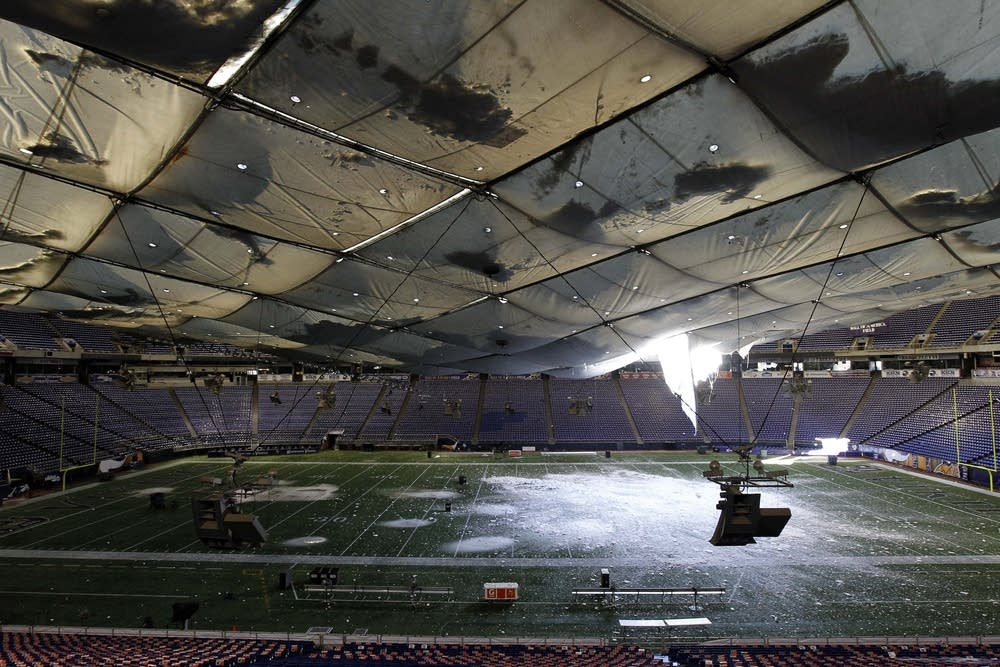
Early in the morning on Dec. 12, 2010, the roof fell in at what was then the Minnesota Vikings’ stadium, the Metrodome.
Minnesota Now looked back at MPR News coverage of the collapse and talked with the only person who was in the arena when it happened. Peter Eisenschenk, former building operations manager of the Metrodome, joined MPR News host Nina Moini to share what he remembers.
Use the audio player above to listen to the full conversation.
Subscribe to the Minnesota Now podcast on Apple Podcasts, Spotify or wherever you get your podcasts.
We attempt to make transcripts for Minnesota Now available the next business day after a broadcast. When ready they will appear here.
Turn Up Your Support
MPR News helps you turn down the noise and build shared understanding. Turn up your support for this public resource and keep trusted journalism accessible to all.
Audio transcript
CATHY WURZER: It's making national news, the collapse of the Metrodome's Teflon roof from a potent combination of a lot of snow and high winds over the weekend.
NINA MOINI: You know that voice. That's Morning Edition host Cathy Wurzer reporting on the destruction at what used to be the Minnesota Vikings Stadium. She talked with Bill Lester, leader of the Metropolitan Sports Facilities Commission, the day after the roof fell in.
CATHY WURZER: The Fox Sports video of the roof tearing with the snow falling onto the field is amazing footage. What condition is the Metrodome in this morning?
BILL LESTER: It's in its deflated condition. So on the upside, we're very proud of the fact that no one was killed, no one was injured, and now we just have to attack the problem of fixing those three panels that failed.
CATHY WURZER: I would presume it's fairly cold on the field right now because, of course, you have a big hole in the roof.
BILL LESTER: Yeah, it's absolutely freezing. In fact, it does give you a taste of what outdoor football might be like in Minnesota in December.
CATHY WURZER: Any changes in procedures needed, or measures, or new equipment that could be put in place that could prevent this from happening again?
BILL LESTER: No, I don't think so. In the early days, there were three deflations in '82 and '83. And then we refined the snow melt system. And for the last 28 years, there have been no problems. The system worked as we designed it to do.
With the discussion today with the representatives of Birdair today and tomorrow, we'll see if there's any additional measures. But first and foremost for us is the safety of the fans, patrons, and users of the stadium. So we take care of that first, and then we'll figure out if there are any other steps we have to do with the roof.
CATHY WURZER: As you've obviously heard, there are many fans who think that this collapse means that the Metrodome is obsolete. You have to get rid of it, build a new stadium. What do you say to that?
BILL LESTER: Well, the stadium is functional economically for the Vikings to maximize revenues and compete with the other teams in the NFL. A new stadium, a reconstructed stadium would offer those opportunities. But from a functional standpoint, from the structure itself, there's a lot of concrete there. And though maybe not the most athletic building in the world, it functionally could last a while longer.
NINA MOINI: The Metrodome roof was repaired. And the Vikings played a few more seasons there before it was demolished for a new stadium. Well, Peter Eisenschenk is the former building operations manager of the Metrodome. He was the only person in the arena when the roof collapsed. And he joins me now. Peter, thanks for coming on the show and reliving this with us. I really appreciate it.
PETER EISENSCHENK: Absolutely.
NINA MOINI: This was such a moment in Minnesota history, many of us remember. What was it like for you in there? Can you take us back to that moment and just give us a peek into what you were experiencing?
PETER EISENSCHENK: Well, the night before, our ground crew guys were setting up for a Viking game that day, the Sunday that is. And we were unable to get enough people onto the roof. I think maybe the forecast wasn't the best.
So, anyway, we pulled all of our guys off the roof at midnight. We normally used fire hoses to clear the roof up there. And I was off the clock at midnight. And I elected to stay because I knew our building was in trouble.
The center had pushed in, the center of the roof, that is. And so I went to first aid. And I got some rest. Got up around 4 and brought a forklift out and started emptying these containers we put in all four corners of the building to collect water.
And I got to the last container. And I spilt it behind the Viking bench. And I thought, oh, they're going to really be angry about this. And so I began picking up the container. And suddenly, I heard a slide on the other side of the roof, and then a big explosion. And all I could see was black sky. So, I jumped back on the forklift and took off out of there and checked the clock. It was 4:03 or 4-- or 5:03 or 5:04. I'm going to die.
NINA MOINI: Oh.
PETER EISENSCHENK: So I was in a hurry. I scampered out of there. And by the time I got to the end of the ramp, the roof was down.
NINA MOINI: Wow. That is such a shocking experience to have, Peter. Our producers mentioned you did retire after that. You were in your '60s. You were like, all right. So, when you think back on that time and just what it meant for the state, and then it took another five and a half years for US Bank Stadium to open, the replacement, I'm curious to know, what do you think about US Bank Stadium? Have you been?
PETER EISENSCHENK: Oh, yes, I have. It's really a beautiful facility. Yeah, I've been around most of the arena. And yeah, it's really, really pretty. I'd have to-- how can I say this-- give the sports commission-- I know there's a sports authority now, but they were the sports commission then-- a lot of credit because they really took care of our people well.
NINA MOINI: Got it. That's good to know.
PETER EISENSCHENK: Mortenson built the bank. And they hired all of our guys to help build that new arena. And when it was complete, the commission hired them all back again.
NINA MOINI: Wow. That's good to know, because you don't always hear, Peter, about people getting taken care of well after something like that, so I really appreciate your time. And I wish we had more time, Peter, because this, again, was such a big deal. I'm so glad you're OK, first of all. And I appreciate you coming on the show to talk about this moment in time. Thank you so much, Peter. Wishing you the best.
PETER EISENSCHENK: Absolutely. Sure. Thank you.
Download transcript (PDF)
Transcription services provided by 3Play Media.

