
Post Modern Times plans to continue donation-based restaurant model as long as possible
Go Deeper.
Create an account or log in to save stories.
Like this?
Thanks for liking this story! We have added it to a list of your favorite stories.


Earlier this year, a longtime south Minneapolis restaurant stopped putting prices on its menu.
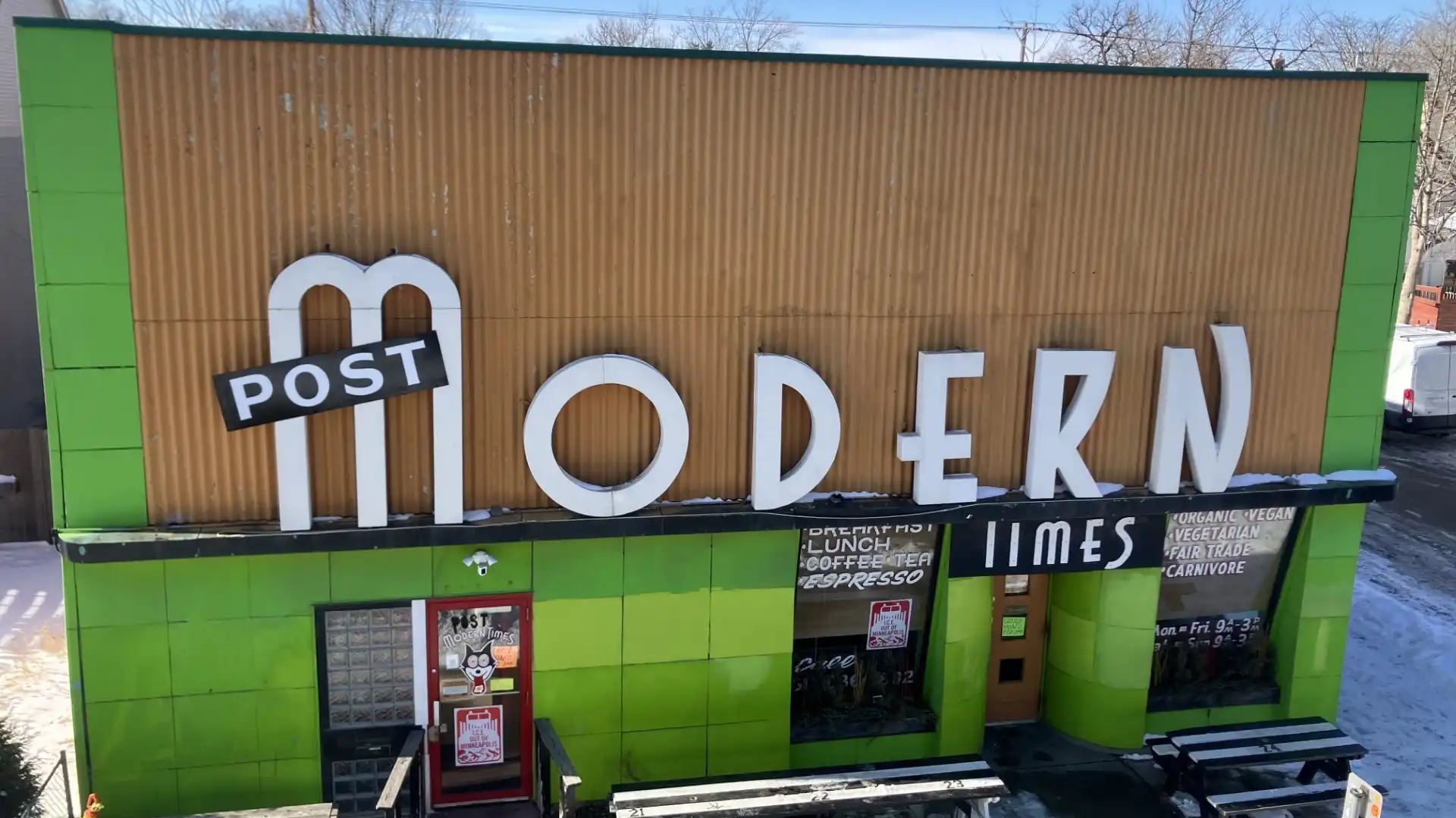
The diner formerly known as Modern Times rebranded itself as Post Modern Times and shifted to a donation-based model during the Minnesota ICE surge. Owner Dylan Alverson said he wanted to create a place where anyone could get a meal, regardless of their ability to pay. Months later, the restaurant is still operating on donations and drawing national attention for its unconventional approach.
Dylan Alverson, owner of Post Modern Times in Minneapolis, spoke to Minnesota Now host Nina Moini about why he’s sticking with the approach and how he’s getting neighborhood input.
Use the audio player above to listen to the full conversation.
Subscribe to the Minnesota Now podcast on Apple Podcasts, Spotify or wherever you get your podcasts.
We attempt to make transcripts for Minnesota Now available the next business day after a broadcast. When ready they will appear here.
Turn Up Your Support
MPR News helps you turn down the noise and build shared understanding. Turn up your support for this public resource and keep trusted journalism accessible to all.
Audio transcript
Joining me now is Dylan Alverson, owner of Postmodern Times in Minneapolis. Thanks for being here, Dylan.
DYLAN ALVERSON: Hi. Thanks for having me.
NINA MOINI: Well, must be becoming an old pro at doing interviews because I've seen them. This story has really taken off since you had a feature in the New York Times. How has that been for you?
DYLAN ALVERSON: Yeah, it's been good. It saves, I guess either way, we're doing something that is unexpected and at times hard to explain. So the interviews honestly saved me some talking about it. So it's been good. It's definitely a change for me to be in the public spotlight, but I am doing my best.
NINA MOINI: You say it can be hard to explain, and I'd love for you to try to explain. Take us back a few months when you decided to make this huge shift in your business model. Where did you come up with the idea and how does it work?
DYLAN ALVERSON: Well, yeah, at the end of January, during the heart of the ICE occupation, we were again in the center of a neighborhood in an international incident. And I think it mostly came out of frustration of being a business owner, and being a resident of this neighborhood, and seeing the amount of trauma being inflicted on this neighborhood, and wanting to do something. So I wanted a way to keep employing 27 people through a time of crisis and hardship, which is difficult on its own, and be there to be able to provide comfort to people in our neighborhood that we're experiencing all of this. And that's what we do. We're a restaurant.
So making home-cooked food is our way of supporting people. And so I took the prices off. I said, let's just see how this goes. We can stop participating in creating sales tax and take a bit of a stand, I guess, against what we saw as our government not standing up for the people.
NINA MOINI: So it's donation-based You come in. There are no prices on the menu. And I think when this first started, people I'm sure were like, oh look, he's doing this. He has it, feels in his heart that this is the right thing to do. But I don't think as many people probably thought that it would be a lasting model. It seems to have lasted some time. I don't know how long you would even decide before you if something has been successful for you and for your business. But how is this working for you? What's the response been these months later?
DYLAN ALVERSON: Yeah, it's four months, so. I mean, it's complicated and it's been great. I think that the first day that we were operating without prices, it was pretty clear that we had made a much bigger impact than we were anticipating. And essentially we're producing hope in a very dark time for our country and for our city. So it felt pretty clear that that was the path forward. And since then, we've been scrambling, trying to essentially figure out how to make it work, how to create a model that is a business foremost, instead of seeking a profit, which is nearly impossible for any restaurant these days.
We were reestablishing as a business that is trying to provide public good, or in this case, access to food. So we went back to traditional payroll and are essentially a regular restaurant just without prices. So donations come in a separate way, and we gauge everything as are we staying ahead.
We still have a staff of about 29 people that are all getting paid, and we're basically operating as a normal restaurant. It's just with a different revenue stream, and we are charging for our merchandise, our t-shirts and sweatshirts and things, which after the New York Times article, we are almost sold out of everything.
NINA MOINI: Wow.
DYLAN ALVERSON: But so it's been a lot of scrambling. It's been a lot of creating systems, looking at things differently, seeing--
NINA MOINI: Yeah, you seem pretty open as well to feedback from people. You said it can be complicated. Obviously, if you're essentially offering something that could be free, it invites lots and lots of people to the area, I'm sure sometimes. And I understand you're kind of hosting a community meeting tonight for your neighbors and people around the area and customers. What are you hoping for? I feel like you're like, I'm trying to build something, and I want people to give feedback, and you're open to that.
DYLAN ALVERSON: Yeah, I mean, when we took down the monetary wall, it essentially opened up access, and it also opened up visibility to a lot of bigger community problems. So we've had mixed reactions from people in the neighborhood, and we want to ensure them that we're examining everything and that we're working through and trying to have a safer and closer-knit community in the future.
The meeting actually was organized by a group of neighbors that are in support and trying to assist us. Part of this is that it's bigger than just us. We're building kind of a volunteer support system around us that can help us deal with all the outside issues. So this is a meeting to evaluate neighbors' concerns in this neighborhood directly and see if we can answer questions. And if we can work together to keep moving forward.
NINA MOINI: Yeah. Is this you think going to be the business model for you moving forward no matter what? Is this something you're having to assess month to month? I mean, to your point, the restaurant business is not easy a lot of the time. And sometimes people are operating on a month-to-month basis. How long do you envision this going?
DYLAN ALVERSON: I plan on doing it as long as I can. So it's hard to say. I do know that since the pandemic, us and pretty much every restaurant that I've talked to has been scrambling to try to break even every year, unsuccessfully. So this is presenting new challenges. But honestly, in some ways it is less challenging than operating the restaurant as it's been since the pandemic.
And I think that there's something in this system where we're seeing this change. We're seeing people having access to prepared food, and choice, and all these things that there's a large number of people in our society that just don't have those opportunities. And we're seeing what that does to people. And it's really inspiring to us. So I'll keep doing it as long as we can.
NINA MOINI: All right. Dylan, thanks so much for your time. Really appreciate your perspective.
DYLAN ALVERSON: Yeah. Thank you.
NINA MOINI: That was Dylan Alverson, owner of Postmodern Times in Minneapolis.
Download transcript (PDF)
Transcription services provided by 3Play Media.

