
Twin Cities commercial spaces are shrinking in value, forcing communities to rethink development
Go Deeper.
Create an account or log in to save stories.
Like this?
Thanks for liking this story! We have added it to a list of your favorite stories.


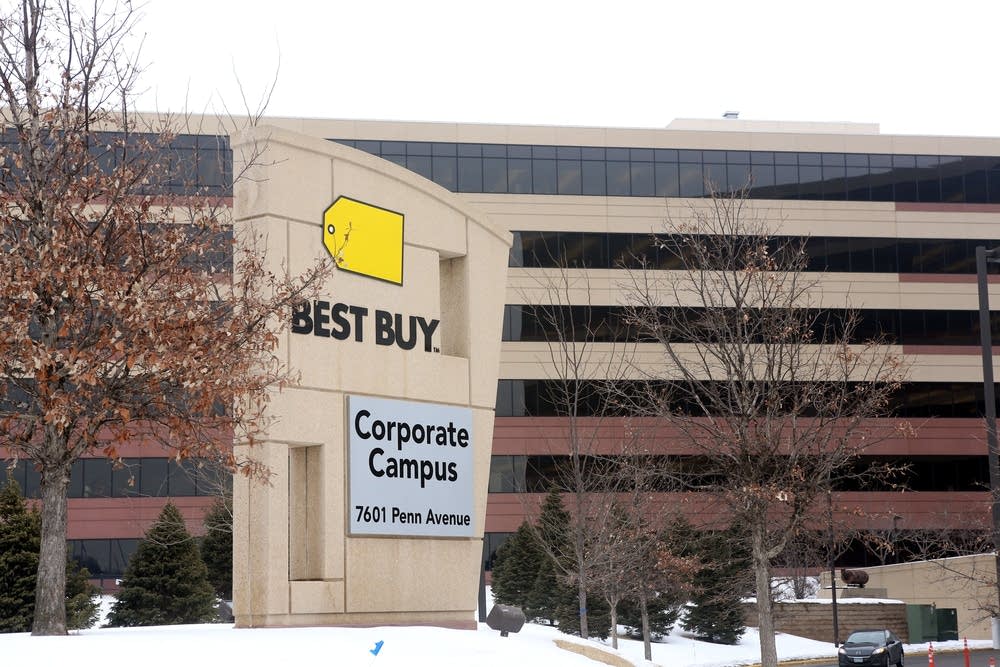
The value of commercial spaces, like office buildings, are shrinking in the Twin Cities. That became apparent last week, when the city of Richfield shared that Best Buy’s headquarters building dropped nearly 50 percent in value in its most recent assessment.
But how was that office building’s value decided? And how does it affect your tax bill?
Josh Hoogland, assessor for Hennepin County, and Laura Russ, executive director for the Shenehon Center for Real Estate at the University of St. Thomas, joined MPR News guest host Catharine Richert to talk about commercial spaces and the impact their value has on cities.
Use the audio player above to listen to the full conversation.
Subscribe to the Minnesota Now podcast on Apple Podcasts, Spotify or wherever you get your podcasts.
We attempt to make transcripts for Minnesota Now available the next business day after a broadcast. When ready they will appear here.
Turn Up Your Support
MPR News helps you turn down the noise and build shared understanding. Turn up your support for this public resource and keep trusted journalism accessible to all.
Audio transcript
JOSH HOAGLAND: Thank you, Catharine.
CATHARINE RICHERT: And we have Laura Russ. She is the Executive Director of the Shenehon-- I hope I'm getting that right-- Center for Real Estate at the University of St. Thomas. Thank you for being here, Laura.
LAURA RUSS: Thanks so much.
CATHARINE RICHERT: All right, Josh, I want to start with you. If you own a home, you may be aware of the assessment process. But even so, usually you just get sent a number of your home's value, and that's kind of it. When it comes to commercial properties, can you explain how you decide how much a building is worth?
JOSH HOAGLAND: So generally speaking, we're guided by a pretty substantial statutory framework. So really, regardless of what type of property it is, our process is almost identical. That said, we're also guided by appraisal theory and market forces where things start to vary a little bit differently.
But ultimately, what we're doing is looking at market data. We're diving deep into all of the data that we can collect, whether it's sales or other aspects of the market that might be important for our process. And then what we do is basically place a value on every single property in the county. And every county assessor throughout the state will do the same thing as of January 2 of each year. That's our assessment date. So what we're trying to do is figure out, what do we think that property would sell for based on some pretty substantial data analysis on January 2 each year?
CATHARINE RICHERT: Now in Hennepin County, Josh, what did you see in the numbers for 2026 for those commercial buildings and offices?
JOSH HOAGLAND: Overall-- so I'll put a little plug in. Every year, we publish an assessment report that basically displays a statistical analysis or the statistical results of each assessment each year. That's available on the Hennepin County website in March each year if anybody wants to take a look. But as far as commercial properties overall, including new construction-- so on a gross basis, we saw a reduction overall of about just shy of 2%.
CATHARINE RICHERT: Now Laura, when you hear those numbers, what do you make of them? What do you think is driving this trend?
LAURA RUSS: Yeah, I think it's important to remember that assessments reflect values as lagging indicators of how our economy is changing. So really from a market standpoint, we have been seeing this trend for some time. But as a lagging indicator, it's showing us that the market is really pricing this in as a structural, not a temporary change now. The good part of that means, though, that we can now begin to adapt to that, and communities can begin to plan for what that may mean to them on a tax basis.
CATHARINE RICHERT: Right. So it provides a little more stability, a little more certainty there. But when you saw that Best Buy's corporate building valuation dropped 50%, did that surprise you? Is that unusual?
LAURA RUSS: That is unusual from a historical standpoint, but it is in line with some of what we're seeing across the country, really, not just here in the Twin Cities. Richfield does not have as large a tax base or as diverse a tax base as some other regions or cities, and so they have indicated it will cause an adjustment in the overall proportion of taxes that they will need to spread out across their tax base.
CATHARINE RICHERT: Josh, I'm hoping you can say more of that. Commercial buildings are obviously just a piece of all of this. When those commercial spaces drop in value, how much impact does that have on the tax base overall?
JOSH HOAGLAND: Well, Catharine, that is highly dependent on the community, and as Laura said, the diversity within the community. And just as kind of a highlight of that, what I just said, I just mentioned that commercial went down about 2%. Industrial went up a little over 3%, which is the same tax rate, basically. So if we look at that on an overall basis, on a county-wide basis, depending on the community and if they have a great deal of industrial, not a lot of office buildings, they might have saw basically an increase on their 3A commercial industrial property tax base.
Overall, the county-wide assessment is just shy of $260 billion. And of that $260 billion, commercial on an overall basis makes up about 10%. Office is about 3% of that. And the industrial market is about 5.5% with residential and apartment making up the rest of the balance.
CATHARINE RICHERT: Now Laura, Minnesota has a lot of headquarters based here, a lot of corporate and office spaces. If all of these spaces are now worth a little less, what does that mean for how cities need to think about their tax base going forward? Are they thinking about how they might, for instance, convert office buildings into something else so they're more valuable than they are right now?
LAURA RUSS: Yeah, I think that's an important point as we look towards really, how do we adapt to this? Minnesota does traditionally have a legacy of a lot of corporate headquarters here, which is a positive thing and remains a positive thing.
It doesn't necessarily mean that we have more office space because we have corporate headquarters. It just means that we have a diverse economy. That diversity of economy is an important strength, because those headquarters are not just in one industry. They're in a number of different kinds of industries. And as Josh said, each of those types of uses contribute something differently to the tax base.
Another thing that we have done more in the last few decades is integrate more of our areas with various kinds of property classes. So downtown is no longer just office space. It includes a good chunk of housing. And as we move forward and as we clear out a lot of this excess inventory, that is absolutely what communities and building owners and developers should be looking towards. How do we adapt this space? How do we convert to uses that the market is asking for more of rather than less of?
CATHARINE RICHERT: Now looking around the state, Laura, are you seeing anything very creative, cities that have taken an older building and just turned it into something that really fit the community's needs?
LAURA RUSS: Yeah, I think we have seen that really across the state, particularly in our major metro areas. Both downtown Minneapolis and St. Paul, as well as Duluth, have used historic tax credits and other incentives to attempt to do some conversions of space. That is a difficult endeavor.
But when prices reach a low enough point, it does open up those opportunities for communities and developers to think more creatively about, how can we use this space differently? That may mean in the future we even have corporate campuses that sublease out a portion of their space to, who knows? Dog parks, fitness centers. We are embarking on a new way of thinking about space. And ultimately, that's good for the economy, even as it inflicts some pain on owners and our property tax base.
CATHARINE RICHERT: All right, Josh. For folks who may not be super familiar with all of this, when they get their tax bill, what do you think people should know about? What goes into that?
JOSH HOAGLAND: Well, I think that's a very tricky answer, I suppose, because there's multiple different things that impact a tax bill. There's the market forces that impact what I do as an assessor, and then there's also policy decisions at the state legislature. The state legislature is who sets the tax rates and can create a statute that provides different programs for various types of property. And then there's also the levy decisions at each of the taxing authorities-- city, county, school district, and the special authorities.
Just as an example of impact of the policy decisions at the state, a couple of years ago the legislature changed the calculation for the homestead market value exclusion. And in Hennepin County alone, that reduced our taxable market value for homesteaded property by about $1 billion. So those are all of the things, the major components that impact that tax bill, which makes it very difficult to answer the question as to what an impact is today of any one event.
CATHARINE RICHERT: All right. We had Josh Hoagland-- he's the Hennepin County Assessor-- and Laura Russ. She is the Executive Director of the Shenehon Center for Real Estate at the University of St. Thomas. Thanks to you both for being here.
LAURA RUSS: Thank you.
Download transcript (PDF)
Transcription services provided by 3Play Media.

