
Teen poets to share work reflecting on history and the future they hope for
Go Deeper.
Create an account or log in to save stories.
Like this?
Thanks for liking this story! We have added it to a list of your favorite stories.


How do teens imagine the future of our country and world? That's the question a group of youth poets will answer at a reading taking place Thursday at the Bell Museum.
It's the culmination of a program that spanned several weeks where a group of teens took workshops and received mentorship from adult writers. In that time, they reflected on the 250th anniversary of the U.S. and were prompted to imagine the world they want to see.
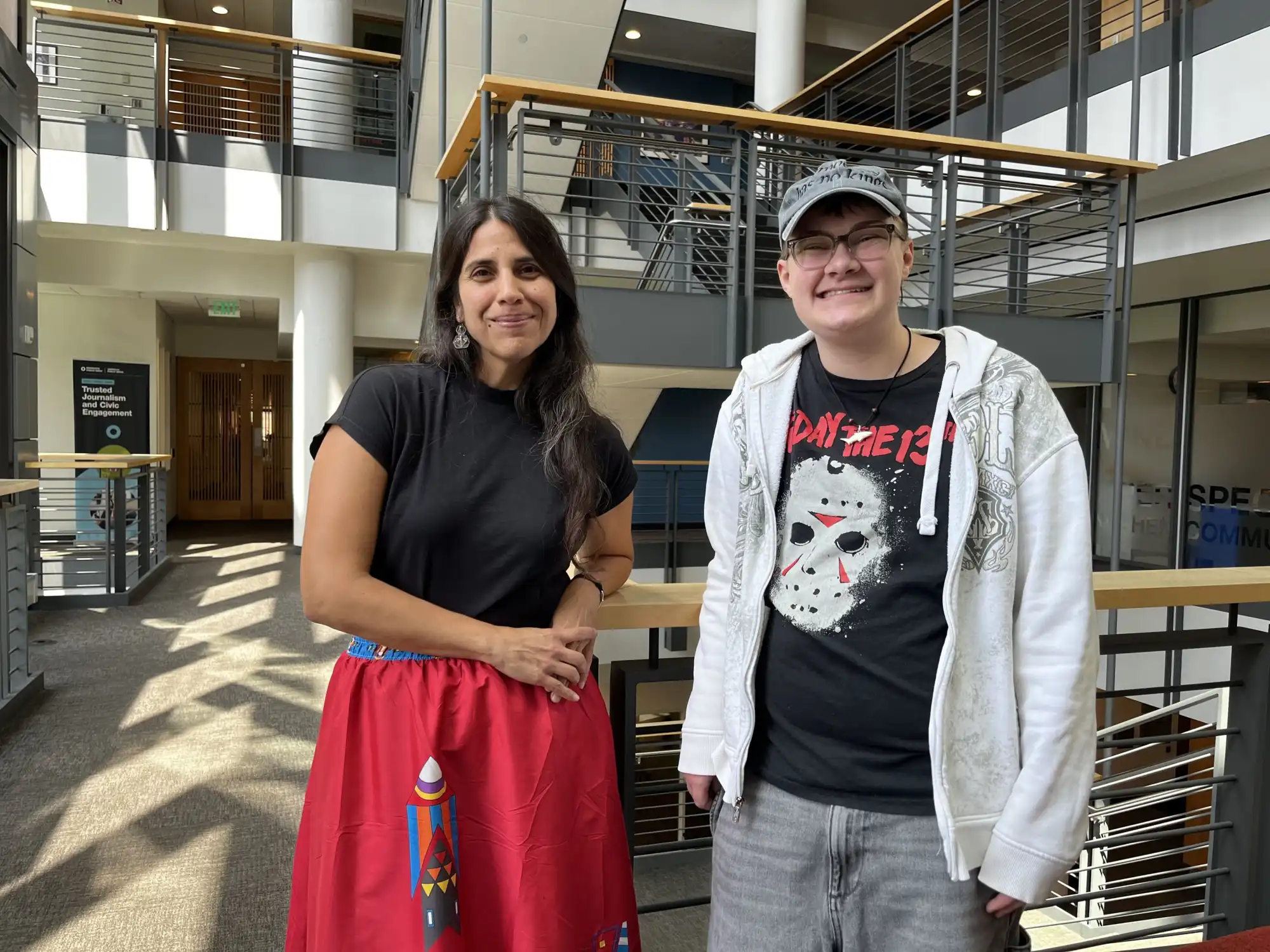
Knox Frederickson is one of the teen poets and a rising senior. Amanda Rosas is one of the mentors and a teacher at Visitation School. They talked with MPR News host Nina Moini and shared pieces of their work.
Use the audio player above to listen to the full conversation.
Subscribe to the Minnesota Now podcast on Apple Podcasts, Spotify or wherever you get your podcasts.
We attempt to make transcripts for Minnesota Now available the next business day after a broadcast. When ready they will appear here.
Turn Up Your Support
MPR News helps you turn down the noise and build shared understanding. Turn up your support for this public resource and keep trusted journalism accessible to all.
Audio transcript
In that time, they reflected on the 250th anniversary of the US and were prompted to imagine the world they want to see. Joining me now in the studio are two poets who took part in the program. Knox Frederickson is one of the teen poets and an incoming senior. Thanks for being here, Knox.
KNOX FREDRICKSON: Thanks for having me.
NINA MOINI: Also with us, we're happy to have Amanda Rosas, who is one of the mentors and a teacher at Visitation School. Thanks for being here, Amanda.
AMANDA ROSAS: Thanks for having me, too.
NINA MOINI: This is so fun. Knox, I would love to start with you. What got you interested in this program and poetry?
KNOX FREDRICKSON: For poetry, I've always been interested in poetry and in writing. But poetry really became an interest for me when I discovered spoken-word poetry. It was a way for me to be able to express myself. I sometimes struggle with speaking, but being able to write down my thoughts just makes it so much easier to express myself and then connect with others.
And this program meant a lot to me because there are so many poetry groups, but they're often targeted for adults. And this is just so specific for teens. And it just helped build such a great community with other teen poets. And that was just an incredible experience.
NINA MOINI: Sometimes it's an even better way to communicate, to be able to do your spoken-word poetry. Amanda, you're a teacher by day. You also write beautiful poetry. What drew you to this experience of working with younger folks?
AMANDA ROSAS: I mean, any chance I have to work with poetry and poets, I'm going to just take it. But I think the piece that really drew me in was, there's so much there. There's the poetry, but there's also the history piece and examining what 250 years means for the US, and beyond those 250 years, where are we going?
And so just unpacking that idea of 250 years. But 250 years-- obviously, we know this land has existed so much longer than that. And so just really unpacking that from a historical standpoint too. And to do it through creativity and poetry.
NINA MOINI: Amazing. Knox, would you tell us a little bit more about what the experience was like? I understand you did four workshops, and then you worked with mentors. What was that like?
KNOX FREDRICKSON: Yeah. So there were four different mentors. And each session we had, which was around an hour and 30 minutes, you were able to connect with this poet. And they would tell you their take on poetry. They would teach you new poetry techniques. They would talk about how they use poetry and history to weave stories.
And it was so cool to get all these perspectives, because poetry isn't this linear thing. It can be used in so many different ways. And to have these four mentors and get a different perspective from each person was truly incredible.
NINA MOINI: Yeah, it's not really about saying it's right or wrong. It's about sharing tools. Amanda, how did you create the space you wanted in your workshop? How did you want everyone to feel?
AMANDA ROSAS: I wanted a feeling of just there's a field. It's not a page. It's a field. And where are you going to go? What memories are going to emerge as you walk through this field? And just things like that.
And so the workshop I gave was actually called "The Poetics of Freedom Dreaming." And so it was really about capturing joy and imagining the world and how it could be different and how it could be better. And the best minds to do that are the youth.
NINA MOINI: Knox, I understand you are willing to share one of your pieces, a part of it, with us today. Would you tell us the name? And then you can go ahead and read some of it.
KNOX FREDRICKSON: This piece is still untitled, but it's a Tanka.
A bound journal with the pages housing dying thoughts that will not end
This is where I store my soul
Where I have kept my heart safe
NINA MOINI: Beautiful. Will you want to share a little bit about the background of it and the inspiration behind that?
KNOX FREDRICKSON: Yeah. So a Tanka-- I'm not going to act like a professional on this topic.
NINA MOINI: Sure.
KNOX FREDRICKSON: This was taught during one of the classes. A Tanka is a Japanese-style poetry piece where it's a syllable scheme. And this is based off of my poetry journal. I write absolutely everything in it. And like the poem says, it's kind of become my heart. It's where I put every single thought down. So it means so much to me. And I just wanted to write about that because it's such an important thing to me.
NINA MOINI: It's a tool.
KNOX FREDRICKSON: Yeah.
NINA MOINI: Amanda, you want to share a bit of your poetry as well, I understand. Thank you. And you can just give the name and then go ahead.
AMANDA ROSAS: Great. This is just an excerpt from a longer poem called "Mothers."
A time will come when our present is read as past
In text or in the rippling words of a private journal
Or seen on a corner sidewalk plaque
By the slanting feet of pedestrians lost in AirPods and thoughts
When this is history found with poem and the driftwood shelves of libraries
Let the story be that our efforts were gallant before the fall
That we mended the wounds of tattered skin
Calmed the friction in a battle of untold tears
That after a while, a time came like postpartum to nurture and rebuild
And we possessed the handheld capacity and motherly humanity to do it
NINA MOINI: That's beautiful. Do you want to share a little bit about maybe what inspired it?
AMANDA ROSAS: Yeah, I think I thought a lot about the Voices Forward program and thinking about recent history and the country and just the things that we have been going through in the United States and wanting to imbibe some hope into that.
NINA MOINI: Knox, something you said stood out to me, that sometimes it feels like people don't want to hear as much from teens and younger people. But you are literally the future, and so you are the ones to imagine what it could be and share that hope with everybody. What was it like to be surrounded by other teens and having a voice in that way?
KNOX FREDRICKSON: It was extremely uplifting. It felt like I was truly given a community and a stage to really give my voice. There was no judgment. It was just really connection and just gaining feedback from other teens and being able to give that feedback too and just build that connection with other teens. It's so important, especially in the writing and poetry world. And it was so powerful.
NINA MOINI: Did you come away from it-- I'm curious, Knox-- with a more concrete idea of what you would want to be hopeful for in the future or what you would imagine?
KNOX FREDRICKSON: Yeah, I feel like I always-- my poetry really aligns with the topics of this program. But being able to hear, again, all these mentors and all the other teens' stories, it did give me an idea. I just want to walk away with hope, that there may be bad in the world, but to have that hope in the world is such an amazing thing.
NINA MOINI: And Knox, I'm curious. If folks are listening, I think sometimes people are intimidated by the idea of writing poetry because they're like, I'm not a poet. I don't what I'm writing. What would you say to somebody, maybe perhaps a young person like yourself, about the benefits of just sometimes getting stuff down in that journal or taking a chance on yourself and not judging it?
KNOX FREDRICKSON: It's so important. And I feel like a lot of people say this. But the biggest thing is to write it down and make it better later, because the biggest thing is getting that idea down and then coming back to it later. That's always what I do.
And then my other thing for poetry is don't follow rules. I feel they can really bog people down. Just write what you want to see and what you want to be able to look up to. You should be writing that.
NINA MOINI: Amanda, I'm sure it gives you a lot of joy to hear young people be excited and confident and in this form of art, really. What is the most meaningful thing you think you'll take away from this time in the workshop?
AMANDA ROSAS: I think Knox has really described it well. I think hope. As an educator, that's what keeps me going. And to work with young people who are our future is a privilege. And just working with them is a way to just continuously have inspiration.
Students think that, oh, teachers don't need that. But students inspire us every single day in so many ways. So I've just been inspired that, at such a young age, they're already embracing the power of poetry, the power of language and words and how that can shape the future.
NINA MOINI: Thank you both. This has truly been inspiring. You've inspired me. Thank you so much for coming by.
AMANDA ROSAS: Thank you so much.
KNOX FREDRICKSON: Thank you.
NINA MOINI: Knox Frederickson and Amanda Rosas will both be at the reading event tomorrow, again, at the Bell Museum in St. Paul. It's called Voices Forward, Teen Poets imagine the Future.
Download transcript (PDF)
Transcription services provided by 3Play Media.

