
Weekend weather looking better; update on Thursday tornado drills
Go Deeper.
Create an account or log in to save stories.
Like this?
Thanks for liking this story! We have added it to a list of your favorite stories.


Our weekend weather looks generally good.
Saturday will be the mildest day, with highs reaching the lower 60s in southern Minnesota and mostly 50s elsewhere:
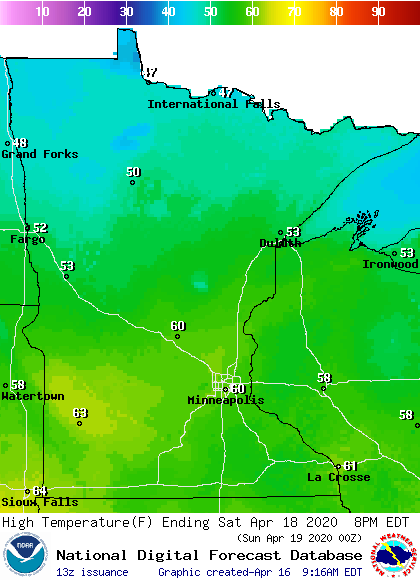
The Twin Cities metro area could hit 60 Saturday afternoon. Far northwestern Minnesota may top out in the upper 40s.
Winds will be breezy Saturday afternoon, with gusts over 20 mph at times:
Turn Up Your Support
MPR News helps you turn down the noise and build shared understanding. Turn up your support for this public resource and keep trusted journalism accessible to all.
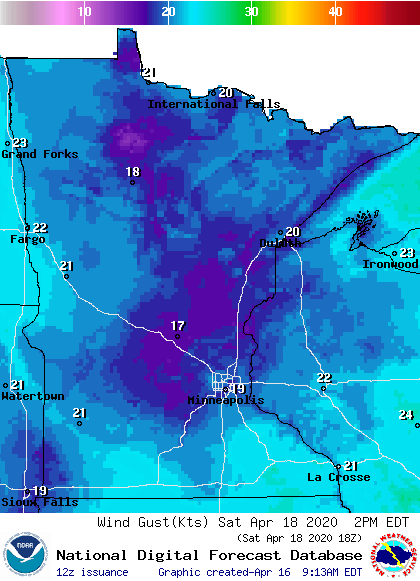
Plotted values are in knots, with 19 knots equal to around 22 mph.
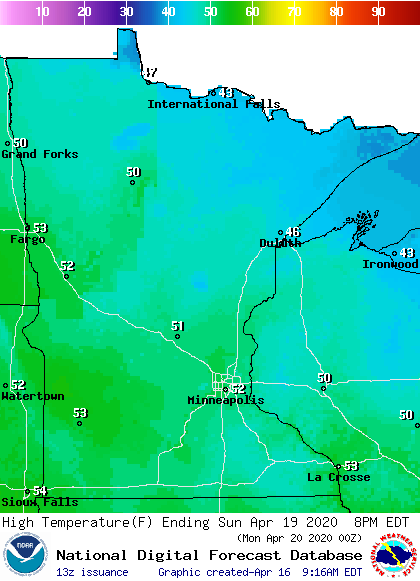
Sunday high temps will be mainly in the lower 50s, with some 40s in far northern Minnesota:
Saturday shower chance north
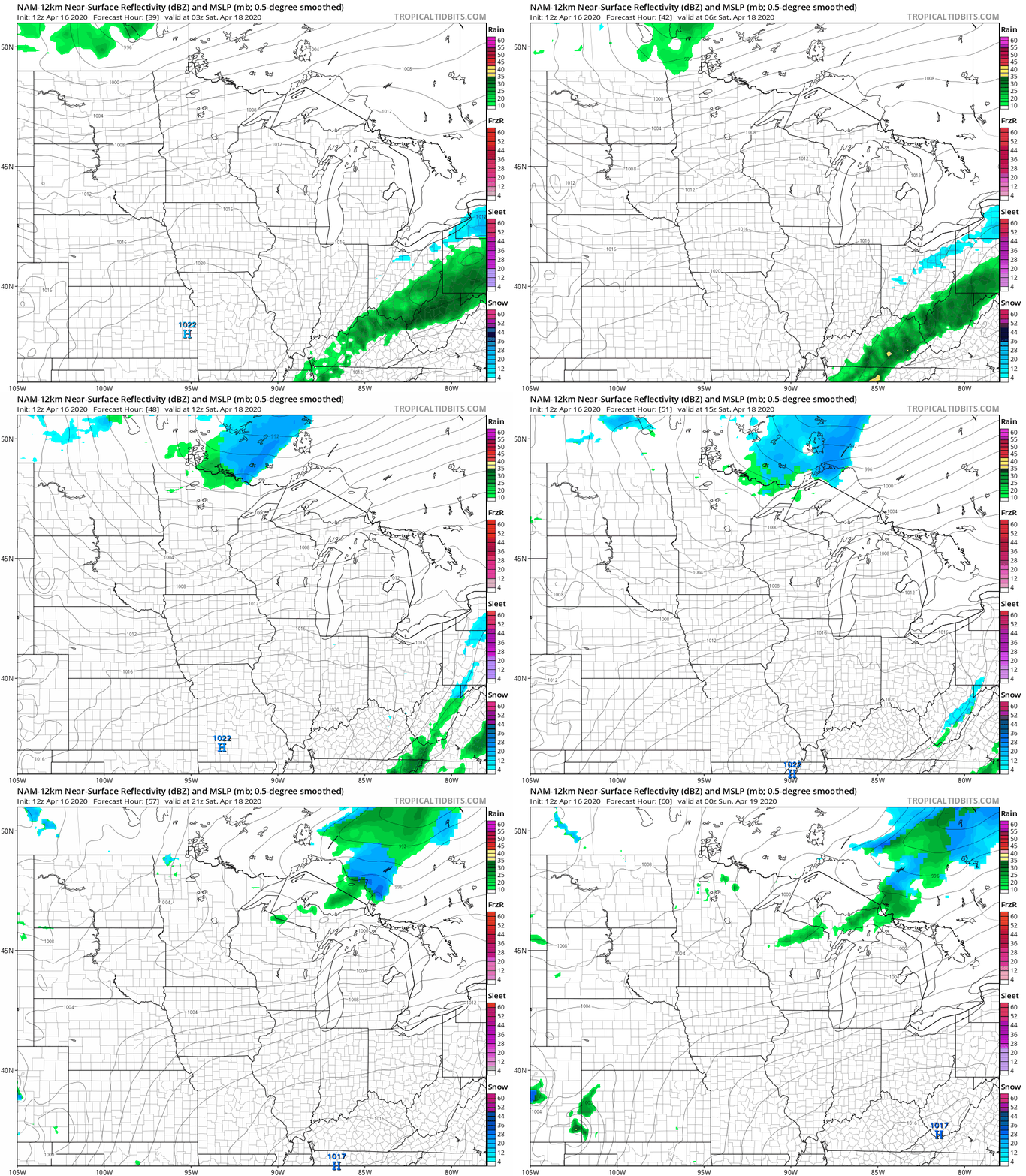
Northwestern Minnesota could see some scattered rain showers Friday night, and there will be a chance of a few rain showers and snow showers in roughly the northern third of Minnesota on Saturday.
The National Oceanic and Atmospheric Administration’s North American Mesoscale (NAM) forecast model shows the potential precipitation pattern Friday night and Saturday:
You can hear updated weather information on the MPR network, and you’ll see updated weather info on the MPR News live weather blog.
Tornado drills update
This is Severe Weather Awareness Week in Minnesota and Wisconsin. In Minnesota, sirens will be activated in many communities at 1:45 p.m. and 6:45 p.m.:

Notice that many Minnesota communities will activate the sirens twice, while the Wisconsin communities that decide to activate sirens will only do the 1:45 p.m. activation.
National Oceanic and Atmospheric Administration weather radios will not be activated in Minnesota and Wisconsin for the tornado drills this Thursday.
As you hear the sirens during the tornado drills, think of what you would do if it was a real tornado warning.
Here are tornado safety guidelines by location from the National Weather Service:
House with a basement
Avoid windows. Get in the basement and under some kind of sturdy protection (heavy table or work bench), or cover yourself with a mattress or sleeping bag. Know where very heavy objects rest on the floor above (pianos, refrigerators, waterbeds, etc.) and do not go under them. They may fall down through a weakened floor and crush you.
House with no basement
Avoid windows. Go to the lowest floor, small center room (like a bathroom or closet), under a stairwell, or in an interior hallway with no windows. Crouch as low as possible to the floor, facing down; and cover your head with your hands. A bath tub may offer a shell of partial protection. Even in an interior room, you should cover yourself with some sort of thick padding (mattress, blankets, etc.), to protect against falling debris in case the roof and ceiling fail.
Apartment, dorm or condo
If you live in an apartment that is on an upper floor, get to the lowest level of the building that you can immediately. This could be an underground parking garage or a neighbor’s first floor apartment. Then move to the most interior area possible, away from windows.
If you live in a high-rise apartment building, you may not have enough time to get to a lower level, so picking a place in the hallway in the center of your building is the best idea such as a stairwell. If that is not available then a closet, bathroom or interior hall without windows is the safest spot in your apartment during a tornado. Power loss during a tornado storm is common, so avoid elevators and keep a flashlight handy.
Office building, hospital or store
Follow instructions from facility managers. Go directly to an enclosed, windowless area in the center of the building -- away from glass and on the lowest floor possible. Then, crouch down and cover your head. Interior stairwells are usually good places to take shelter, and if not crowded, allow you to get to a lower level quickly. Stay off the elevators; you could be trapped in them if the power is lost.
Mobile home
Get out! Even if your home is tied down, you are probably safer outside, even if the only alternative is to seek shelter out in the open. Most tornadoes can destroy even tied-down mobile homes; and it is best not to play the low odds that yours will make it. If your community has a tornado shelter, go there fast. If there is a sturdy permanent building within easy running distance, seek shelter there. Otherwise, lie flat on low ground away from your home, protecting your head. If possible, use open ground away from trees and cars, which can be blown onto you.
School
Follow the drill! Go to the interior hall or room in an orderly way as you are told. Crouch low, head down, and protect the back of your head with your arms. Stay away from windows and large open rooms like gyms and auditoriums.
Car or truck
Vehicles are extremely dangerous in a tornado. If the tornado is visible, far away, and the traffic is light, you may be able to drive away from its path by moving at right angles to the tornado. Otherwise, park the car as quickly and safely as possible -- out of the traffic lanes. Avoid seeking shelter under bridges, which can accelerate the wind while offering little protection against flying debris.
Open outdoors
If possible, seek shelter in a sturdy building. If not, lie flat and face-down on low ground, protecting the back of your head with your arms. Get as far away from trees and cars as you can; they may be blown onto you in a tornado.
Shopping mall, large store or stadium
Listen for instructions from building security. Watch for others. Move as quickly as possible to an interior bathroom, storage room or other small enclosed area, away from windows. Move away from any glass.
Church or theater
If possible, move quickly but orderly to an interior bathroom or hallway, away from windows. Crouch face-down and protect your head with your arms. If there is no time to do that, get under the seats or pews, protecting your head with your arms or hands.
Here’s a reminder of the difference between a tornado watch and a tornado warning:
More information on Severe Weather Awareness Week activities in Minnesota can be obtained from the Minnesota Division of Homeland Security and Emergency Management. More information about Severe Weather Awareness Week activities in Wisconsin can be obtained from Wisconsin Emergency Management.
Receiving warnings
As we go through the 2020 severe weather season, you can hear tornado warnings and other severe weather information on the MPR network, and from various other media plus some phone apps. NOAA weather radio is a great way to get tornado warnings and other severe weather alerts whether you are awake or asleep.

