
Mild temps; Periods of snow in many areas Sunday evening and overnight
The conjunction of Jupiter and Saturn happens on Monday
Go Deeper.
Create an account or log in to save stories.
Like this?
Thanks for liking this story! We have added it to a list of your favorite stories.


This isn’t typical weather for Dec. 20. Our average Twin Cities high temperature is 26 degrees this time of year. Most of the metro area will see Sunday highs in the upper 30s. Minnesota and western Wisconsin highs will be mainly in the 30s this Sunday afternoon, with 20s in parts of northeastern and north-central Minnesota and 40s in southwestern Minnesota.
It’ll look like December this evening and overnight. An approaching low pressure system will bring a chance of rain showers and snow showers to northwestern and west-central Minnesota by late Sunday afternoon. Snow coverage then expands across much of northern, central and eastern Minnesota plus western Wisconsin Sunday evening and Sunday night. The snow will probably linger into Monday morning in northeastern Minnesota and parts of western Wisconsin.
The National Oceanic and Atmospheric Administration’s North American Mesoscale (NAM) forecast model shows the potential precipitation pattern Sunday afternoon through Monday afternoon:
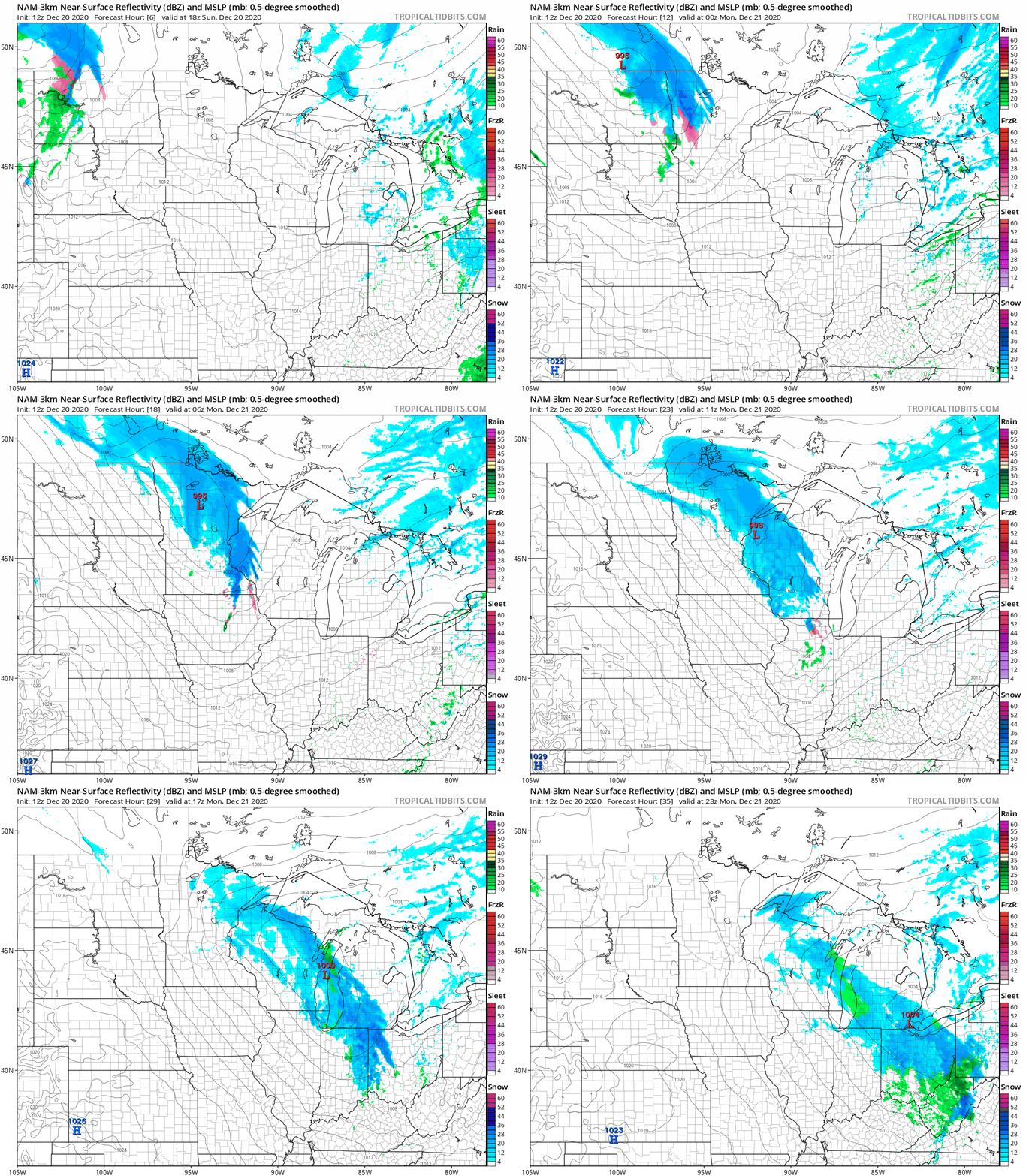
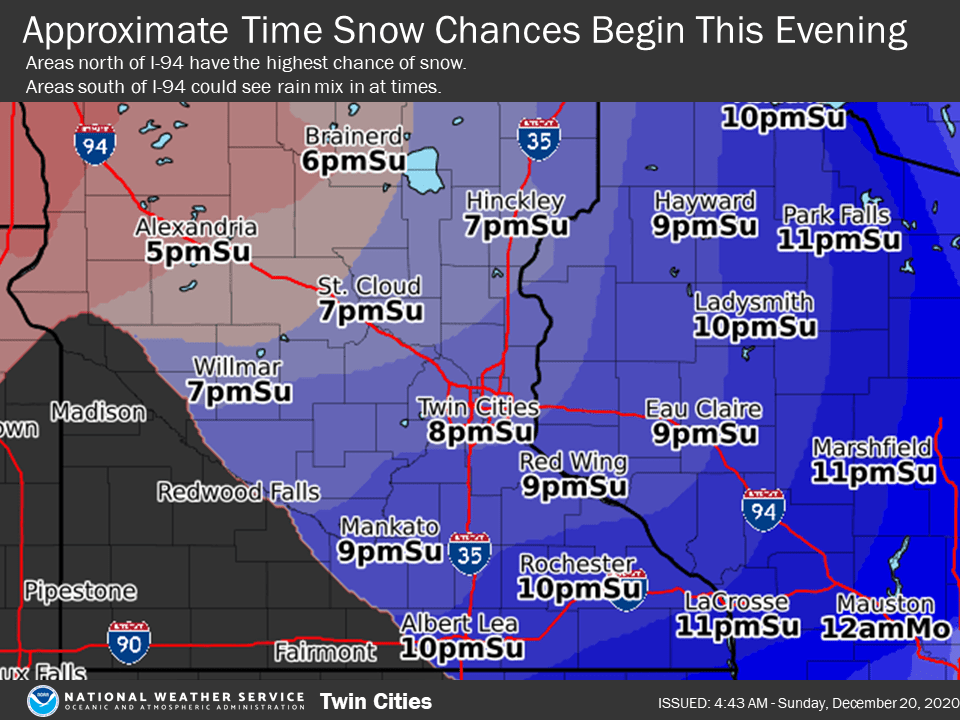
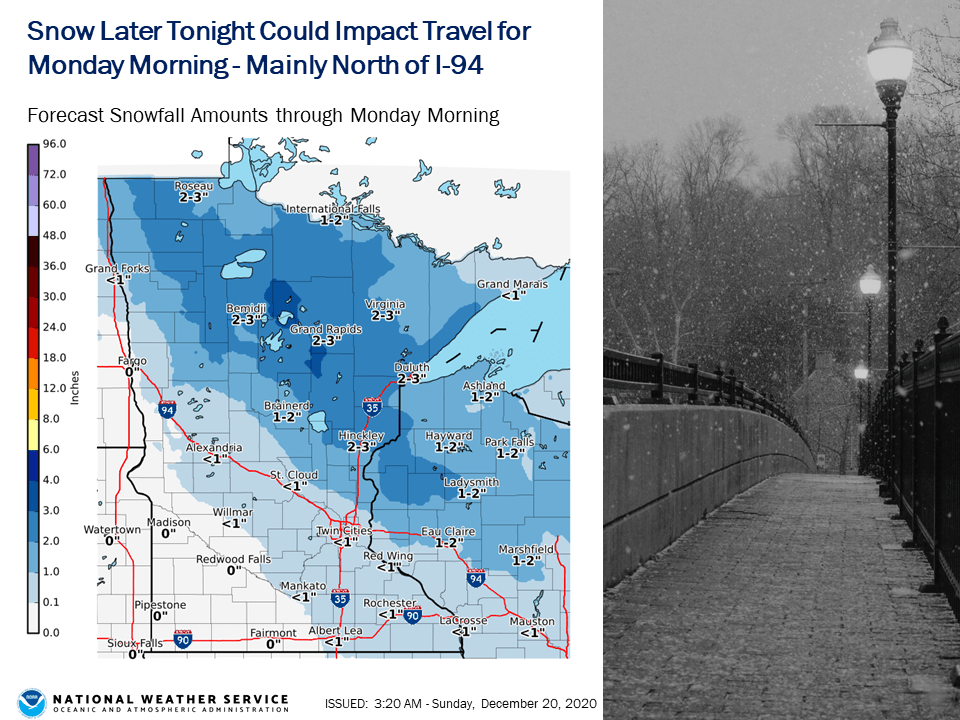
The Twin Cities metro area will probably see some periods of light snow Sunday evening and overnight. The flakes could be mixed with rain at times. Snow accumulations in the metro area are expected to be less than one inch. There could be slick spots on some roads tonight and early Monday.
Turn Up Your Support
MPR News helps you turn down the noise and build shared understanding. Turn up your support for this public resource and keep trusted journalism accessible to all.
Here’s the NWS depiction of precipitation timing:
Potential snow totals Sunday evening through Monday morning could look like this:
You can hear updated weather information on the MPR network, and you’ll see updated weather info on the MPR News live weather blog.
The week ahead
Northeastern Minnesota and western Wisconsin have the best chance of flakes on Monday. Most of Tuesday looks dry. Some forecast models show snow for northern and central Minnesota plus northwestern Wisconsin Tuesday night into Wednesday. A few models include the Twin Cities metro area in that accumulating snow. Some other models keep the metro area dry Tuesday night and Wednesday. We’ll have more details on that tomorrow. Thursday and Friday look dry in most areas.
Monday highs will be mainly in the 30s, with 20s in far northern Minnesota:
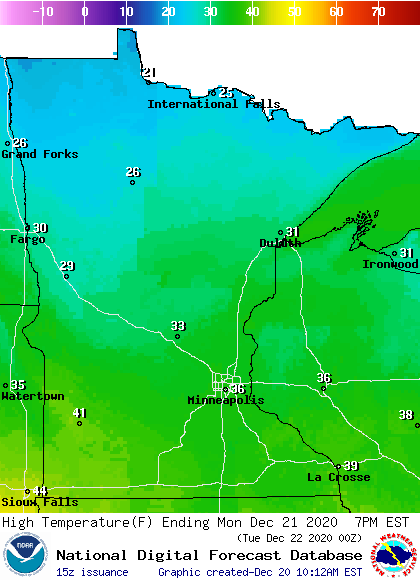
A few spots in southwestern Minnesota could top 40.
Monday will be windy, with gusts of 20 to 30 mph in many areas:
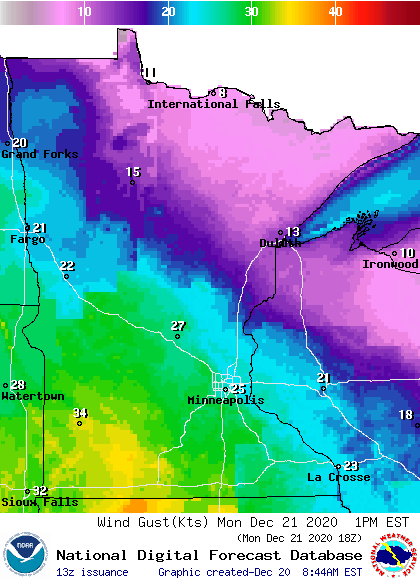
Plotted winds are in knots, with 25 knots equal to 29 mph. Monday wind gusts could reach 40 mph at times in southwestern Minnesota.
Back to temps, Twin Cities metro area highs are projected to reach the upper 30s on Monday, then around 40 degrees on Tuesday. We could see lower 30s early Wednesday morning, with temps falling through the 20s as we go through the rest of the day. Metro area highs only reach the middle teens on Thursday, followed by lower 20s on Christmas Day.
Conjunction of Saturn and Jupiter
If you’ve been looking at the southwestern part of the evening sky lately, you may have noticed that Saturn and Jupiter appear closer together each day.
Here’s an image from Sky & Telescope showing the position of the two planets over the past few months:

According to Sky & Telescope:
While we're all trying our best to keep our distance from one another during the current pandemic, Jupiter and Saturn are defiantly doing exactly the opposite. Since September they've been drawing closer and closer as they inch toward their Great Conjunction on Monday, December 21st. That night the gas giants will shine shoulder to shoulder just 0.1° apart (1/5th the apparent diameter of the full Moon) in their closest conjunction since July 1623.
Every 20 years, Jupiter, the closer and faster planet, laps slower Saturn and the two pair up briefly in a Great Conjunction. The last occurred on May 31, 2000, when they stood 1.2° apart low in the solar glare at dawn.
Minnesota may have patchy clouds Monday evening, so there will be a chance to see the conjunction in some areas.
Here are viewing tips from NASA:
For those who would like to see this phenomenon for themselves, here’s what to do:
Find a spot with an unobstructed view of the sky, such as a field or park. Jupiter and Saturn are bright, so they can be seen even from most cities.
An hour after sunset, look to the southwestern sky. Jupiter will look like a bright star and be easily visible. Saturn will be slightly fainter and will appear slightly above and to the left of Jupiter until December 21, when Jupiter will overtake it and they will reverse positions in the sky.
The planets can be seen with the unaided eye, but if you have binoculars or a small telescope, you may be able to see Jupiter’s four large moons orbiting the giant planet.
According to NASA:
What makes this year’s spectacle so rare, then? It’s been nearly 400 years since the planets passed this close to each other in the sky, and nearly 800 years since the alignment of Saturn and Jupiter occurred at night, as it will for 2020, allowing nearly everyone around the world to witness this “great conjunction.”
The closest alignment will appear just a tenth of a degree apart and last for a few days. On the 21st, they will appear so close that a pinkie finger at arm’s length will easily cover both planets in the sky. The planets will be easy to see with the unaided eye by looking toward the southwest just after sunset.
From our vantage point on Earth the huge gas giants will appear very close together, but they will remain hundreds of millions of miles apart in space. And while the conjunction is happening on the same day as the winter solstice, the timing is merely a coincidence, based on the orbits of the planets and the tilt of the Earth.
Programming note
You can hear my live weather updates on MPR News at 7:35 a.m., 9:35 a.m. and 4:39 p.m. each Saturday and Sunday.

