
Minneapolis crime is down — even if it doesn’t always feel that way
Go Deeper.
Create an account or log in to save stories.
Like this?
Thanks for liking this story! We have added it to a list of your favorite stories.


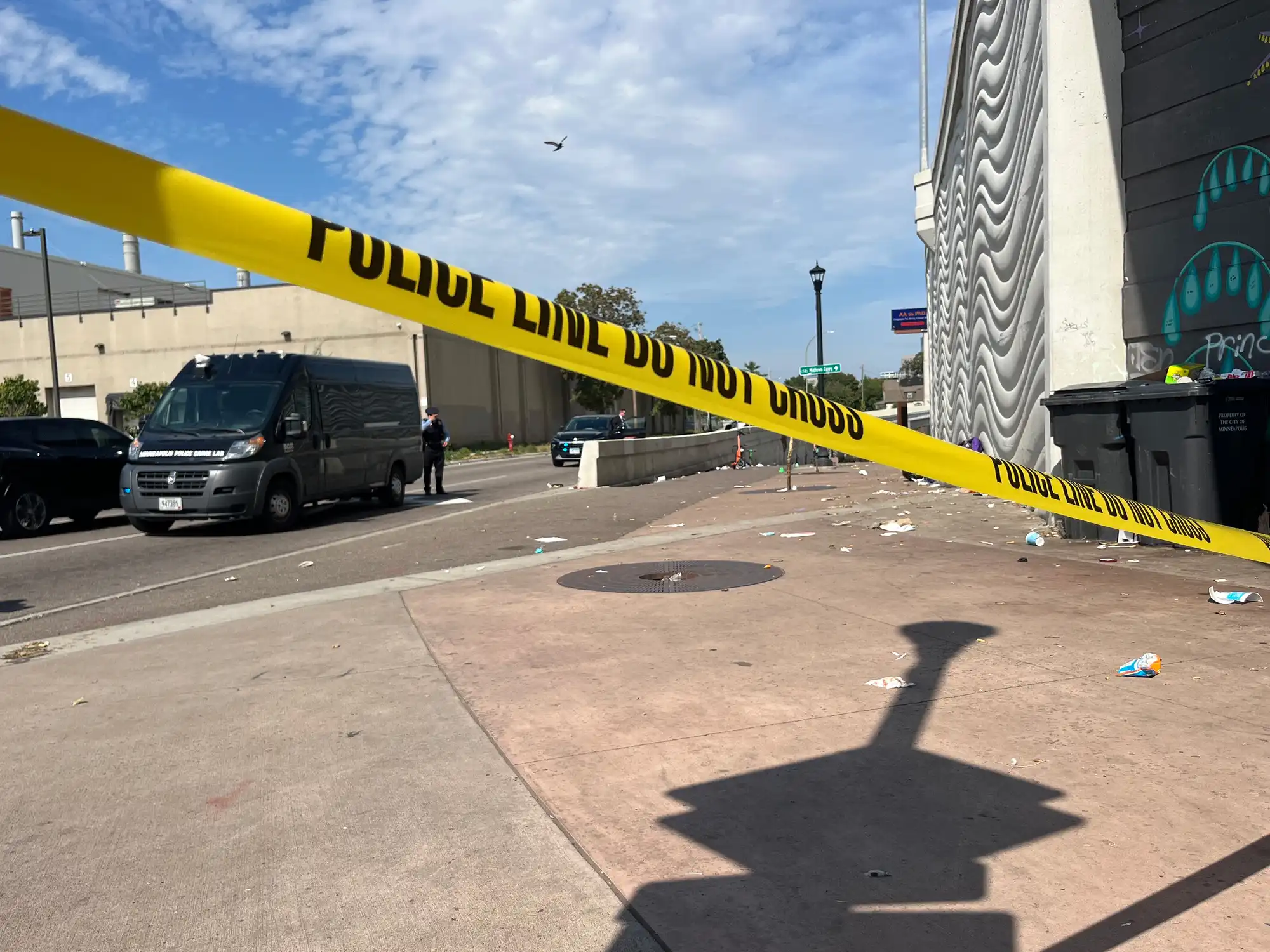
A recent string of mass shootings in Minneapolis has put a spotlight on crime in the city.
But data from the city’s crime dashboard show most types of crime, including robbery, carjackings and homicides, have decreased after nearing peak numbers in 2020 and 2021.
It doesn’t always feel that way. Producer Gretchen Brown talked with University of Minnesota Sociology Professor Michelle Phelps to try to make sense of the gap in crime perception versus reality.
Can you help me understand why people still might not ‘feel’ safe?
You know, this is actually a long-running historical challenge. There has never been a time where we had recorded crime data that was somewhat reliable and there wasn’t a gap between public perceptions and what those crime data were showing. And there’s a couple of interrelated reasons for that.
Turn Up Your Support
MPR News helps you turn down the noise and build shared understanding. Turn up your support for this public resource and keep trusted journalism accessible to all.
One of the big issues is that crime means lots of different things to different people. And so, when some people are asked a question about crime, or talk about crime, they’re thinking about violent crimes and homicides and murders. When other people hear the word crime, they’re thinking about disorder. Are they seeing folks panhandling on the street?
And so when you have this really nebulous concept, it makes it really hard, A, to know what the objective trends are, because you’re looking at lots of different metrics that may not be tracking together. And B, it creates this perception challenge.
And the last piece of it is the media. The environment that folks are in, they’re often hearing about the worst things that are happening. Those are often the stories that get traction. That’s what’s on the TV news, and that’s what’s hitting people’s social media feeds. And so there’s sort of constantly this perception of crime going up, even so much so that when, you know, there have been big crime declines since the 1990s and huge declines in homicide, in particular, across the country, since 2000 and most of the public responds to those poll questions like the violent crime and crime are increasing over those periods.
In some ways, there’s a large amount of alarmism around crime across the country. We’re in such a divisive time. It feels like we can’t even agree on one interpretation of the data.
You know, there is no sort of established metric, for example, for exactly how many police officers you need, and a lot of what we know about the research on preventing and reducing crime suggests that we shouldn’t just be turning to law enforcement. We should be thinking about schools and after-school programs. We should be thinking about safety-net programs. We should be thinking about health care. We should be thinking about other public guardians. But there is no formula that says, given a city’s condition, this is exactly the array of public safety institutions and broader supports that you would want.
And what we know in Minneapolis is that things are certainly looking a lot better than they were. To the extent that there is sort of a crisis moment, we are past the crisis. Certainly, we have seen a political polarization around perceptions of crime, so when your party is in office, you have a rosier perception of crime trends. And those sort of partisan skews in perceptions of crime have grown.
One of the things this current moment is really teaching us is that you can lie with statistics as easily as you can lie with stories. One of the funny ways that shows up is sort of the push for people, to, “do their own research.” You would think, “do your own research” is a good thing — we’re empowering citizens to find answers. But in a really fractured online environment, what that means is, essentially, people can search for the answers that are more most consistent with their worldview, even if they’re coming from disreputable or untrusted sources.
And so, I would guess that this divide between actual crime trends and crime perceptions and the weaponization of crime data is set to get worse, not better, as much as that is not comforting.

