
Local groups marshaling recovery help for Jamaica in the wake of Hurricane Melissa

Go Deeper.
Create an account or log in to save stories.
Like this?
Thanks for liking this story! We have added it to a list of your favorite stories.


Hurricane Melissa made landfall Tuesday afternoon as a Category 5 storm, bringing destructive winds and flooding rain.
In Minnesota, members of the Caribbean Disaster Relief Fund say they’ve been working around the clock since before landfall.
Merina Neal helps lead the Caribbean Disaster Relief Fund Minnesota and the Jamaica Minnesota Organization.

“We’re very anxious. It’s not even just the hurricane that hits that we're all worried about. It's the after-effects of the flooding and the landslides and loss of life,” she said.
Turn Up Your Support
MPR News helps you turn down the noise and build shared understanding. Turn up your support for this public resource and keep trusted journalism accessible to all.
Neal says the groups are coordinating with the Jamaican government, the consulate and Minnesota businesses to organize relief and collect donations.
“And so we ask them to have barrels where people can drop items such as batteries, toiletries, diapers, hygiene products, wipes, deodorant, non perishable food items, canned milk, canned fish, rice — you know, anything that is going to be a new state that will be readily available for people to use.”
Neal says communication with the island remains spotty, and families should expect delays before hearing back from loved ones.
Riding out the storm
Before the hurricane made landfall, Jamaica’s prime minister urged residents to brace for catastrophic flooding and landslides.
For Minnesotans with family there, like Samantha Warren, that warning quickly became reality.
Warren is visiting her mom who lives on the island.
“And then the storm came,” she said.
Warren, a south Minneapolis resident, is now stranded at her mother’s hillside home in the parish of St. Ann, which is located on the north coast of the island.
She spoke to MPR News several hours before the center of the storm made landfall. At the time, she saw signs of the storm’s arrival.
“You could see the big waves. It looks very unsettled, and then the clouds — the sky is covered with clouds,” she said. “You don't see a sliver of sun anywhere, and that's not usual at all. It's usually at least a little sliver of sun here.”
At that moment, Warren said their house in the hills felt safe — but her feelings of uncertainty for others was growing.
“I feel calm, but I'm worried about the aftermath of everyone else; because they say when the power goes out like this after a hurricane, it can be months, weeks before it comes back on.”
Warren says she hopes to be able to get back on a flight to Minnesota soon.
“I’m hoping the sun comes out tomorrow and we can all be okay,” she said.
An unusually strong storm
MPR News Chief Meteorologist Paul Huttner says the storm has already broken a few records.
“Looks like it has tied the Labor Day hurricane of 1935 for the lowest pressure of an Atlantic hurricane at landfall,” he said.
Huttner says the storm’s slow movement prolongs danger, leaving parts of Jamaica exposed to hours of heavy rain and flooding even after the strongest winds pass.
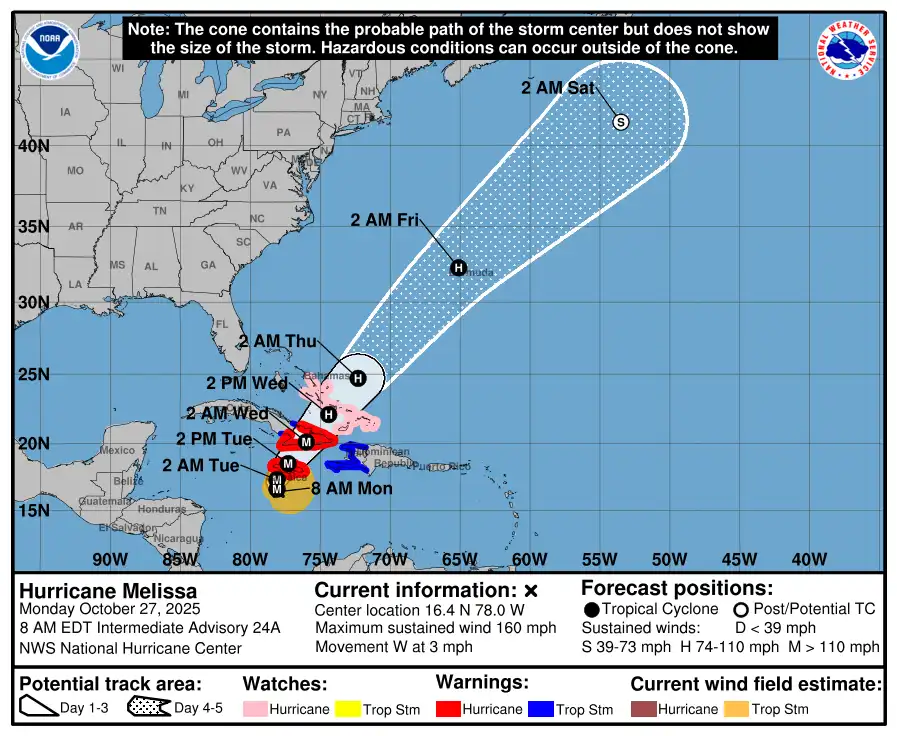
“As the storm sits or moves slowly over an area, you get those winds for a longer period of time,” said Huttner. “So those winds of 185 mph with gusts over 200 could last for several hours, and they come from different directions as the eye passes over. So structures get torn at from one side, and then the wind shifts and comes from the other side. That is a devastating combination.”
Merina Neal said for updates on how to help with relief efforts, visit the Jamaica Minnesota Organization Facebook page.

