
U of M scientists find fungi can fight emerald ash borers
Go Deeper.
Create an account or log in to save stories.
Like this?
Thanks for liking this story! We have added it to a list of your favorite stories.


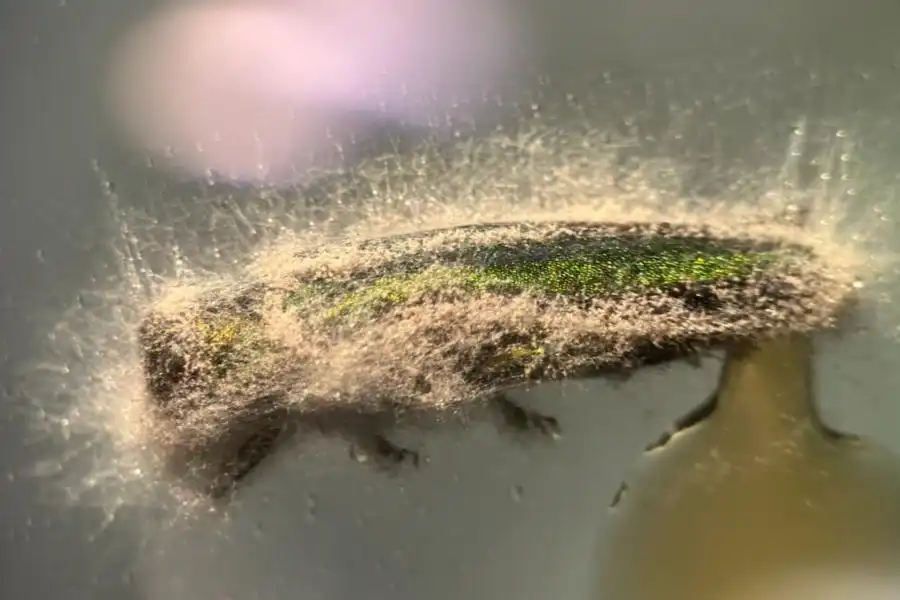
University of Minnesota researchers say they’ve discovered several naturally occurring parasitic fungi that could be weaponized against emerald ash borers, the invasive beetles responsible for killing millions of ash trees across Minnesota and the eastern United States.
Scientists found the fungi on Minnesota as wood samples, then cultivated them in the lab for closer study.
“We were seeing that a lot of the fungi that we were growing out of these ash trees were insect killers,” said Colin Peters, a graduate student and lead author of the research study. “We wanted to know: Can we use these or leverage the power of these fungi against the emerald ash borer itself?”
Turns out, they can.
Turn Up Your Support
MPR News helps you turn down the noise and build shared understanding. Turn up your support for this public resource and keep trusted journalism accessible to all.
Peters said that all of the 10 Minnesota fungi species they studied were all able to infect emerald ash borers, but four species — three native to the state — showed the most promise by consistently reducing the beetles’ lifespan. In some cases, fungi could be seen sprouting from the bodies of dead ash borers.
Now researchers are developing field tests they hope will spread the fungi to beetles in the wild using “autodissemination.” Imagine a trap designed to attract emerald ash borers where they could be exposed to the fungi and then spread it to other beetles.
According to the Minnesota Department of Natural Resources, the state’s forests have more than 1 billion ash trees. In some cities, they make up 20 percent of the canopy.
Dead trees are only part of the problem, researchers say. Ash tree die-offs can lead to a habitat changing over to grass, cattails and shrubs, threatening plants and animals that rely on forests.
"With a billion ash trees in Minnesota, we need to explore all possible methods to try and control this devastating pest,” said Robert Blanchette, a professor in the U’s Department of Plant Pathology and a co-author of the study, which was published recently in the journal Forests.
“Laboratory studies show that biological control of the beetle using fungi is possible and the next step is to figure out how to get this to work under field conditions," he added.
While no single treatment or technique will revert the ecosystem back to before the emerald ash borer’s arrival from East Asia, Peters said the study shows natural forest management practices can help keep the invasive bug in check.
“It shows that potentially, in the future, there's a world where we are applying less chemicals to the landscape, and instead leveraging the power of these relationships between organisms already happening on the landscape,” he said.

