
A tough shipping season ends with Duluth’s Twin Ports facing stiff economic headwinds
Go Deeper.
Create an account or log in to save stories.
Like this?
Thanks for liking this story! We have added it to a list of your favorite stories.


When the Soo Locks, which connect Lake Superior to the lower Great Lakes, close for winter maintenance just before midnight Thursday, it will mark the end to a difficult Great Lakes shipping season, especially for the Twin Ports of Duluth and Superior, Wis.
“It’s been a year of headwinds,” acknowledged Kevin Beardsley, executive director of the Duluth Seaway Port Authority, noting that the total tonnage shipped will likely come in well below last year’s number.
“There's no single factor driving the decline. It's a combination of market trends, shifting trade lanes and geopolitical forces,” said Beardsley.

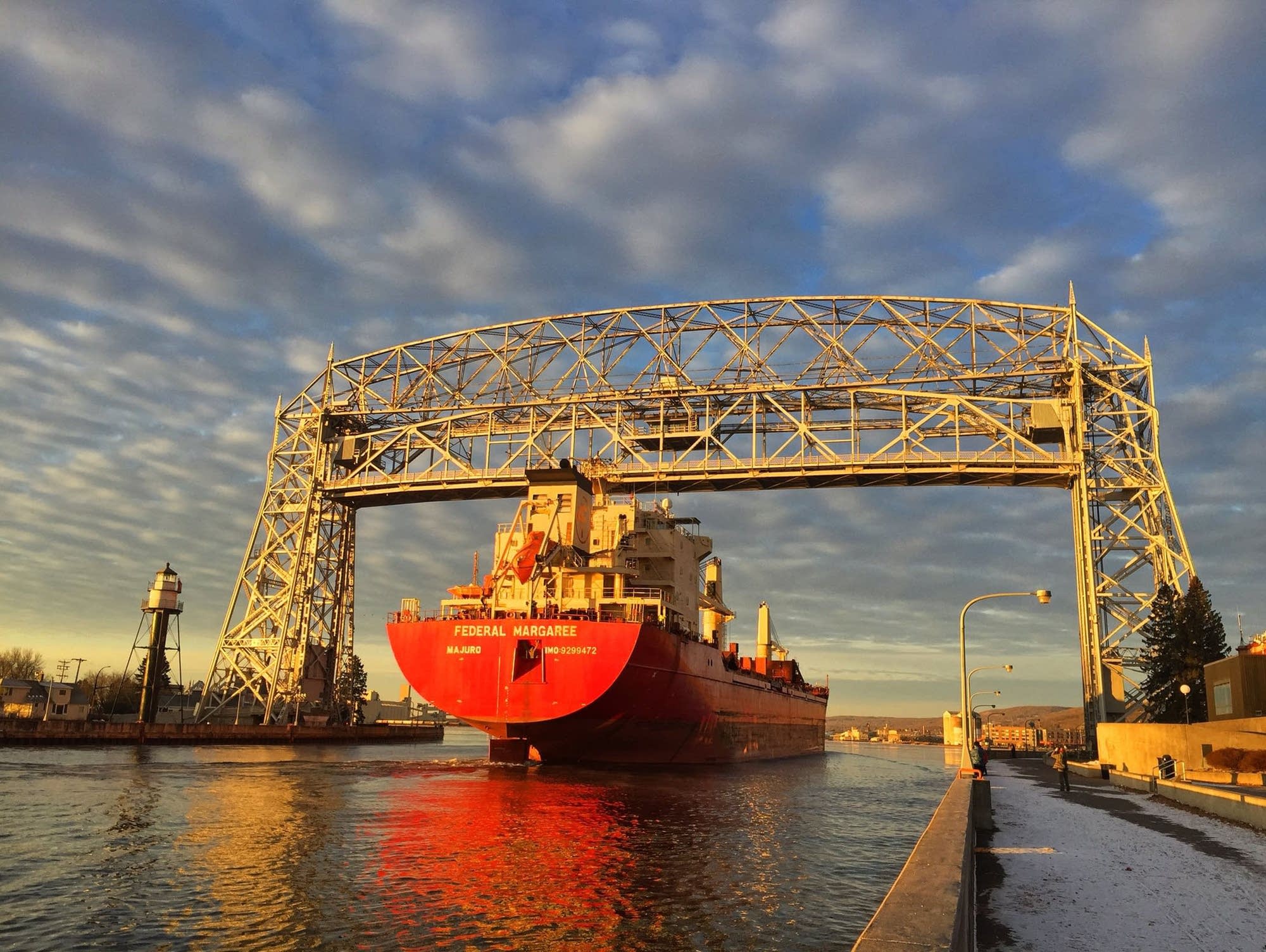
Less cargo means fewer ships, which are a huge draw for tourists who flock to Duluth every summer to see one thousand-foot-long ore boats and colorful ocean-going vessels affectionately dubbed “salties” glide under the Aerial Lift Bridge and through the city’s shipping canal.
Turn Up Your Support
MPR News helps you turn down the noise and build shared understanding. Turn up your support for this public resource and keep trusted journalism accessible to all.
About 550 ships sailed into the Duluth-Superior port in 2025, compared to 688 vessels last year.
There are several reasons for the slump in shipping out of the Twin Ports. The first round of bad news came last March, shortly after the shipping season got underway, when one of the huge taconite mines on Minnesota's Iron Range announced it was temporarily closing. A second mine, Hibbing Taconite, also partially shut down. Nearly a year later, those facilities remain idled.
Taconite pellets from the mines are shipped on trains to the Twin Ports, where they're mounded into enormous piles and then loaded onto ships bound for steel mills around the Great Lakes. Iron ore makes up more than half the port's cargo every year.

But this year, iron ore shipments were down 16 percent due in part to fewer shipments to Canadian steel mills, because of the Trump administration’s trade conflict with Canada.
The port suffered another blow at the end of August when agribusiness giant CHS, Inc. closed its grain terminal in Superior, Wis., With over 500 towering silos and 23 employees, the nearly century-old terminal was the largest grain facility in the Twin Ports.
"It just truly is the end of an era,” said John Griffith, executive vice president of Ag for CHS. “There's not any big problem that came to rise,” Griffith added. “It's just that the world has changed."
For years, farmers in the northern plains have shipped durum and high-protein spring wheat by truck and by train to the Twin Ports. From there, it’s loaded onto “salties” that sail through the Great Lakes and St. Lawrence Seaway and then across the Atlantic to the Mediterranean, where it's made into high-end breads and pastries, pasta and couscous.

But it’s now more efficient for CHS to load grain onto long, 120-car trains and send it to deep water ports in the Pacific Northwest or the Gulf Coast, Griffith said. The ships that call on those ports carry two and a half times as much grain as the ships that can make it through the Great Lakes' lock and dam system.
It’s a difference of “900,000 bushels versus 2.3 million bushels on a single vessel,” Griffith said. “And so you can just imagine the scale and the efficiency that comes with that.”
The infrastructure on the Great Lakes isn’t large enough to allow ships of that size to pass through. They also sit much deeper in the water than what Great Lakes ports can accommodate.
Those ships that pick up and haul grain from the Twin Ports also need to be carrying cargo to Duluth and Superior, to make the week-long sail through the St. Lawrence Seaway work economically. “It becomes very expensive to come in empty, which then makes the port less competitive with those big boats that are more efficient anyway,” said Griffith.

The third piece of bad news came in the fall, when Midwest Energy Resources announced it would close its coal loading terminal in the Twin Ports in the summer of 2026. 56 employees will lose their jobs. In recent years, coal has made up about 15 percent of the total tonnage of cargo shipped out of the port.
“That one was not a surprise, but still it's significant,” said Daniel Rust, a professor of transportation and logistics management at the University of Wisconsin-Superior.
The facility opened 50 years ago. It received shipments of low-sulfur coal from the Power River Basin in Wyoming and Montana via rail and shipped it to coal-fired power plants around the Great Lakes.
Coal shipments peaked in 2008. But they’ve since declined by about 75 percent as electricity is increasingly generated by cleaner-burning natural gas and by renewable energy sources such as wind and solar.
"If that terminal doesn't get some other operator to come in and it does just shutter and sit there empty, that's a pretty big blow for the Twin Ports,” said Rust.
Break bulk cargo a bright spot
For more than 150 years, the Twin Ports have been a critical energy transportation hub in the heart of the country. In the late 1800s and early 1900s, coal and other supplies were shipped west to Duluth to support growing cities. More recently coal has moved in the opposite direction to eastern power plants that needed cleaner-burning fuel.
And now the port has become a hub for the shipment of wind energy components. 2025 marked the 20th consecutive year the port has received shipments of turbine blades and other machinery that in turn gets loaded on trucks and trains and is shipped to wind farms around the upper Midwest.
And despite the Trump administration’s animosity toward wind energy, the number of those shipments continue to grow in the Duluth port. “2026 is looking very promising for more project cargo such as wind,” said the Port Authority’s Beardsley, who notes that some of the blades and gear coming in are being used to repower older wind farms with newer equipment.
Wind energy components are part of a broader category known as break bulk cargo that’s been a bright spot for the Twin Ports — large goods, like wind turbine blades, that can't fit into standard shipping containers.
In 2023, a new service was launched that provides monthly cargo shipping between Duluth and Antwerp, Belgium, Europe’s second largest seaport. That service was recently expanded to connect Mediterranean ports to Duluth.
“We’ve seen continued growth in that area,” said Port Authority spokesperson Jayson Hron. “It's helped bring more ocean going traffic into the port with various break bulk cargoes, and also some of those ships have then been able to sail from the port with grain.”
The service can handle both the break bulk cargo and shipping containers, which can then be transported from Duluth via truck or train. It also allows for something known as “ship parceling.”
“Which means you can partially load a ship,” explained Hron. “So if you're a manufacturer or an operator here in Minnesota or Wisconsin, and you know that you really only have one or two or five containers to move to Europe with your goods, that's fine.”

The shipments have brought in huge pieces of machinery used in a Duluth paper mill and an Iron Range taconite mine. It’s also been used to export niche agricultural products like beet pellets and kidney beans.
There’s real potential for continued growth in that service, said UW Superior’s Rust. But he said Great Lakes shipping will always be hindered by its harsh winters, which force shipping to shut down every year from mid-January to late March.
“The seasonality of the Great Lakes I think is probably the greatest impediment to developing new supply chains, new cargoes that could be coming into the Twin Ports and exported from the Twin Ports,” Rust said.
Rust added that the Twin Ports will likely soon lose its bragging rights as the busiest Great Lakes port, and will be surpassed by Chicago for shipping the most tonnage each year.
“I think that's going to be just psychologically, a real shift for the port," Rust said.
Still, port officials remain bullish. They’re hopeful that new markets such as sustainable fuels or copper nickel-mining could emerge. A new taconite mine, Mesabi Metallics, is also slated to open later this year.
There’s also the prospect of growing the ship building and repair industry in the Twin Ports. Fraser Shipyards in Superior employs about 200 people. That workforce swells to around 600 this time of year, when ships need maintenance and repairs while they are laid up for the winter.
The company also manufactures smaller watercraft, including a custom-built icebreaking ferry recently shipped to the Beausoleil First Nation in Canada.
The company recently received an $800,000 federal grant to install a huge crane in its shipyard. CEO Patrick Kelly says the Great Lakes are an underused resource.
“You talk to any vessel operator, tugboat operator, port terminal operator, and they'll tell you they're about 50 percent utilized. So we have great infrastructure. It's not being used to its fullest capacity. Let's find other businesses, other products to bring to the Great Lakes,” Kelly implored.
That’s what the Duluth Seaway Port Authority and other agencies are trying to do. They’re buoyed by a simple geographic advantage the Twin Ports will always enjoy — its location as the farthest inland seaport in North America.
“We know there's opportunities out there, and we're chasing them,” said Beardsley. “We just need some of these headwinds to become tailwinds.”


