
9 Minnesota counties set to receive aerial treatments to control an invasive moth species

Go Deeper.
Create an account or log in to save stories.
Like this?
Thanks for liking this story! We have added it to a list of your favorite stories.


The Minnesota Department of Agriculture plans to use low-flying aircraft this summer to target spongy moths, an invasive leaf-eating pest that damages oaks and many other species of trees. The treatment program will focus on nine counties in southeast and northeast Minnesota where spongy moths have expanded their range westward from Wisconsin.
Starting in June, planes will drop synthetic pheromones on tree canopies in 35 treatment areas totaling about 152,000 acres. The sex chemicals confuse male spongy moths and prevent them from mating.
State officials said the pheromone product has the consistency of toothpaste or hand cream and is nontoxic to humans, animals and other insects.
“It's not even toxic to spongy moths,” said John Larsen, interim spongy moth treatment coordinator for the ag department. “I had a land commissioner in northern Minnesota call it 'Old Spice for spongy moths' and that's exactly what it is.”
Turn Up Your Support
MPR News helps you turn down the noise and build shared understanding. Turn up your support for this public resource and keep trusted journalism accessible to all.
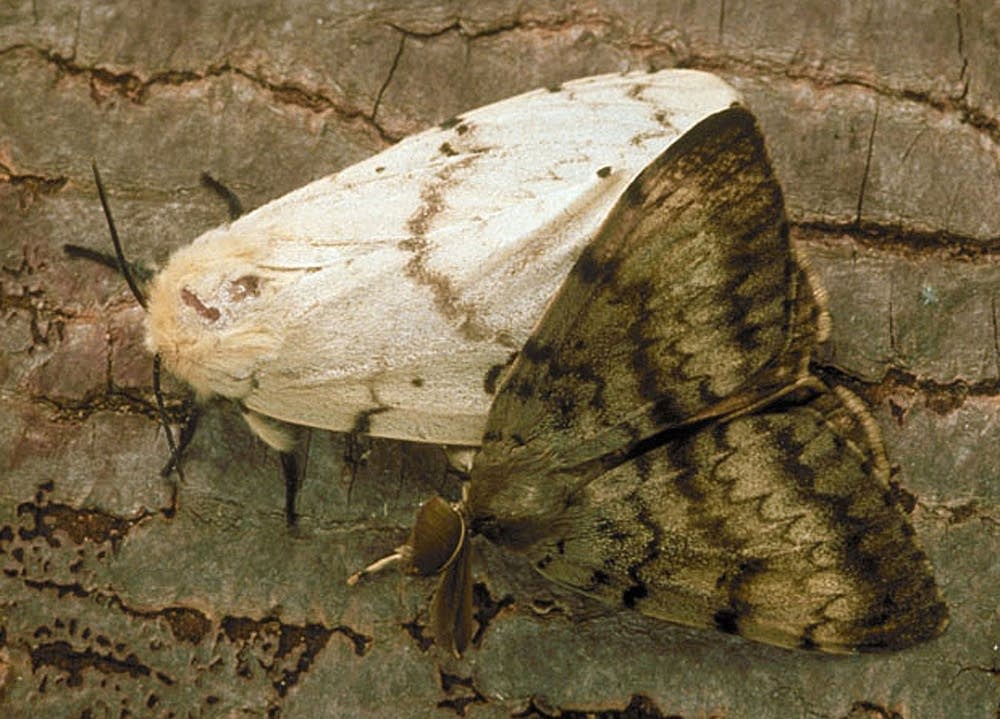
The pheromone treatment works best in areas where the spongy moth population is not yet fully established.
Spongy moths are native to parts of Europe, Asia and North Africa and were transported to the U.S. over a century ago.
Wisconsin has a significant infestation. In 2023, the state reported 400,000 acres of trees damaged by the pest. Currently, most counties in Wisconsin are under a quarantine.
In Minnesota, the eastern part of the state has seen the most spongy moth activity, especially in the northeast in Cook and Lake counties, which are also under a federal quarantine.
In their caterpillar stage, spongy moths will “defoliate” or eat leaves from over 300 types of shrubs and trees, though their favorite is oak trees.

Defoliation weakens trees and makes them more susceptible to disease, which can eventually result in tree death.
“Each caterpillar consumes about a square meter of foliage in its lifetime,” said Larsen. “That damage grows exponentially, considering that each egg mass that one female will lay, is anywhere between 500 to 1000 eggs.”
If residents live in a quarantine zone, Larsen said they should make sure they're not doing anything that would move moth eggs around.
“We've found egg masses on vehicles, we've found egg masses on boat trailers, on picnic tables, on firewood. Give it a once over, look for a little cream-colored egg mass about the size of a quarter,” said Larsen.
Pheromone treatments are set for Aitkin, Carlton, Fillmore, Mower, Olmsted, Pine, St. Louis, Wabasha, and Winona counties this summer.
The agriculture department is hosting informational meetings this month and next to share more details about its management plan.

