
Turkeys are trotting everywhere right now. We got an expert to answer your questions
Go Deeper.
Create an account or log in to save stories.
Like this?
Thanks for liking this story! We have added it to a list of your favorite stories.


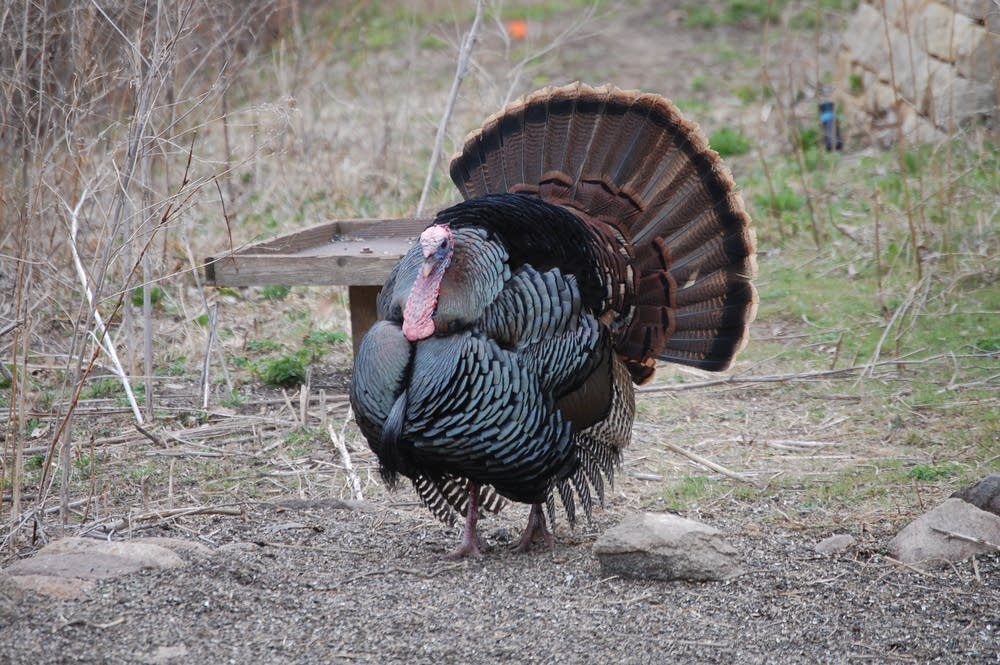
You've likely been seeing these big-tailed birds strutting down your street or holding up traffic crossing the road in flocks. And if you haven't seen them, maybe you’ve heard them gobbling.
If you're feeling like wild turkeys are everywhere lately, it's because they are. It's the time of year when turkeys are out and about looking to expand their flock after a winter spent roosting.
So, we took the chance to get some turkey testimonials from Minnesotans about encounters they're having with our big-feathered friends and get questions they'd ask a turkey expert if they could.
Roy Churchwell, resident gamebird consultant with the DNR, joined Minnesota Now to answer those questions.
Turn Up Your Support
MPR News helps you turn down the noise and build shared understanding. Turn up your support for this public resource and keep trusted journalism accessible to all.
The following was edited for length and clarity. Use the audio player above to listen to the full conversation.
Why are there so many around right now? How did they survive the winter?
You don't see as many turkeys in the winter time because that's the time of year when they're the most flocked up.
That's when you'll see the biggest groups and they're really focused on food resources that time of year. So, they'll be in areas where they can most easily find food and that kind of concentrates the area that they're in so there'll be areas within the city that you don't see them at that time of year.
But then, as spring comes and food becomes more available across the landscape, the groups will spread out more and people will start to see more turkeys. That's why it seems like they come and go, even though they are in the area year-round.
What are they doing up in the trees? Can turkeys actually fly?
They do fly up at night. They do often go into the trees or they will go into the trees right around dusk and come out right as the sun's coming up.
They do that at a time when lot of people are indoors and eating dinner and eating breakfast. So, a lot of people don't catch them at that time but if you do follow them around at that time, you could potentially see one fly up into a tree.
At one point, the turkey population was wiped out in Minnesota. How did it bounce back?
They were first reintroduced in the mid- to late-1970s. It started out in southeast Minnesota. They first put some birds there.
As that population grew, they would take birds from the growing population as well as from other states, and bring them in and add them to other locations within the state.
They continued to do that through the 1990s and that set the birds up to the extent that they are now.
But currently, turkeys have been observed in every county of the state.
Is there an estimate for how many there are? Or is it hard to track?
It is really difficult to count the number of turkeys. There are methodologies but Minnesota hasn't invested in that yet. That being said, it is a goal of ours to start doing that. So, we're working on some methodologies that hopefully will get us there.
Wisconsin, our neighbor to the east, has been using trail cameras to do that. They just started about seven years ago and they're getting their methodology to where it is working pretty well.
So, that's something that we may try to implement so that we can count turkeys here as well.
What is the life of a wild turkey like?
Life as a wild turkey is a little bit difficult. Turkeys out in the wild live kind of a shorter life, you know, three to five years. But individuals can make it longer. The longest have lived around 12 years.
It is pretty difficult for a wild turkey, especially in their first year life. Most of them don't make it through that time period. But if they do then it's that three to five years. And then there are a few individuals that will continue to live even longer.
What should people do if they encounter a turkey?
Nine times out of 10, it's not going to be an issue. They're probably going to be afraid of you.
Turkeys do have a pecking order in turkey lives. So, they will be more dominant over certain turkeys and maybe there are certain turkeys that are more dominant over them, and they have that established.
But birds that are very human-habituated can also mix humans into that mix. If there are people that they see regularly — that's where we get the issue. So, it's pretty rare for that to happen but because it happens to a few people in the city, over a year or so, we do hear about it.
In those cases, I would first suggest — oftentimes, I think people might be going for walks or something along those lines when they see these birds — so, carrying a walking stick will help you.
If you have that interaction where the birds are testing you for dominance, if at all possible, you want to show that you're dominant to them and drive them away so that pattern of them dominating over people doesn't get established.
Other things, if you're in your yard with a rake or maybe you're watering plants, you can shoot them with the hose water or get rid of them with a rake — something along those lines.
Subscribe to the Minnesota Now podcast on Apple Podcasts, Spotify or wherever you get your podcasts.

