
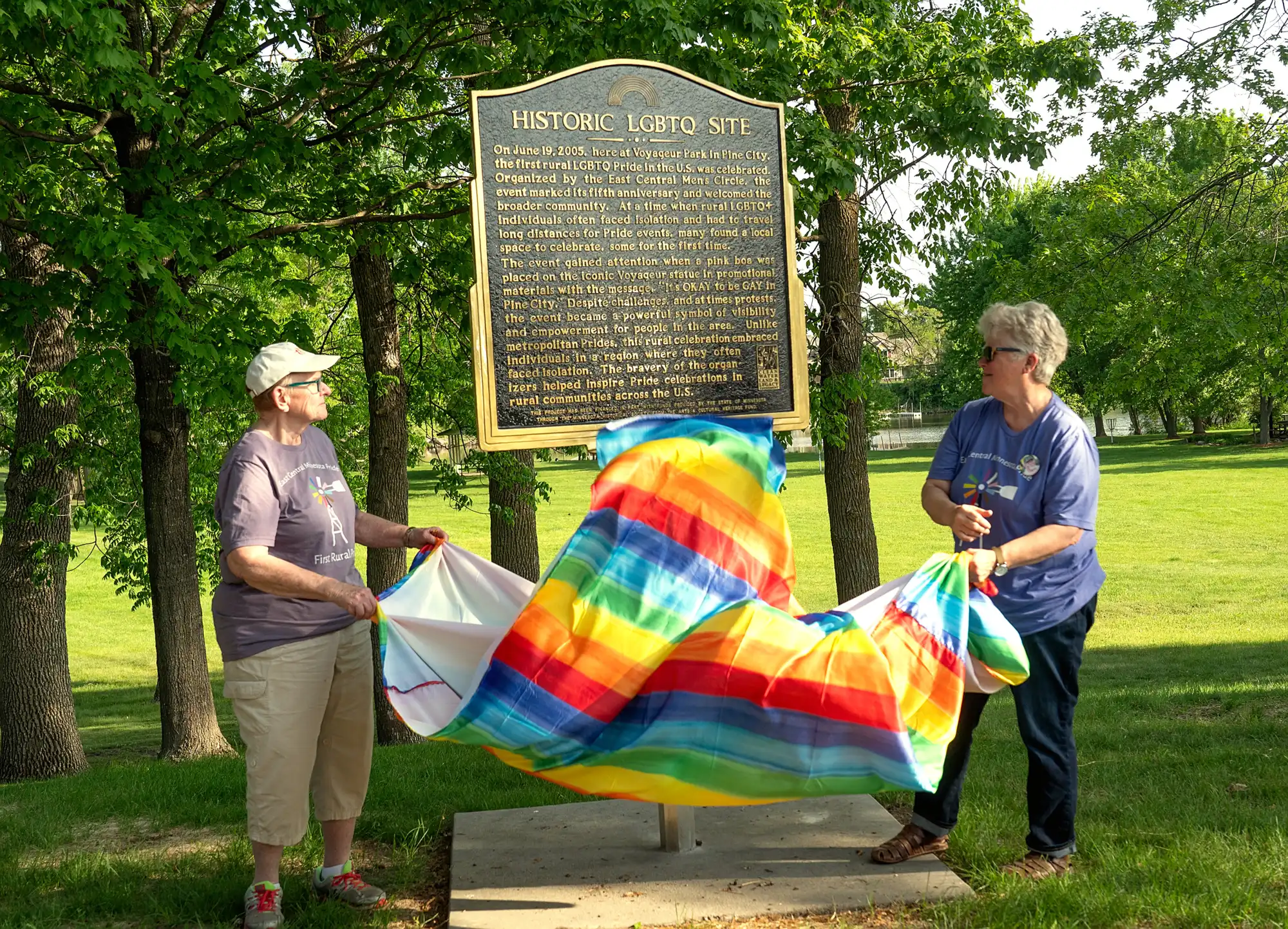
Pine City plants its marker as home to the first rural Pride in the U.S.
Go Deeper.
Create an account or log in to save stories.
Like this?
Thanks for liking this story! We have added it to a list of your favorite stories.


Nadia Honary-Satriano has moved a lot. Originally from Iowa, she moved to Minneapolis and then an even bigger city, Los Angeles. She thought she’d stay in California, working in cinematography and directing. But then she met Diane at Twin Cities Pride during a visit to Minnesota and fell in love.
Nadia and Diane Honary-Satriano married in 2021 in St. Paul, and then made what could be considered their biggest move of all — an hour drive north to Pine City, population 3,100.
Now, they say they’re living what was their real dream all along — owning a small farm in eastern Minnesota, making videos of their chickens (including a one-act play Nadia wrote, acted out by their friends) and living in the town where the first rural LGBTQ+ Pride in the country took place.

On Thursday evening, residents gathered for a dedication ceremony for a historic marker issued to the town honoring a 2005 gathering in Voyageur Park. According to Don Quaintance, one of the founders of the East Central Men’s Circle, that first Pride was a picnic the group hosted on June 19, 2005.
Turn Up Your Support
MPR News helps you turn down the noise and build shared understanding. Turn up your support for this public resource and keep trusted journalism accessible to all.
Over 70 people came and hamburgers and hot dogs were grilling, served by co-founder Randy Olson, and there were many, many desserts — including bars, their favorites.
A pink feather boa was placed on the statue in the park with promotional materials reading: “It’s OKAY to be GAY in Pine City.” This was eight years before gay marriage was legalized in Minnesota, something the men’s circle said they fought tirelessly for.

While Quaintance, Olson, Gary Skarsten and other members of East Central Minnesota Pride spent years trying to make their rural area of the state feel welcoming to LGBTQ+ people, they didn’t think their picnic in the park would one day make national history.
But not everyone was able to see it happen. Olson died days before the dedication ceremony. The original members of East Central Minnesota Pride wore buttons with Olson’s face to honor him at the dedication ceremony.
“We were surprised that it was happening, because in the beginning, I guess we never thought that would become the first rural Pride,” Quaintance said. “In the city, there were a lot of gay people. Here in the rural area sometimes we had to go for meetings or groups 20, 30, 40 miles. It wasn’t just ten minutes down the road. It was much harder meeting and getting together with the GLBT.”

East Central Men’s Circle’s first meeting was in 2000 at Tobie’s Restaurant & Bakery in Hinckley. Skarsten says cigarette smoke filled the air, as about 25 men ate pizza and talked. He was teaching high school at the time and he hadn’t come out. He was a member of an Isanti County human rights group and the director handed him a piece of paper with information for the men’s circle and encouraged him to go.
“I will not ever forget,” Skarsten said. “I was so excited that there was a gay group that I could relate to and talk with.” Because of the men’s circle, he felt comfortable to share his sexuality in his last six years of teaching.
That first Pride event actually was a celebration of the men’s circle’s fifth birthday, and the broader LGBTQ+ community was invited.
Pine City residents cherish the ‘welcoming’ community
Quaintance and Skarsten, like many others from the area, decided to stay in rural Minnesota despite the challenges they faced because of their sexuality. They said it was important for them to work to make their region better, so in the coming years other LGBTQ+ people would feel like they could leave metropolitan areas and move to the Pine City area if they preferred small town life.
When Nadia and Diane moved to town in 2022, the first thing they saw was a banner for the upcoming Pride celebration.
“We were really excited about that, and then we went and it was really, really loving and welcoming and sweet,” Nadia said. “It was just the most comforting thing to see that this place was welcoming to people like us, that we didn’t have to be afraid.”

Nationally, the number of households with same-sex couples doubled from 2005 to 2024. Of the rural counties in Minnesota that aren’t part of any metro area, Pine County had the highest percentage of households with same-sex couples, according to analysis of 2020 U.S. Census data performed by The Williams Institute, a think tank at the UCLA School of Law.
Allie Gosen grew up in Pine City and went to St. Paul for college. After a break up, she moved back to Pine City, reconnected with friends and started the local band The Harlow Pennies, which performed at the dedication. She described her return home like “a romantic comedy montage.”
“You move back home, and you find yourself,” she said. “There's so many people who want you to succeed. It's very, ‘oh, I'm out of a cup of sugar,’ your neighbor’s probably got your back. It’s very old school, and I really like that.”

She is a teacher and said celebrations of Pine City’s LGBTQ+ community, like the unveiling of the historic marker, matter to her LGBTQ+ students.
“I think it is a great opportunity, not only for us all to come together, but also for different members and pillars of the community to be visible in this spot,” Gosen said.
‘In 50 years people will know the story’
Kent Bombard, Pine City’s first openly gay mayor, was elected in 2024. His husband, Aaron Bombard, is the chair of East Central Minnesota Pride. They met online and went snowboarding on their first date in the Twin Cities. Aaron Bombard said he fell in love and soon packed up his things and became a Pine City loyalist.
Kent Bombard grew up in Pine City and returned after college. He says he’s been able to see the changes made in the community in real time, and it made him want to return.
“I never would have thought this was a possibility when I was a kid. I never would have thought that a gay person could be the mayor of a town,” he said. “Our community is growing here. It's one of the fastest growing communities in the state. So we've got to let everybody in, we've got to appreciate everybody if we're going to grow, otherwise we're going to stagnate.”

To get the historic marker, Aaron Bombard said the town had to go through a long process, including getting letters of recommendations saying historians and researchers have not identified an earlier documented rural Pride event, and the Minnesota Historical Society agreed it was accurate. Jack Matheson from MNHS said the funding for the project came from the Clean Water Land and Legacy Amendment. Money is put aside specifically for groups wanting to honor cultural heritage, which the historic marker does.
In the years since 2005, Aaron Bombard said rural Prides across the country have reached out to get advice on how to get started. While overall the Pine City area is accepting, he says they did receive some pushback on if the Pride event should be deemed “historical.”
Aaron Bombard said that is where the issue lies — what history gets to be remembered?
“This is exactly why we don’t know much about the community because nothing ever gets documented,” he said about LGBTQ+ history. “That became a real driving force for me because we need to document this so in 50 years people will know the story of what happened in this little town.”
June is nationally recognized as Pride Month and the next East Central Minnesota Pride is on June 6 in Pine City.


