
'Art tells the truth': New coffee table book becomes an archive of ICE protest art
Go Deeper.
Create an account or log in to save stories.
Like this?
Thanks for liking this story! We have added it to a list of your favorite stories.


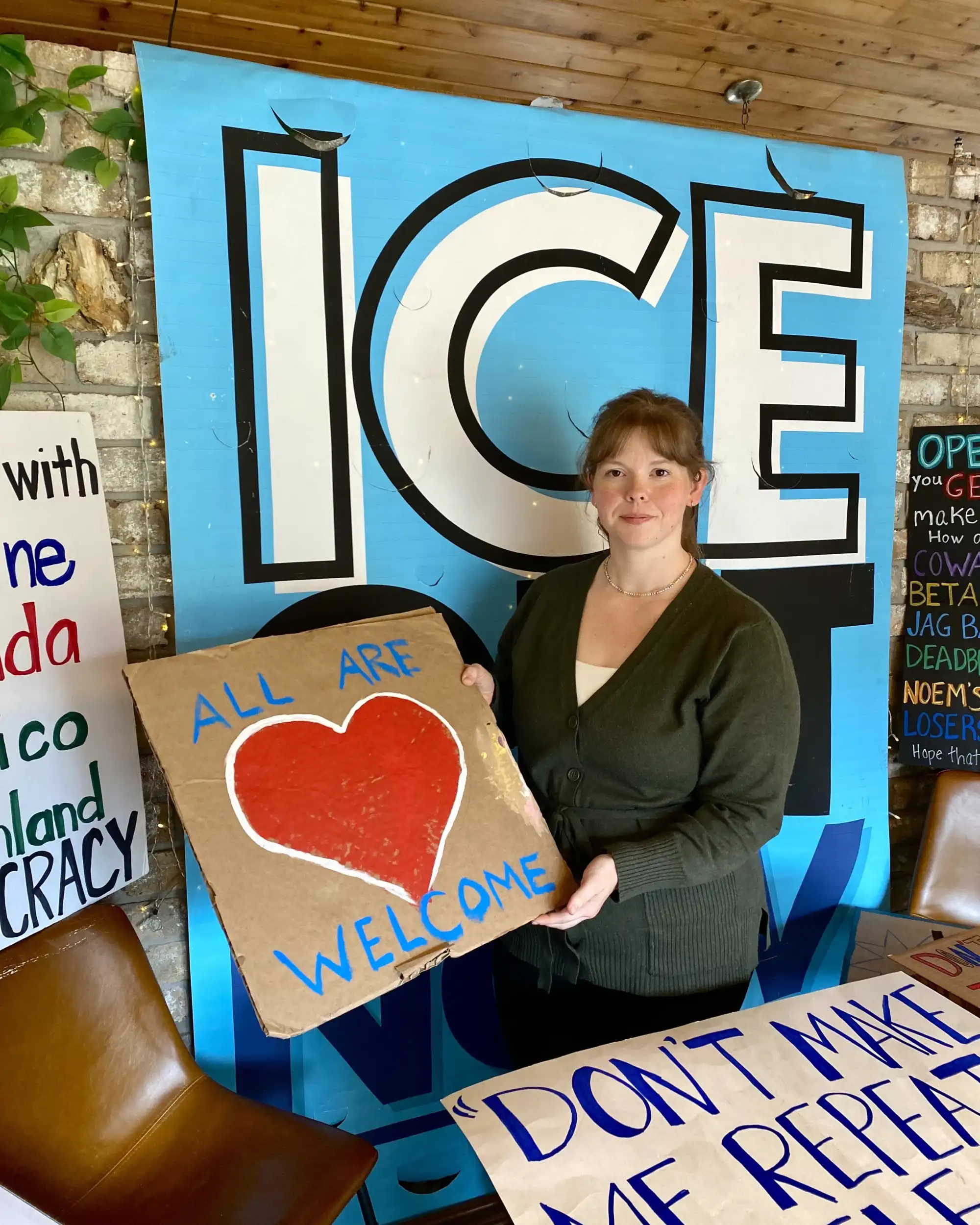
Erica Helander never expected to work in archives or preservation. But stacks of posters and signs ranging in size and message told a different story. In April, they covered tables and leaned against walls in the living and dining rooms of the home she shares with her in-laws.
These signs came from protests over U.S. Immigration and Customs Enforcement's Operation Metro Surge.
Helander began to put out calls to collect posters for The Rebel Loon Archive, an organization she started as she saw the vast amount of art being created during the months of protests and fear.
She was inspired by the way the Rebel Loon, a Moorhead artist’s depiction of Minnesota’s state bird with its wings outstretched, caught fire in the art world, appearing on shirts, signs and tattoos.
Turn Up Your Support
MPR News helps you turn down the noise and build shared understanding. Turn up your support for this public resource and keep trusted journalism accessible to all.
For her, drawing is less of a preferred medium. She was a stay-at-home mom with a 4-year-old and infant when the federal immigration enforcement surge ramped up.

A jeweler by trade who also has a background in writing, she turned to poetry to pour out her anxiety. And as she started to share her poems on social media, she was encouraged to document her writing offline so she began to create a short book of poetry.
"I want this to be part of something larger," she said. "I know that my art is powerful, and it's more powerful in community, just like all of us are."
She began to ask artists on social media and by email if she could archive and publish their work nonexclusively through a right of reproduction agreement, allowing artists to publish their work elsewhere.
"These people poured their grief, their rage, their fear, and their hope and their love into this art, and just threw it up on the internet," Helander said. "Collecting this art is such an honor for me."
The goal quickly became ensuring what was being made and posted wasn't lost to the internet.
“If it's just on social media, optimistically, give it a week or two weeks, it's going to be so far down in the algorithm that you're going to have to scroll down to find it,” Helander said. “It's going to functionally be lost.”
The book became the archive's way of creating something physical from these digital primary sources. The small book of poetry that started as a 30-page stapled booklet, grew into a hardcover 8 ½ by 11-inch, 250-page-coffee table book. It features 300 local, national and international artists.
That broad approach to who was featured reflected how the Minnesota story of ICE's impact was being told, Helander said.
"This is not about how many followers you have. This is about human rights, human dignity, and your right to speak truth as an artist," she said. "Your right to say here's my experience and here's what happened,” she said.
The artwork is divided into nine segments that follow chronologically and thematically. Each begins with an essay by an expert. Helander believed it was necessary to share not only each artifact, but also its meaning.


A June online fundraising campaign for the book quickly surpassed Helander's expectations. She opened a second online ordering window, that again drew sales she hadn't anticipated.
Helander has even heard from educators and libraries about opportunities to make the book accessible to students.
Over 1,225 physical copies and 59 e-books have been preordered. Net proceeds from book sales will support the Immigrant Defense Network.
Each artist featured in the book will receive a copy.
As for the physical artifacts, she collected posters and signs from across the Twin Cities, carrying them in trash bags to keep them dry. Those posters have been shown in art exhibitions in Minnesota and across the country. The Rebel Loon Archive is working to digitize all artifacts and pieces of artwork so it can be accessed by anyone online.
After the book’s September release, Helander said the archive's next project will be about the Boundary Water Canoe and Wilderness.
For Helander, the archive is more than just preserving art. It also means protecting the voices of people willing to challenge those in power.
“Those are voices that get shut down because art is dangerous,” Helander said “Art mobilizes people. Art can heal us, and art tells the truth, which is the scariest thing to people using their power in a way that they shouldn't.”
Correction (Aug. 26, 2026): A prior version of this story misidentified the location of the artist who created the Rebel Loon. The story has been updated.

