Raised in river water: New approach to help ancient sturgeon return to Lake Superior’s headwaters

Go Deeper.
Create an account or log in to save stories.
Like this?
Thanks for liking this story! We have added it to a list of your favorite stories.


Quick Read
This month marked a major milestone in a decades-long effort to restore a huge and ancient fish to the headwaters of Lake Superior.
More than a half-century after the giant lake sturgeon were wiped out of the St. Louis River, natural resources officials, fisheries experts and others released hundreds of 6-month-old sturgeon into the river, after raising them from tiny eggs in protected tanks.
This wasn’t the first time biologists have stocked the St. Louis River with sturgeon in an effort to restore their population. Efforts have been underway since the 1980s.

But this project, a unique collaboration between state, federal and tribal partners and the Great Lakes Aquarium in Duluth, marked the first time that the sturgeon were raised in water pulled directly from the St. Louis River. It’s an important change scientists believe will increase the odds the sturgeon will return to the river decades from now when they’re ready to spawn.
Turn Up Your Support
MPR News helps you turn down the noise and build shared understanding. Turn up your support for this public resource and keep trusted journalism accessible to all.
“Sturgeon, they grow a lot, they see a lot and they know a lot,” said Eric Torvinen, fisheries biologist for the Fond du Lac Band of Lake Superior Chippewa. “That's why they're such an important fish to us and such a unique fish to keep around.”
Giant, ancient fish
Lake sturgeon are wild-looking creatures. They’re gigantic. By far the largest fish in Minnesota, they grow up to 7 feet long and can weigh over 200 pounds.
It’s not uncommon for a lake sturgeon to live for well over 100 years. A new study suggests they can live to be 400 years old.
Sturgeon are also covered in bony plates instead of fish scales. “When you look at them, they look like sharks,” said Jay Walker, executive director of the Great Lakes Aquarium, which features a large pool where visitors can touch sturgeon as they swim past. Four finger-like projectiles dangle beneath their mouths with taste buds all over them.
"They have these cool little barbels that are underneath their bodies that they swim around to get their food,” Walker said. “Once they sense it, this fleshy siphon of a mouth comes out and sucks it in like a vacuum.”
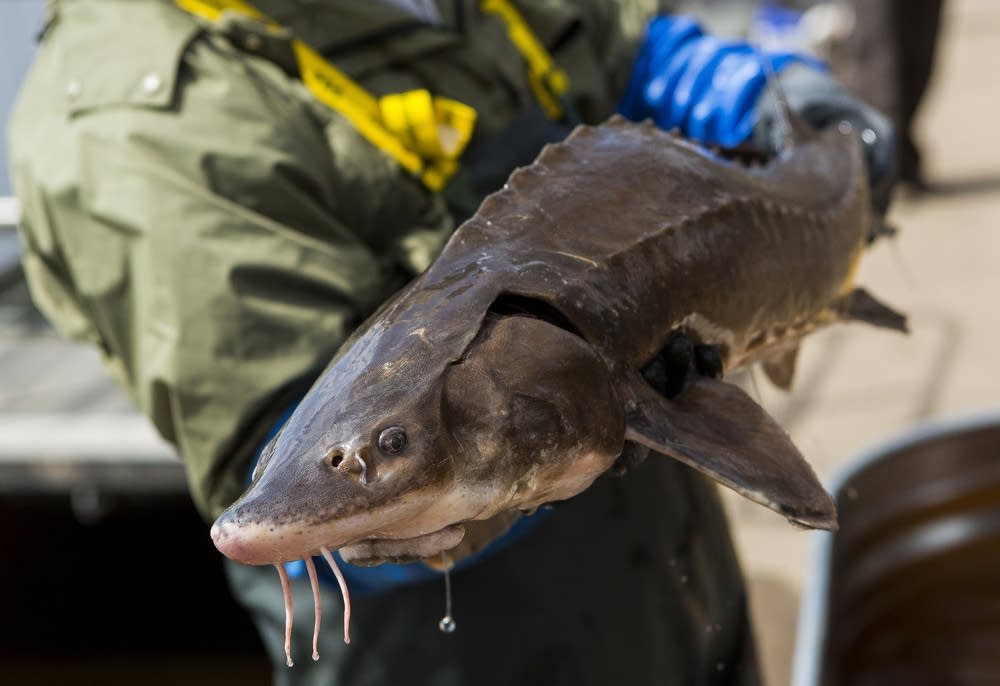
Sturgeon are also extraordinarily old. They date back 150 million years, to the time of dinosaurs. They survived that extinction. But they've had more trouble thriving amid humans.
"Lake sturgeon were extirpated from the St. Louis River on Western Lake Superior in the mid-1900s, related to habitat degradation, overharvest and pollution,” said Dan Wilfond, area fisheries supervisor for the Minnesota Department of Natural Resources in Duluth.
But as the river has gotten cleaner, sturgeon have slowly made a comeback. In the early 1980s, DNR biologists began stocking the lower river with young fish. The Fond du Lac Band stocked the upper river starting in the 1990s.

In 2011, fisheries managers found the first naturally reproduced sturgeon fry in the lower St. Louis River. But the sturgeon population in the river still isn't self-sustaining. And they still haven’t detected spawning above a pair of dams in the upper river, along the Fond du Lac Band’s reservation.
So this summer, the Minnesota DNR teamed up with the aquarium, the Fond du Lac Band and U.S. Fish and Wildlife to try a new approach.
In a trailer parked behind the aquarium in Duluth, just steps away from the St. Louis River, aquarium staff raised 255 baby sturgeon. They hatched from tiny eggs in May. By the end of October, they were about 7 inches long and looked almost like alligators.
"They're spiky when they're little, which helps keep them from getting eaten,” said Great Lakes Aquarium Curator of Aquatics Miranda Rinnie.

The fish were raised in a series of tanks filled with water pulled directly from the St. Louis River.
That should help ensure that more sturgeon will return to the river when they're ready to spawn.
Similar to salmon, young sturgeon memorize — or imprint — the unique chemical and odor signatures of the water where they’re born.
"There's a lot of research that shows that the sturgeon imprint on the water they're raised on within the first 30 to 45 days of their life,” said Rinnie. “That [imprinting] cues the fish where to return to spawn."

Past batches of sturgeon stocked into the St. Louis River were reared in well water or river water from northern Wisconsin and Upper Michigan. So scientists suspect some of those fish never returned to the St. Louis after migrating out into Lake Superior.
The hope is that these fish, by being reared in “natal water” — from their place of birth, the St. Louis River — for the first several months of their lives will return when they’re ready to spawn in 20 years, or even longer.

By early November, the fish were large enough to release into the river. Inside the trailer, biologists first recorded the weight and length of each fish and injected a tiny electronic tag the size of a grain of rice into their bodies, similar to the device embedded in pets to identify them.
"And so it's very possible that biologists, well past [when] I'm gone, maybe even when my kids are gone, are going to be able to look at these fish and [learn] super interesting stuff,” said Wilfond, “when you think about the longevity of this species."
‘Have a good life!’
On Nov. 3, biologists with the Minnesota DNR and the Fond du Lac Band drove coolers full of water holding five-month-old sturgeon to release points on the lower and upper St. Louis River.
At Chamber’s Grove Park on the far western edge of Duluth, Angela Piket, an aquarist at Great Lakes Aquarium, gently tilted a bucket holding two tiny sturgeon and watched them slowly swim away.
"Have a good life, little buddies!" she called.
Piket helped raise the fish starting in May when they hatched from tiny eggs. "We babied them so much over the last six months,” she said. “So just to just put them out in the river and hope Mother Nature does its thing …” she said, her voice trailing off.
Wilfond, with the Minnesota DNR, said when sturgeon grow to 7 inches long, research suggests about 90 percent of them will survive after they’re released into the wild.
In addition to the 255 sturgeon raised in St. Louis River water, hundreds more that were raised in different waters were also released into the river. The Fond du Lac Band set hundreds of fish free at a community event in late September. In Ojibwe culture, long-lived sturgeon are revered for their wisdom.

“We had a bunch of our younger generation of tribal members and people coming to let these fish go, and to see the expressions on their faces to actually get to see this? That didn’t exist 30 years ago,” said Terry Perrault, the lead tech for the Fond du Lac Band’s Resource Management Department.
“That’s my main goal, is to actually see something that wasn't here,” Perrault said. “Now it is here, and I hope it continues to stay here.”
The $1.6 million project also includes the creation of a new sturgeon exhibit at the Great Lakes Aquarium, scheduled to open in October 2027, which will tell the conservation story of restoring the fish to the St. Louis River.
Aided by nearly $1 million in state grants, the aquarium is also building an indoor rearing facility that will allow project partners to raise 3,500 sturgeon annually in subsequent years.
“This is not going to be just an endless stocking campaign,” said Wilfond. “We do expect these fish to recover, to be able to reproduce on their own, to become sustainable in the St. Louis River.”