
Ramsey County Jail crowding risks 'life-threatening harm,' Corrections Commissioner says
Go Deeper.
Create an account or log in to save stories.
Like this?
Thanks for liking this story! We have added it to a list of your favorite stories.


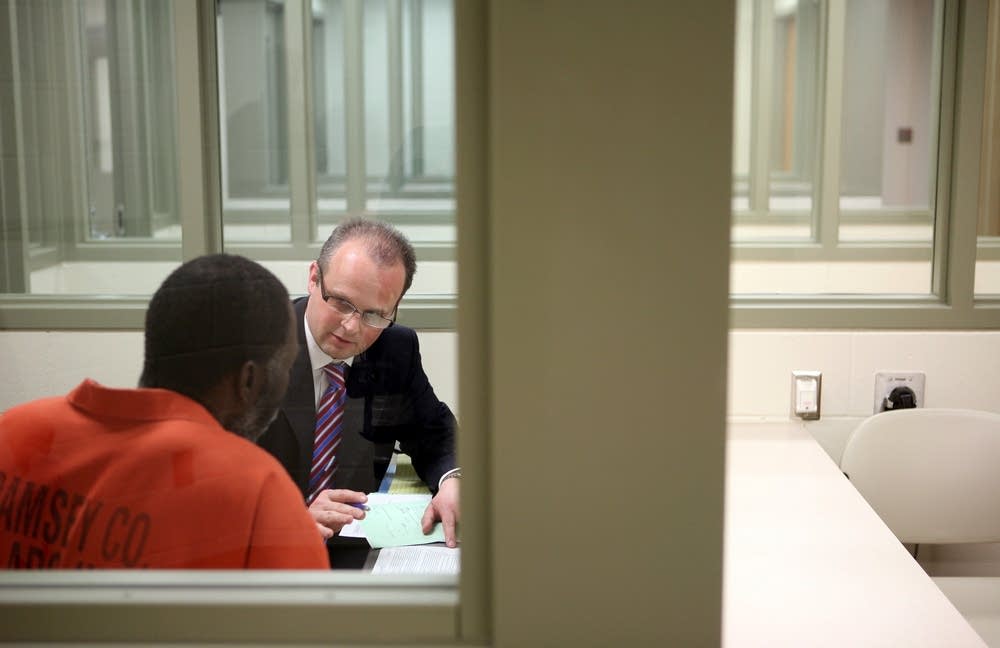
The Ramsey County Jail is overcrowded— and it will need to reduce capacity by 168 inmates, according to Minnesota Department of Corrections Commissioner Paul Schnell.
In a Friday letter to Ramsey County Sheriff Bob Fletcher, Schnell wrote that understaffing at the jail poses an "imminent risk of life-threatening harm."
Commissioner Schnell joined MPR News host Cathy Wurzer to explain why understaffing and healthcare concerns caused him to call for a capacity reduction plan.
MPR News reached out to Ramsey County Sheriff Bob Fletcher. He declined an interview, but sent a statement on Sunday:
I share the concerns about overcrowding in our jails. In fact, it’s an issue we’ve tried to raise with the county board for months and months, including as far back as last May.
Overcrowding isn’t a new problem. It’s part of a nationwide trend and entirely predictable, caused by significant increases in crime, massive backlogs in the criminal justice system and a nationwide worker shortage.
We’ve been working hard to address the issue by aggressively recruiting and hiring corrections officers while at the same time trying to work with our County Commissioners on solutions—like making better use of the Ramsey County Workhouse, that’s only using 25 percent of its capacity.
We haven't gotten there yet, but I’m heartened to see the Board ready to take the challenge seriously and looking forward to working with them on a permanent solution. In the meantime, we’ll be moving some inmates to other secure facilities throughout Minnesota. No inmates will be released.
- Bob Fletcher, Ramsey County Sheriff.
Subscribe to the Minnesota Now podcast on Apple Podcasts, Google Podcasts, Spotify or wherever you get your podcasts.
We attempt to make transcripts for Minnesota Now available the next business day after a broadcast. When ready they will appear here.
Turn Up Your Support
MPR News helps you turn down the noise and build shared understanding. Turn up your support for this public resource and keep trusted journalism accessible to all.
Audio transcript
PAUL SCHNELL: It's good to be with you today.
INTERVIEWER: Thanks. Your letter indicates violations of five state rules. This is an emergency order. It also requires the jail to submit a capacity-reduction plan, as we mentioned, by the end of the day today. How did things get to this point?
PAUL SCHNELL: Well, you know, I think the county has been in a position where staffing has been a concern. We have been, through our regular licensing process, been looking at a number of issues related to well-being checks and so forth. And then about just over a week or so ago, an issue was brought to us by high-ranking county officials, concerns really about health care and the ability of people who are incarcerated there to access health care in a timely-- on a timely basis.
We sent investigators in as a result of that. They did a review and identified, corroborated some of the concerns that were raised. And that's what prompted this action.
INTERVIEWER: Has this been an ongoing concern in the Ramsey County Jail?
PAUL SCHNELL: Well, I mean, I think we know that-- I believe that there has been issues. Historically, I believe that, some time ago, the county board did provide additional resources for the jail to be able to meet its staffing needs. And yet, we know that, as an industry, you know, corrections officers for county jails, for the Department of Corrections even, this is a challenging work environment. And recruitment does become an issue. That said, nothing really relieves any of us who provide these level of services to make sure that we're addressing people's medical needs, especially when they're urgent.
INTERVIEWER: This sounds familiar. And you recently sanctioned, if I recall, the Beltrami County Jail in the Bemidji area for similar incidents. Are there connections here? Is this a bigger issue?
PAUL SCHNELL: Well, I mean, I think I'm not saying that this is a statewide issue in every single county jail across the state. But it is something that I think since the passage of the Hardel Sherrell Act. You may recall, a couple of years ago, the legislature passed this was sweeping reforms around the jail after some cases-- really high-profile cases out of Beltrami County, in fact, that came to public attention.
That prompted a lot of legislative focus on the issue. And really, the expectation was made clear by state policymakers that there needed to be renewed focus on ensuring the quality of care for people who are in custodial settings. And these are the things that now are built in. These conditional orders that was issued here in Ramsey and in Beltrami a week or so ago, these are remedies that the legislature put in place for us to address issues or concerns, where there is immediate life safety concerns.
INTERVIEWER: And who normally-- and help us out here. Who normally handles the medical care for inmates in county jails? Is that done by the county? Is that farmed out to a provider? How does that happen?
PAUL SCHNELL: Typically, there would be a provider. In Ramsey's case, they essentially contract with Ramsey County Public Health. They have their own infrastructure for medical direction that comes through the public health entity. And in many other counties across the state, they contract with private providers.
And but nonetheless, in the jail standards, there is a requirement that when a qualified medical professional directs a certain type of care, like, say, emergent care, that that cannot be overridden by the custody setting itself. So they would have to comply with that directive. If medical care is urgent, that has to happen.
And oftentimes, in some of the cases we saw here, staffing was a factor. They simply didn't have people that were available to provide that care. But nonetheless, the county is-- the jail is obligated to make sure that that person gets the level of care that's required in that situation.
INTERVIEWER: We did reach out to Sheriff Fletcher yesterday. And he declined to interview with us. But he sent a statement that says he shares the concerns about overcrowding in our jails. It's not a new issue. It's part of a nationwide trend caused by significant increases in crime, massive backlogs in the criminal justice system, and a nationwide worker shortage.
Now, you and I just talked about the worker shortage. What do you know about massive backlogs in the criminal justice system from where you sit? Is that a key issue here?
PAUL SCHNELL: Yeah. I mean, I don't know that that is the driving consideration here. I mean, Ramsey County has their population-- their license limit is about just shy of 500, 496, 497, something like that is their capacity. And this new order will set a max capacity limit of 360. So it's substantial. But the county was operating at around 370 to 380 with their typical population.
So you know, I don't know the extent to which the backlog-- there is a considerable backlog. We are seeing numbers of people even coming into the prison system go out because of that backlog that was created by COVID. But the courts have been really working diligently to address that backlog and get people processed through the court system. So that is a factor. But I don't know how much that contributed to this particular incident.
INTERVIEWER: And finally, Commissioner, since Ramsey County has to reduce its capacity by about 168 inmates, what's going to happen to those people? Where do they go?
PAUL SCHNELL: Well, I think there's a number of strategies that counties can look at. They can use other types of things like electronic monitoring. And that could be an example.
They may have other custodial settings. In Ramsey County, they do have more of a center that they oftentimes use for work release, people who are sentenced. That could be a strategy.
And in some other places, it's not uncommon for counties, who are at capacity, to board-- contract board people who are in their system-- in their jail system in other jails in the region. And that's certainly what's happening up in Beltrami. I don't know exactly what Ramsey's plan will ultimately be to address the issue.
INTERVIEWER: And you should see it by the end of the day.
PAUL SCHNELL: Today, we should see it by the end of the day with the expectation that they hit that number that we are requiring by Wednesday at noon.
INTERVIEWER: All right, Commissioner, always a pleasure. Thank you so much.
PAUL SCHNELL: Thank you. Take care.
INTERVIEWER: You too. That was Minnesota Department of Corrections Commissioner Paul Schnell.
Download transcript (PDF)
Transcription services provided by 3Play Media.

