
Canada-Minnesota border crossings are down this summer and local businesses are noticing
Go Deeper.
Create an account or log in to save stories.
Like this?
Thanks for liking this story! We have added it to a list of your favorite stories.


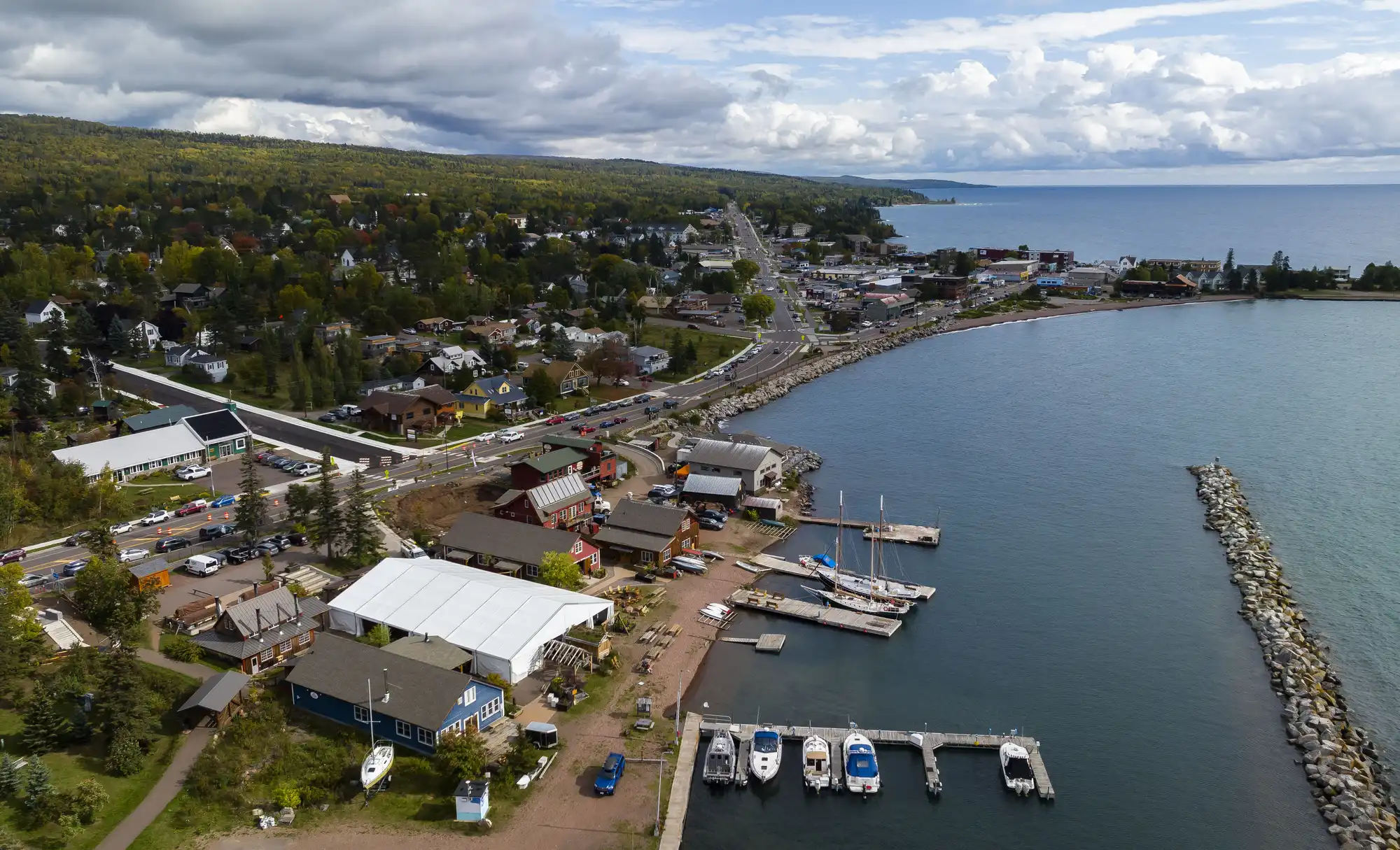
Summer is a busy time for road trips and travel on the North Shore. But data from the Department of Transportation shows that fewer people are crossing from Canada into Minnesota.
This June, there were about 16 percent fewer people traveling in by car compared to last June. That’s about 26,000 fewer people who came to visit our state.
Earlier this year, MPR News host Angela Davis and Minnesota Now guest host Chris Farrell traveled to the Minnesota-Canada border to talk about how the U.S. tariffs on Canada have affected the relationship between the two nations.
Minnesota Now is checking in on how that relationship may have slowed summer traffic into the states. John Fredrikson is an owner of the Gunflint Lodge & Outfitters in Grand Marais, and Kirsten Brune is a manager at the restaurant My Sister’s Place also in Grand Marais. They spoke to Farrell about the changes they are seeing.
Turn Up Your Support
MPR News helps you turn down the noise and build shared understanding. Turn up your support for this public resource and keep trusted journalism accessible to all.
Correction (July 29, 2025): A previous version of this story misstated the name of the Gunflint Lodge & Outfitters.
Use the audio player above to listen to the full conversation.
Subscribe to the Minnesota Now podcast on Apple Podcasts, Spotify or wherever you get your podcasts.
We attempt to make transcripts for Minnesota Now available the next business day after a broadcast. When ready they will appear here.
Audio transcript
And early this year, MPR News host Angela Davis and I, we traveled to the Minnesota-Canadian border to talk about how the US tariffs on Canada might have affected the relationship between the two nations. It was a wonderful reporting trip. And so I want to catch up on how that relationship may have slowed summer traffic into the states.
So here with me now are people from two businesses who rely on tourists, some from Canada, to keep afloat on the North Shore. John Fredrikson is an owner of the Gunflint Trail Lodge in Grand Marais. Hi, John.
JOHN FREDRIKSON: Hi, Chris.
CHRIS: And Kirsten Brune is a manager at the restaurant My Sister's Place in Grand Marais. Hi, Kirsten.
KIRSTEN BRUNE: Hello, there.
CHRIS: So, Kirsten, I'm going to start with you, and tell me a little bit about your restaurant, My Sister's Place, and how long have you worked there?
KIRSTEN BRUNE: I have been at My Sister's Place now for just shy of 12 years. I've managed now for just shy of two years.
CHRIS: And John--
KIRSTEN BRUNE: We're kind of--
CHRIS: Go ahead.
KIRSTEN BRUNE: Oh, sorry. Go ahead.
CHRIS: Go ahead. Give us a little bit of description.
KIRSTEN BRUNE: We're just kind of one of those Northwoods restaurants. We've got cool antiques on the wall and just classic American fare.
CHRIS: That's right. And so if you're coming from the north, you'd be one of the first restaurants you'd hit, right, driving into Grand Marais?
KIRSTEN BRUNE: Yes. Yep. We're one of the first places you'll see when you know you've reached our town.
CHRIS: OK. And John, tell me about the Gunflint Lodge. How long have you been one of the owners?
JOHN FREDRIKSON: So my wife and I bought it nine years ago this past June.
CHRIS: And as I mentioned when we did the trip up to the border that, at that time, visitors from Canada were down. And I'm wondering if you noticed that dip, Kirsten. I mean, what has business been like for you this year compared to previous years?
KIRSTEN BRUNE: We've definitely noticed lower business levels. And I think that's from both ends of the highway, coming from both directions. It's definitely been a slower year. COVID was a very busy stretch for us. We were a safe place to go, was kind of the thought.
CHRIS: Oh, OK.
KIRSTEN BRUNE: And so business levels were very high during COVID, and we're back down to definitely pre-COVID and then the slower end of pre-COVID at this point, which is kind of a sad day for us.
CHRIS: So, Kirsten, do you think some people are deciding, well, I'm going to go elsewhere since COVID's in the rear-view mirror? So you're losing-- somewhat less business for that reason. And then how about from Canada?
KIRSTEN BRUNE: We see a far lower rate of Canadian traffic coming through. It's been really sad because we have a lot of loyal customers that we've seen year after year come through. We're their first stop. They stop for lunch on their way down to go see a movie in Duluth, or go shopping in the Twin Cities, or go to a sporting game that they want to go see down in the Twin Cities or elsewhere.
And we're not seeing that kind of traffic really much at all. We do see some of our Canadian friends are still coming, but it's in smaller amounts, for sure. It's really been a big change this year.
CHRIS: And how about you, John? What is your experience with Canadian visitors?
JOHN FREDRIKSON: So we're a ways off, clearly, a ways off of Highway 61, which is the main corridor for people heading from Thunder Bay and Canada down to Duluth or the Twin Cities. So it has to be a little bit more of a destination for folks. And we typically don't get a lot of Canadian guests up at the lodge, although we have had some this summer. But it's usually not a high number. So I'm not a great barometer on the amount of traffic. I know we've tracked-- in the county, we've tracked the number of border crossings coming in, just like you're talking about today, and it's obviously lower, but I think it hits the folks down in Grand Marais and along the Highway 61 corridor quite a bit more than it does us.
CHRIS: And how is overall business for you?
JOHN FREDRIKSON: Business is good. The summer started-- actually, the winter started out very strong. We added some skate trails that brought a lot of people up. So our winter is very strong. But May and June softened up quite a bit. Now, July is ahead of pace from last year, and we're pacing out. We should finish out with a good summer. So things are pretty active up here.
CHRIS: And so, Kirsten, in terms of your Canadian customers, I mean, obviously, you're welcoming them. You want them to come in. So is there anything you think you can do to bring more Canadian customers back across the border and stopping at your restaurant?
KIRSTEN BRUNE: So we welcome everyone with wide open arms. And we have actually had a few past guests call us because they trust us. And so they have actually called us a couple of times I've fielded two questions-- or two separate calls from people that were wondering if it would be worth the trip down, if they would be greeted by just the general community south of the border, if they would be safe.
We've had a couple of questions to that extent when there was-- this is during the height of all of the uncertainty that there was a couple months ago. Things have settled a little bit since then, for sure. And so during that chunk of time, we did field a couple of questions from people calling specifically asking if it would be welcoming. And while we did tell them, you're welcome any time, that stands year round, all year, for everyone. Anyone is welcome here.
CHRIS: Yeah, that's a little disconcerting, though, that you would get that question. And obviously, you would say, welcome. And John, I'm curious-- I would imagine, and I'm imagining here that you and other resort lodge owners, you talk to each other. So are you having discussions about, how do we create this more welcoming environment for Canadians? Because I tell you, when we were up in-- Angela Davis and I were up in Canada, there was this sort of an underlying concern that, just as Kirsten has said, are we going to be safe if we cross the border?
JOHN FREDRIKSON: Yeah. I mean, we do talk about it. We-- in the chamber meetings and our Visitor Bureau meetings, we talk about if there are issues or what we can do on the issues. I think, a lot of times, it's larger than just our local impact. Obviously, nobody in Cook County is chasing away Canadians or making Canadians feel threatened. I think it's a little bit more hyperbole nationally that there's more angst between Americans and Canadians. When we see Canadians here or in Grand Marais, obviously, everybody-- on an individual basis, everybody gets along fine, and we're all still friendly. I think people maybe sometimes just focus a little bit on how much they see in the news and on social media and maybe not what the actual interaction is with folks.
CHRIS: And John, has there been sort of conversations, OK, not just welcoming environment, but how do we actually boost the numbers of people coming from Canada? Are there things you feel in the community that can be done?
JOHN FREDRIKSON: Yep. Our local tourism group is focusing a little bit more attention on advertising up in Canada, bringing people down. We're trying to do what we can to help out the casino up in Grand Portage to reopen that business. They were impacted drastically during COVID when the borders were closed, because they relied so much more on Canadian business than American business. And so we're doing what we can to try and help bring folks down and return that traffic, certainly.
CHRIS: And Kirsten, sort of same question to you. I mean, you're My Sister's Place, and there's South of the Border and Java Moose. And so are there conversations going on about, how can we relieve our Canadian neighbors? How we can get more people to cross the border?
KIRSTEN BRUNE: That is a conversation that is definitely ongoing. And it's one that I don't think that we have just this grand answer to, aside from just consistently being welcoming. We are happy to host any person that feels inclined to come and visit us, whether it's for a day trip or staying a weekend or longer, coming in for a meal, stopping for a coffee. We're happy to host anyone who stops and that, through consistency and just always being a welcoming space, that that will hopefully just carry over now and going forward.
CHRIS: Well, thank you very much. I think that's a nice note to end this conversation, and I really appreciate both of you taking your time. And that was John Fredrikson and owner of the Gunflint Lodge in Grand Marais and Kirsten Brune, the manager of My Sister's Place restaurant in Grand Marais.
Download transcript (PDF)
Transcription services provided by 3Play Media.

