
Parent: Proposed Minneapolis school closures will disrupt learning, drive more families away
Go Deeper.
Create an account or log in to save stories.
Like this?
Thanks for liking this story! We have added it to a list of your favorite stories.


The Minneapolis school district announced plans Tuesday night to close more than a dozen of its schools. MPR News education reporter Elizabeth Shockman joined Minnesota Now to explain the proposal. And MPR News host Nina Moini talked with north Minneapolis parent Shakiya Carter, who opposes the closures. Carter is one of the founders of the group Minneapolis Families for Public Schools.
Minneapolis Public Schools proposes closing schools amid budget challengesUse the audio player above to listen to the full conversation.
Subscribe to the Minnesota Now podcast on Apple Podcasts, Spotify or wherever you get your podcasts.
We attempt to make transcripts for Minnesota Now available the next business day after a broadcast. When ready they will appear here.
Turn Up Your Support
MPR News helps you turn down the noise and build shared understanding. Turn up your support for this public resource and keep trusted journalism accessible to all.
Audio transcript
ELIZABETH SHOCKMAN: Thanks so much for having me.
NINA MOINI: So more than 12 schools seems like a lot. Can you give us some context around this?
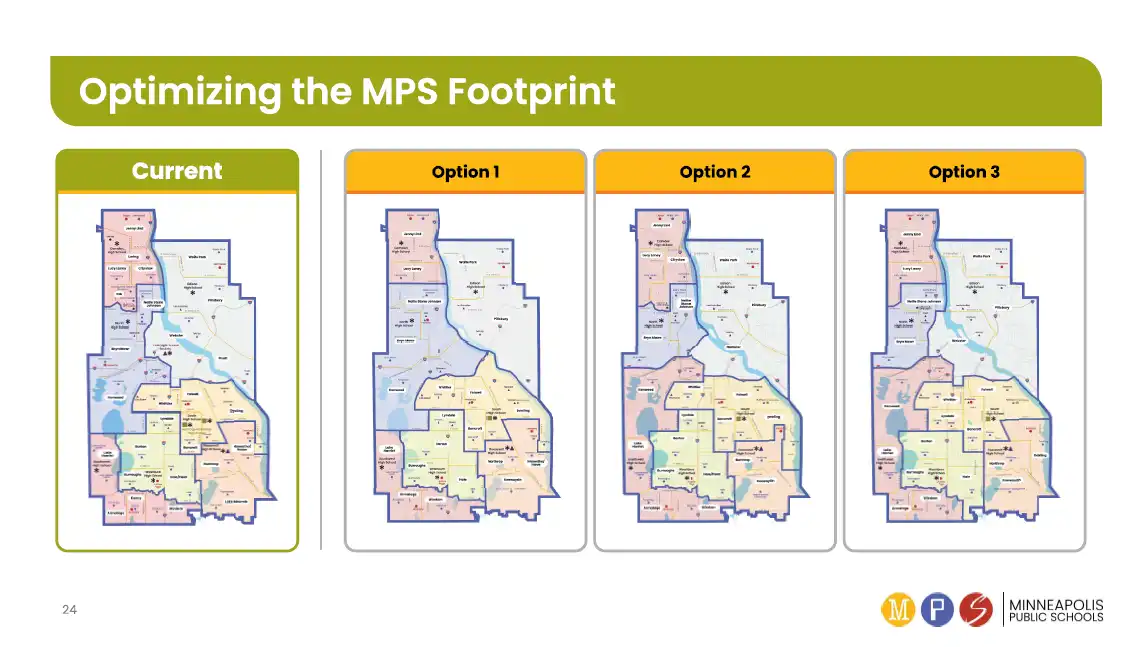
ELIZABETH SHOCKMAN: It is a lot of schools. The proposal laid out to the board last night included three options the district is considering. The options include closing 15 or 16 school buildings. That would affect between 12% to 14% of students through school mergers or attendance boundary changes.
Minneapolis is the fourth largest district in the state in terms of student population. It has more than 50 schools. But this is still a really significant change. To compare, the St. Paul School District five years ago also made the decision to close several school buildings. St. Paul is the second largest district in the state, and their closures affected six different school buildings.
NINA MOINI: So why is Minneapolis suggesting these closures to begin with?
ELIZABETH SHOCKMAN: The district has been sounding the alarm about a budget crisis for several years. Falling enrollment is a major factor. In 2023, it started what it called a school transformation process to reimagine the district. As part of that effort two years ago, school leaders conducted a walkthrough to review the district's buildings. They found that more than half were considered underutilized and were being used at a rate of 70% of their capacity or less.
Superintendent Lisa Sayles-Adams released a video this week talking about the district's process. She said steps to increase enrollment and decrease spending have not been enough to address the district's budget issues.
[AUDIO PLAYBACK]
- The reality is our district is spread too thin, which means resources are used to support an inefficient footprint instead of directly supporting student experiences.
[END PLAYBACK]
ELIZABETH SHOCKMAN: She pointed to chronic underfunding, open enrollment, and demographic changes as factors contributing to the district's financial challenges.
NINA MOINI: How are people reacting to these proposals? What are you hearing?
ELIZABETH SHOCKMAN: There has been a lot of concern raised about these plans. The teachers' union is one group that's concerned. Natasha Dockter is the Vice President of the Minneapolis Federation of Teachers. She told MPR News this morning that the plans are, quote, "unacceptable."
[AUDIO PLAYBACK]
ELIZABETH SHOCKMAN: And we believe that there is a better path forward that doesn't involve closures, closures which will cause families to leave the district, which, as I mentioned, will harm communities.
[END PLAYBACK]
ELIZABETH SHOCKMAN: The union is calling on the district to pause any plans to vote on school closures. Dockter pointed out that there has been modest enrollment growth in recent years and wants the district to focus on that.
NINA MOINI: So what are the district's next steps?
ELIZABETH SHOCKMAN: Well, the board heard these proposals last night. Some board members also seemed concerned about what the district was presenting. School board member Greta Callahan said she's concerned that affected communities are already being notified, even though the board hasn't approved a plan.
[AUDIO PLAYBACK]
- We, the board, have not voted on a single one of these options for closures. We don't have to accept any of these options. We have not agreed to any of them.
[APPLAUSE, CHEERS]
But now the list is out. School communities are being notified on potential closures before the body responsible approving those closures has voted. This is not engagement or thoughtful planning.
[END PLAYBACK]
ELIZABETH SHOCKMAN: So you can hear the cheering there. There's obviously a big community reaction to this announcement. The district plans to collect public feedback through mid-October before the board votes on a proposal in November. The district could begin implementing the changes in the 2027 to 2028 school year.
NINA MOINI: Thanks so much for your reporting, Elizabeth.
ELIZABETH SHOCKMAN: You're welcome.
NINA MOINI: That's MPR News education reporter Elizabeth Shockman. We'll now turn to a parent with kids attending Minneapolis Public Schools. Shakiya Carter lives in North Minneapolis and is one of the founders of Minneapolis Families for Public Schools. She joins me now for some more perspective on the district's proposal. Thanks very much for your time this afternoon, Shakiya.
SHAKIYA CARTER: Hi. Thank you for having me.
NINA MOINI: What is your reaction to this plan laid out by the district here talking about 12 school closures? Are your children's schools on the list of these potential closures?
SHAKIYA CARTER: My children's school is on the list of potential closures. There's actually 16 schools that are slated to close and/or possibly consolidate and/or merge, and our family and community is deeply saddened by the options that were presented from the district to the board last night.
NINA MOINI: What are your specific concerns? I mean, obviously, you hear about your child's school closing, and there are a lot of changes that have to happen for every individual child who would undergo changes, just as anybody would changing schools. But what other concerns do you have about how this could impact your family and others?
SHAKIYA CARTER: The concern that I have about how this could impact my family and others is I'm actually a parent that became a parent in the district during the CDD, which was the Comprehensive District Redesign that happened during COVID. And at that time, I was a new parent in the district. So my child was actually in pre-K. And during her tenure in those first few years of the CDD, she had to switch a school every year because they kept changing the boundaries to be able to maintain what they were trying to implement.
And essentially, it failed. The goals of the CDD were to decrease the transportation costs and increase the equity across the district, and neither one of those goals were achieved. And I couldn't imagine having to be a new family in the district all over again, especially this year coming in and learning that, as early as next fall, when the new school year starts, that the school that I just started attending would close.
Essentially, it's going to drive families out. And we know that the families and the students are the ones that bring the funding. So we will also be in a greater deficit, as well. One thing that the plan did not address is if it would save money. And we know, as of last night, they said that it would not save the district any money, which would not help or benefit the deficit at all.
NINA MOINI: Yeah, what other questions do you think could be explored first by the district before closures like this would be recommended? How do you wish the district would approach it differently?
SHAKIYA CARTER: I would like to know what the plans are going to be for the buildings that they decide to close. The district is already sitting on so many empty, vacant buildings that have not been sold. Included on their list of school closures was Lincoln, which has been closed since 2007. That school has not been occupied in almost 20 years. So that's how long that that school has been sitting, along with a few others. So if we're planning on closing other buildings, what are we going to do with them?
There already has not been a plan of contingency for the buildings that we already have. What are we going to do with them? And then the other question is, where is the stabilization formula? Nothing has been created or considered to say, hey, we know that families are going to leave, because in the CDD, we had 18% of the families in the district leave and choose charters or choose private schools. There has not been a formula created to say, hey, if we lose this many people, this is how many we would need to balance this out.
NINA MOINI: So with this in mind, what are you thinking about for your child? I mean, you mentioned sometimes people feeling driven out of the district because of all of this instability, which does sound incredibly disruptive for families. I mean, what are you going to do on a personal level? What are you hearing from other parents moving forward about how you're going to continue to try to talk with the district about this?
SHAKIYA CARTER: So, essentially, what we would like to do is that we are asking the board to delay on making any major decisions until we can get the key questions answered, which are, what are we going to do with the repurposed buildings? How is this going to actually affect impacted families that are going to be in these areas of closure? And how are we going to get the buy-in for them to stay?
Because know, looking at the CDD, that 18% of the families in the district actually left. That would be one of the ways or one of the things that we would want to explore. And again, we want to know, how do you plan to repurpose these buildings? How do you plan to make sure that we have money coming in to fill this deficit so this doesn't continue to happen, so we're not in the same spot five years later?
NINA MOINI: Shakiya, can I ask, what was your reaction to any thoughts from the district about deciding which buildings or which schools would be closed? If it does come down to that some or all of these buildings need to be closed, what factors would you like to see the district just put into deciding which route to go with all these different buildings?
SHAKIYA CARTER: What I would like to see done before they decide to close these buildings is that there will be a racial equity impact analysis, meaning that we are not seeing greater closures in communities that serve primarily Black and Brown students, as opposed to students that may be white or of other race.
NINA MOINI: And what are you hoping the board will continue to engage with parents around, just as the months continue to roll on here? If it does come to be that your student or other students have to change schools, do you think there should be more support around that?
SHAKIYA CARTER: I think there should be. What I think the board should do is increase the timeline of which the district is looking to receive the feedback. Four months is not enough time to receive feedback from thousands of families.
NINA MOINI: All right, Shakiya, we really appreciate your perspective and coming on Minnesota Now and sharing it with us. We hope you'll check back in with us soon. Thank you.
SHAKIYA CARTER: OK, thank you so much.
NINA MOINI: That's Shakiya Carter, one of the founders of Minnesota Families for Public Schools.
Download transcript (PDF)
Transcription services provided by 3Play Media.

