
The line forms here…
Go Deeper.
Create an account or log in to save stories.
Like this?
Thanks for liking this story! We have added it to a list of your favorite stories.


[image]
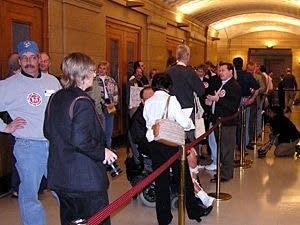
Tom Scheck just sent me a picture of the line waiting to get into the Judiciary Committee meeting where the marriage amendment bill is going to be heard.
Imagine the lines in November if it makes the ballot.
Update: I see where a blog with an occasional, but passing, relationship with reason says that line above proves a bias against the bill. Really? You think? That would mean that everyone standing in that line is for the bill. I'm kinda thinking they're not. I'm also kinda thinking that the bill will draw both opponents and proponents to the polls and I think if the bill passes, there'll be long lines at the polls.
Turn Up Your Support
MPR News helps you turn down the noise and build shared understanding. Turn up your support for this public resource and keep trusted journalism accessible to all.
Where I come from saying, "there'll be long lines at the polls in November if this is on the ballot," means "I think there'll be long lines at the polls." Only reader bias can reach another conclusion.
* * * *
By the way, this question about whether the appearance on the ballot in November is an attempt to help GOP candidates is an interesting one when looked at intelligently. The theory goes that if it's on the ballot, the GOP base will be energized, show up, and vote in GOP candidates.
But is that a given? If you look at the exit polls from 2004, the election was a referendum on Iraq, and John Kerry won the state. Not all that surprising. But what was surprising is that almost 1 in 3 voters voted against a candidate, not for for one.
Consider the top-of-the-ticket as the "referendum." Did it result in change elsewhere on the ballot? Nope. Every incumbent congressperson won re-election.
John Kerry took Wright County, Washington County, and Stearns County , Rep. Mark Kennedy was re-elected. So where was the energized base in this "referendum?"
(This is wrong. See the comments section).
On the other hand, Gov. Jesse Ventura's victory is often credited to a constitutional amendment on the right to hunt. I tend to view this as another example of party hacks not understanding why Jesse Ventura won in this state. Ventura won the minute he sat next to Norm Coleman and Skip Humphrey at the first debate to which he was invited... and opened his mouth.
And it's true that in 2004, DFLers picked up 13 seats in the Minnesota House, 14 incumbents lost. Twelve were Republican (Arlon Lindner ran in a three-way after being disavowed by the Republicans). It's possible, I suppose, that people were so ticked off at Bush, that they voted against the incumbent Republican.
Except that in several of those districts, Bush carried the county.
Here, using the very excellent MPR Campaign 2004 results map, is the state from a presidential point of view:
[image]
And here is the state from a legislative point of view:
[image]
Theoretically, the results should look roughly the same. They don't, of course. I would guess that what drove the vote on the Legislature was a "big honkin'" budget deficit and the efforts to cut it rather than Iraq. So voters were clearly able to distinguish between issues.
Will they still?
(Update 4:18) -- David Kirchner at The Analyst (this is his speciality), provides these two maps for a closer look.
[image]
[image]

