
All aboard
Go Deeper.
Create an account or log in to save stories.
Like this?
Thanks for liking this story! We have added it to a list of your favorite stories.


[image]
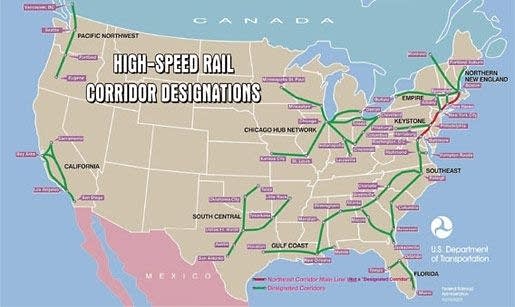
The Obama administration's announcement of $8 billion for high-speed rail development around the country certainly made a splash, but it's not going to put many new trains on new tracks in the near-term. It's hard enough to build a baseball stadium for less than a billion dollars these days.
Here, we're talking about spreading $8 billion around to 10 rail corridors across the country, plus an additional $1 billion a year for 5 years.
While we can admire the rail-centric Europeans or the sleek bullet trains of Japan, is it worth trying to shift the primary mode of transportation for a significant number of Americans?
Turn Up Your Support
MPR News helps you turn down the noise and build shared understanding. Turn up your support for this public resource and keep trusted journalism accessible to all.
Amtrak's Empire Builder runs between the Twin Cities and Chicago. It'll cost you $56-74 and take you 8 hours to get there.
If you're a frequent traveler to Chicago, what's the threshold at which you'll consider switching from plane to train? A 6-hour trip? 4 hours?
Update: In the comments, Tyler notes that the point of this all is that it's high-speed rail.
However, the U.S. actually has different standards for what qualifies as high-speed rail than the European Union, for example. The EU says it's a top speed of 125 mph or more, while 90 mph will earn you the status of "Emerging High-Speed Rail" in the U.S. — or, for the politically expedient, "high-speed rail".
For the interested, the Federal Railroad Administration's high-speed rail strategic plan (pdf) is worth a read.

