
Winter solstice tonight, Christmas night snow chance
Go Deeper.
Create an account or log in to save stories.
Like this?
Thanks for liking this story! We have added it to a list of your favorite stories.


Monday weather headlines
Winter solstice tonight at 10:48 p.m.
On pace for second warmest December on record in Twin Cities
Light rain/snow chances midweek
Watching Christmas night snow chances
Rare Christmas full moon

Brighter days ahead
Turn Up Your Support
MPR News helps you turn down the noise and build shared understanding. Turn up your support for this public resource and keep trusted journalism accessible to all.
There will be a parade at the Weather Lab tonight at 10:48 p.m. A very short parade.
The winter solstice occurs when the sun reaches the furthest point south in the sky on it's annual trek. Starting tomorrow, the days gradually start getting longer. Daylight continues to grow until June 20 and the summer solstice in 2016.
My favorite thing about this time of year is that later sunsets have already started last week The sunset at 4:32 p.m. last week, and we gain five minutes of daylight in the evening by Christmas Day as the sun sets at 4:37 p.m. By New Year's Eve, the sun in the Twin Cities sets at 4:42 p.m., meaning it's light in the west until well after 5 p.m. on clear evenings!
Some quick winter solstice facts for Minnesota.
Winter solstice at 10:48 p.m.
Sun angle at noon today is 21.5 degrees above the horizon in the Twin Cities
Daylight today 8 hours and 46 minutes
15 hours and 14 minutes of darkness
Embracing the darkness?
As depressing as the long nights of darkness (and string of gray days) can be for some, there are positive health benefits from all that dark. Personally I find the long dark nights deeply restful this time of year. No need to race the clock and sun for one more, ball game, evening walk before sunset, one more summer boat ride.
Here's some perspective on why all this dark is good for us from ABC News.
Scientists have now discovered that only when it's really dark can your body produce the hormone called melatonin. Melatonin fights diseases, including breast and prostate cancer.
"It turns off the cancer cells from growing," says Joan Roberts, a photo biologist.
But if there's even a little light around your bed at night, your melatonin production switches off.
"So there may be this natural way that Mother Nature has given us, that is, dark night to keep certain cancers under control," Roberts says.
Even watching TV turns on other immune system hormones that should be active only in daytime. They get depleted, and you're more likely to get a cold.
Nature needs darkness, too.
The immune systems of animals grow weak if there's artificial light at night.
Another angle on the power of darkness from The Guardian.
"Our biological clock has been likened to the conductor of an orchestra, with the multiple rhythms of the body representing the various sections of that orchestra," says Russell Foster, professor of molecular neuroscience at Imperial College, London, which later this month hosts the first international sleep conference.
"The body clock adapts us for the varying demands of activity and rest. It ensures our internal synchronicity: that our various internal systems - temperature, alertness, blood pressure and so on - are working together. And the body clock sets itself using the light/dark cycle. By moving to 24-hour living, and reducing or ignoring the dark bit, we are effectively throwing away the advantages of millions of years of evolution."
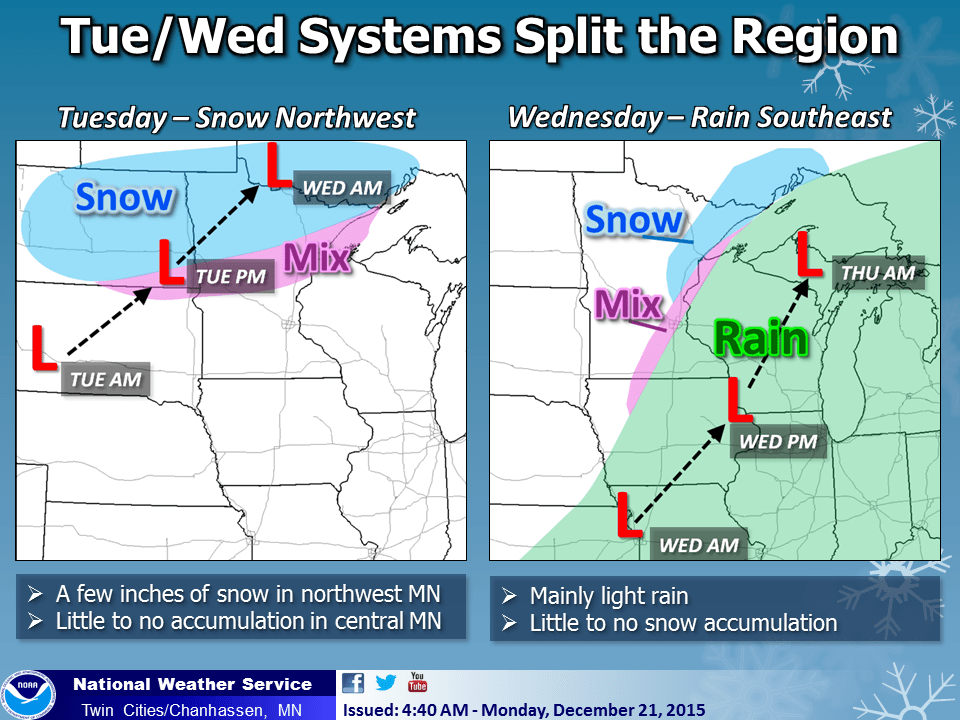
Light mix Tuesday night and Wednesday?
The latest model runs don't look too impressive, but a disorganized series of low pressure systems will bring a mix to Minnesota Tuesday and Wednesday.
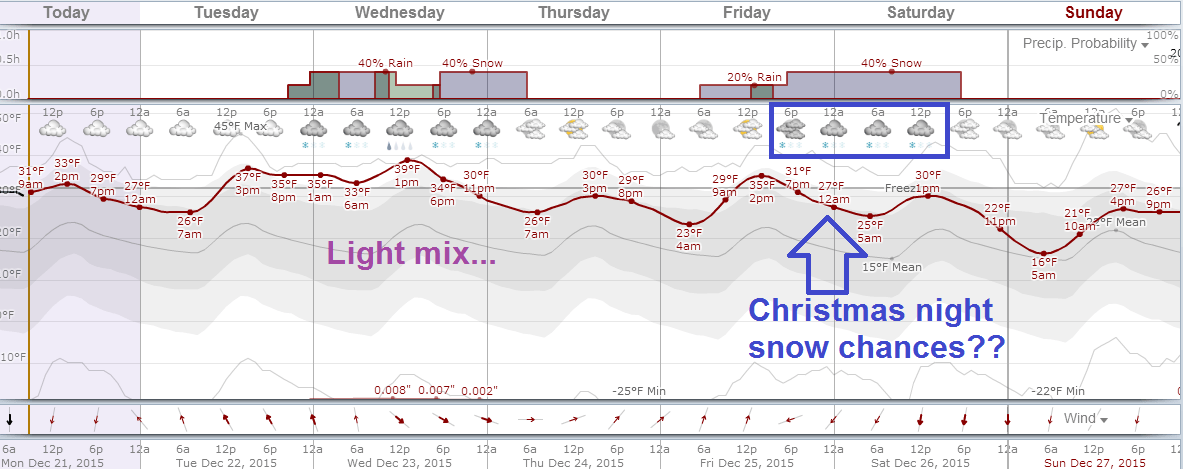
Here's a more detailed breakdown of the holiday week ahead. The best chance of accumulating snow may actually arrive Christmas night. A brown Christmas morning with a white finish?
On pace for 2nd warmest December on record in metro
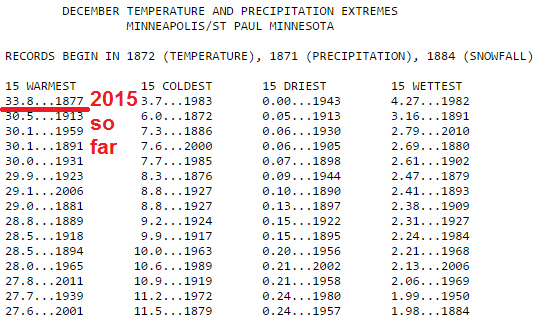
If the forecast stays on track, it look like we may challenge for the 2nd warmest December on record in the Twin Cities.
33.1 degrees average temperature so far for December at Minneapolis-St. Paul International Airport
33.8 degrees warmest December on record in 1887-88
First Christmas full moon in 38 years
Santa will have some bright help in the sky this Christmas Eve -- a rare Christmas full moon.

Details from NASA.
Not since 1977 has a full moon dawned in the skies on Christmas. But this year, a bright full moon will be an added gift for the holidays.
December’s full moon, the last of the year, is called the Full Cold Moon because it occurs during the beginning of winter. The moon’s peak this year will occur at 6:11 a.m. EST.
This rare event won’t happen again until 2034. That’s a long time to wait, so make sure to look up to the skies on Christmas Day.
As you gaze up at the Christmas moon, take note that NASA has a spacecraft currently orbiting Earth’s moon. NASA’s Lunar Reconnaissance Orbiter (LRO) mission has been investigating the lunar surface since 2009.
“As we look at the moon on such an occasion, it's worth remembering that the moon is more than just a celestial neighbor,” said John Keller, NASA’s Goddard Space Flight Center in Greenbelt, Maryland. “The geologic history of the moon and Earth are intimately tied together such that the Earth would be a dramatically different planet without the moon.”

