
Balmy 2020: 14th warmest year for Minnesota; record extreme U.S. weather
And the 6th mildest winter on record so far in International Falls

Go Deeper.
Create an account or log in to save stories.
Like this?
Thanks for liking this story! We have added it to a list of your favorite stories.


2020 was a lot of things.
In Minnesota’s weather, 2020 was the 14th warmest year on record dating back to 1895 according to NOAA.
Overall Minnesota temperatures ran between 1 and 3 degrees warmer than average across most of the state.

For select cities, it was the 10th warmest year on record in Duluth (+1.8F) and the 11th warmest year on record in St. Paul (+1.7F)
Turn Up Your Support
MPR News helps you turn down the noise and build shared understanding. Turn up your support for this public resource and keep trusted journalism accessible to all.
Here’s more from NOAA on 2020 national temperature trends.
Most of the contiguous U.S. experienced above-average temperatures during 2020. Ten states across the Southwest, Southeast and East Coast had their second-warmest year on record. There were no areas of below-average annual temperatures observed across the Lower 48 during 2020.
Mild winter so far
So far winter in Minnesota is running significantly warmer than average.
On the dry side
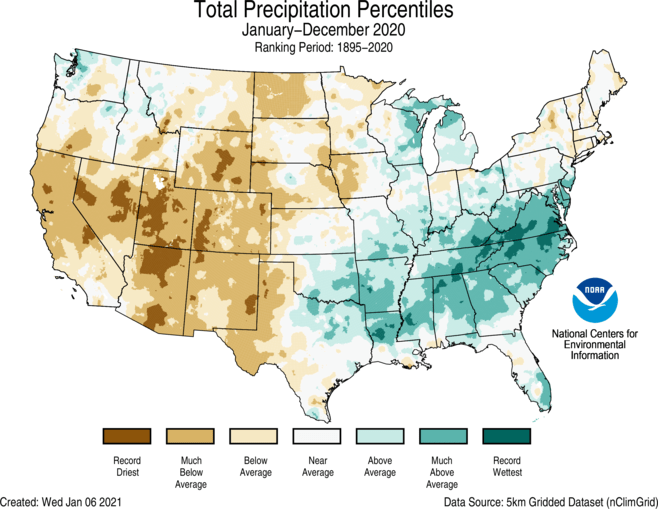
Most of Minnesota received average to below-average precipitation in 2020. Some of the direst areas included extreme southwest and northeast Minnesota.
Record billion-dollar weather disasters
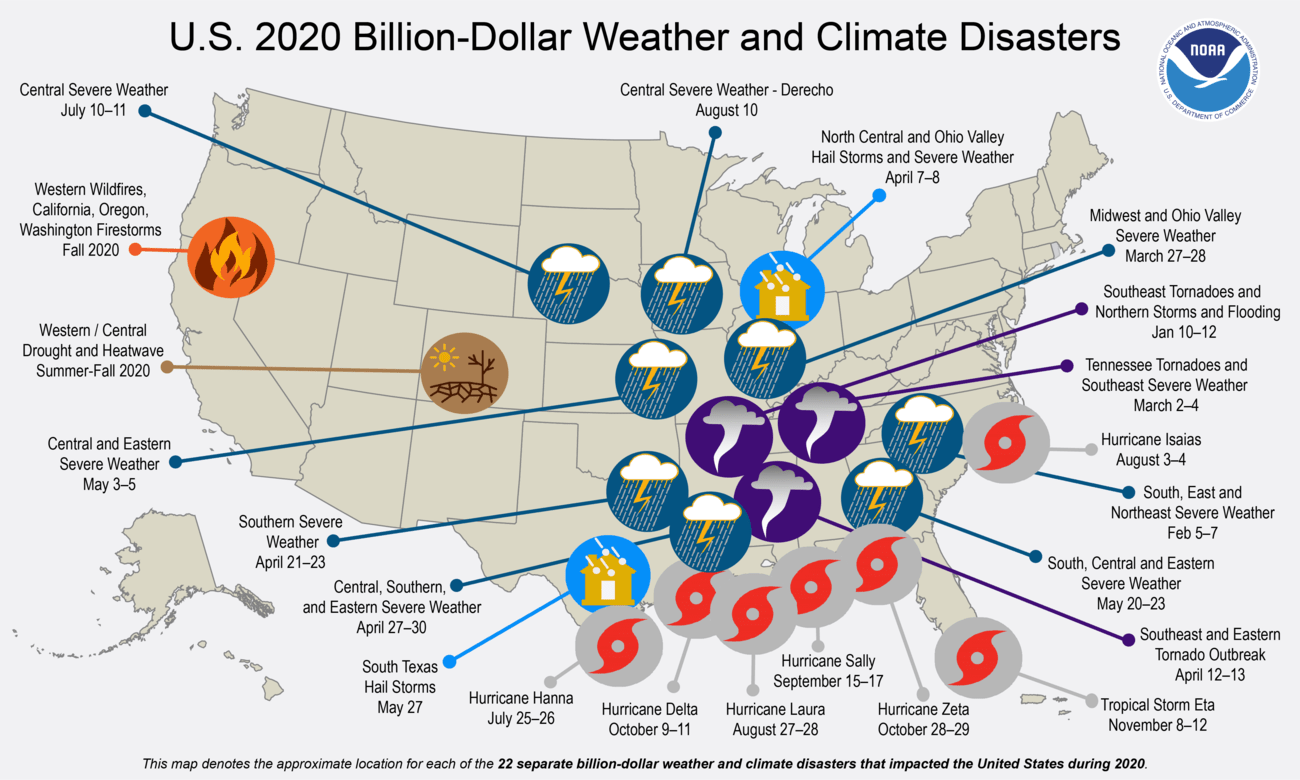
2020: Record billion-dollar weather disasters
The U.S. recorded a record 22 billion-dollar weather disasters in 2020. That smashes the previous record of 16 set in 2011 and 2017.
Heres are some details from NOAA.
In 2020, there were 22 weather and climate disaster events with losses exceeding $1 billion each across the United States — shattering the previous annual record of 16 events that occurred in 2011 and 2017. These events included seven tropical cyclone events, 13 severe storm events, one drought and one wildfire event.
Annual losses in 2020 exceeded $95 billion, the fourth highest cost on record. The most costly events of the year include: Hurricane Laura, the Western wildfires and the Midwest derecho.
Seven of the 12 landfalling tropical systems each produced at least $1 billion in damage, breaking the old record of four separate billion-dollar tropical cyclones in both 2004 and 2005.
The Central states also experienced a historic severe weather event — the August 10 derecho — that produced damage estimated at $11.0 billion. The derecho’s damage to infrastructure and crops is the third severe weather event (since 1980) with CPI-adjusted costs over $10.0 billion, joining the late-April and May 2011 tornado super outbreaks across the Southeastern and Central states.
The total cost of U.S. billion-dollar disasters over the last five years (2016-2020) exceeds a record $600 billion.
2020 also marks the sixth consecutive year (2015-20) in which 10 or more separate billion-dollar disaster events have impacted the U.S.

Record Atlantic hurricane season
2020 shattered records for storms in the Atlantic hurricane season.
Through November 30, and the official end of the North Atlantic hurricane season, several records were tied or broken.
Thirty named storms formed, which breaks the previous record (1950 to present) of 28 set in 2005. The 13 hurricanes and six major hurricanes in 2020 are both the second most on record behind 2005 (15 and 7, respectively).
Twenty-seven of the 30 named storms were the earliest named storm, for their respective number, on record.
Twelve named U.S. storm continental landfalls occurred during 2020. This breaks the previous annual record of nine landfalls set in 1916.
Six hurricanes made U.S. landfall, tying 1886 and 1985 for the most U.S. hurricane landfalls in a single season.
On September 14, five tropical cyclones were active at the same time in the Atlantic. This ties September 1971 for the most storms to be active at once on record.
Category 5 Hurricane Iota formed during November and was the most intense Atlantic hurricane of the season. Iota was also the second-strongest November hurricane on record for the Atlantic and was the strongest Atlantic hurricane on record to occur so late in the calendar year.
This was a record fifth consecutive year with at least one Category 5 storm in the Atlantic.
Five Category 4 and 5 storms formed in the Atlantic during 2020, tying with 1933, 1961, 1999 and 2005 for the record.

Record wildfire season in the West
2020 also was the worst wildfire season on record in the western U.S.
2020 was the most active wildfire year on record (1983 to present) across the West. Nearly 10.3 million acres were consumed during 2020, exceeding the 2000-2010 average by 51 percent. This was the largest acreage consumed in the U.S. since at least 2000.
The three largest wildfires in Colorado history occurred during 2020: The Cameron Peak Fire, the East Troublesome Fire and the Pine Gulch Fire each exceeded the acreage burned by the previous record, the 2002 Hayman Fire.
Approximately four percent of California’s nearly 100 million acres were consumed by wildfires in 2020, which is the largest wildfire season on record for the state. Five of the six largest wildfires in California history also occurred during 2020. The August Complex, SCU Lightning Complex, Creek Fire, LNU Lightning Complex and the North Complex burned nearly 2.5 million acres in all. More than 4.3 million acres were consumed across California during 2020.
With many of these large fires burning simultaneously, heavy smoke and poor air quality impacted many of the western states and Canada over many days during September.
2020 produced extreme weather events previously unseen in many categories.

