
Drought report shows progress; Update on air quality alerts and weekend heat
Dry stretch ahead
Go Deeper.
Create an account or log in to save stories.
Like this?
Thanks for liking this story! We have added it to a list of your favorite stories.


Did recent rains help our drought situation in Minnesota?
The much-anticipated U.S. Drought Monitor report was released Thursday morning:

It shows that 72.67 percent Minnesota is now in drought. That’s down from 79.78 percent of Minnesota in last week’s report.
Most of the Twin Cities metro area is now in moderate drought (shaded beige). One week ago, most of the metro area was in severe drought.
Turn Up Your Support
MPR News helps you turn down the noise and build shared understanding. Turn up your support for this public resource and keep trusted journalism accessible to all.
Our shift to less severe drought categories may be temporary, since rain chances in Minnesota look really minimal over the next five days.
Air quality update
At 5 p.m. Thursday, air quality in parts of northwestern and north-central Minnesota was in the orange (unhealthy for sensitive groups) category. Air quality was mainly in the moderate category elsewhere in Minnesota.
Northwesterly winds are expected to spread Canadian wildfire smoke deeper into Minnesota Thursday evening into Friday.
The Minnesota Pollution Control Agency has posted an air quality alert (shaded orange) that continues until 11 p.m. Friday for much of Minnesota:

Here are details of the updated air quality alert, from MPCA:
Air quality is expected to reach the orange AQI category in northern and central Minn., which is unhealthy for sensitive groups.
The air quality alert for northern and central Minn. continues for Thursday, Aug. 17, and runs until 11 p.m. on Friday, Aug. 18. The alert has been downgraded to Orange for the alert area, and portions of the alert have been cancelled for far southern Minn. and the Arrowhead region. The affected area now includes the Twin Cities metro, Brainerd, Alexandria, Hinckley, St. Cloud, Ortonville, Bemidji, East Grand Forks, Moorhead, International Falls, Hibbing, Ely, Duluth, Roseau, and the tribal nations of Upper Sioux, Mille Lacs, Prairie Island, Leech Lake, Red Lake, and Fond du Lac.
Heavy ground-level smoke from wildfires in the Northwest Territories of Canada reached northwest Minn. on Thurday morning. Strong northwest winds will bring this smoke into central Minn. by Thursday afternoon. Smoke levels are lower than expected and the alert has been downgraded to Orange for the alert area. Winds will become southerly overnight and will prevent the heaviest smoke from reaching southern Minn. The alert has been cancelled for far southern Minn., along with the Arrowhead region. Smoke will linger across the alert area through Friday afternoon. Smoke will continue to disperse as it retreats away from the state. Air quality should improve below alert levels by late Friday.
Fine particle levels are expected to reach the Orange air quality index (AQI) category, a level considered unhealthy for sensitive groups, across northern and central Minn. This area includes the Twin Cities metro, Brainerd, Alexandria, Hinckley, St. Cloud, Ortonville, Bemidji, East Grand Forks, Moorhead, International Falls, Hibbing, Ely, Duluth, Roseau, and the tribal nations of Upper Sioux, Mille Lacs, Prairie Island, Leech Lake, Red Lake, and Fond du Lac. In the orange area, sensitive groups should limit prolonged or heavy exertion and time spent outdoors.
What this alert means
Air moves long distances and carries pollutants. During air quality alerts due to wildfires, the air is mixed with harmful smoke. Wildfire smoke spreads or lingers depending on the size of the fires, the wind, and the weather.
The air quality index (AQI) is color-coded. Air quality alerts are issued when the AQI is forecast to reach an unhealthy level, which includes forecasts in the orange, red, purple, and maroon categories. For a full description of each air quality category, visit airnow.gov.
Orange air quality: Unhealthy for sensitive groups
Sights and smells: In areas where air quality is in the orange AQI category due to wildfires, the sky may look hazy and residents may smell smoke even when wildfires are far away.
Health effects: This air is unhealthy for sensitive groups and pollution may aggravate heart and lung disease as well as cardiovascular and respiratory conditions. Symptoms may include chest pain, shortness of breath, wheezing, coughing, and fatigue.
What to do: People in sensitive groups are encouraged to reduce outdoor physical activities, take more breaks, or do less intense activities to reduce their exposure. People with asthma should follow their asthma action plan and keep their rescue inhaler nearby.
Who’s most at risk
Poor air quality impacts health. Fine particle pollution from wildfire smoke can irritate eyes, nose, and throat, and cause coughing, chest tightness, shortness of breath, dizziness, or fatigue. Smoke particles are small enough that they can be breathed deeply into lungs and enter the bloodstream. This can lead to illnesses such as bronchitis or aggravate existing chronic heart and lung diseases, triggering heart palpitations, asthma attacks, heart attacks, and strokes.
Certain groups experience health effects from unhealthy air quality sooner than others, either because they are more sensitive to fine particle pollution or because they are exposed to larger amounts of it.
Sensitive groups include:
People who have asthma or other breathing conditions like chronic obstructive pulmonary disease (COPD).
People who have heart disease, high blood pressure, or diabetes.
Pregnant people.
Children and older adults.
People with increased exposure include:
People of all ages who do longer or more vigorous physical activity outdoors.
People who work outdoors, especially workers who do heavy manual labor.
People who exercise or play sports outdoors, including children.
People who don’t have air conditioning and need to keep windows open to stay cool.
People in housing not tight enough to keep unhealthy air out, or who do not have permanent shelter.
Anyone experiencing health effects related to poor air quality should contact their health care provider. Those with severe symptoms, chest pain, trouble breathing, or who fear they may be experiencing a heart attack or stroke should call 911 immediately.
You can check hourly current air quality readings at the MPCA site.
The Wisconsin Department of Natural Resources has posted an air quality advisory for all of Wisconsin through this weekend. Air quality in Wisconsin is expected to reach the orange to red category.
Mainly dry this weekend
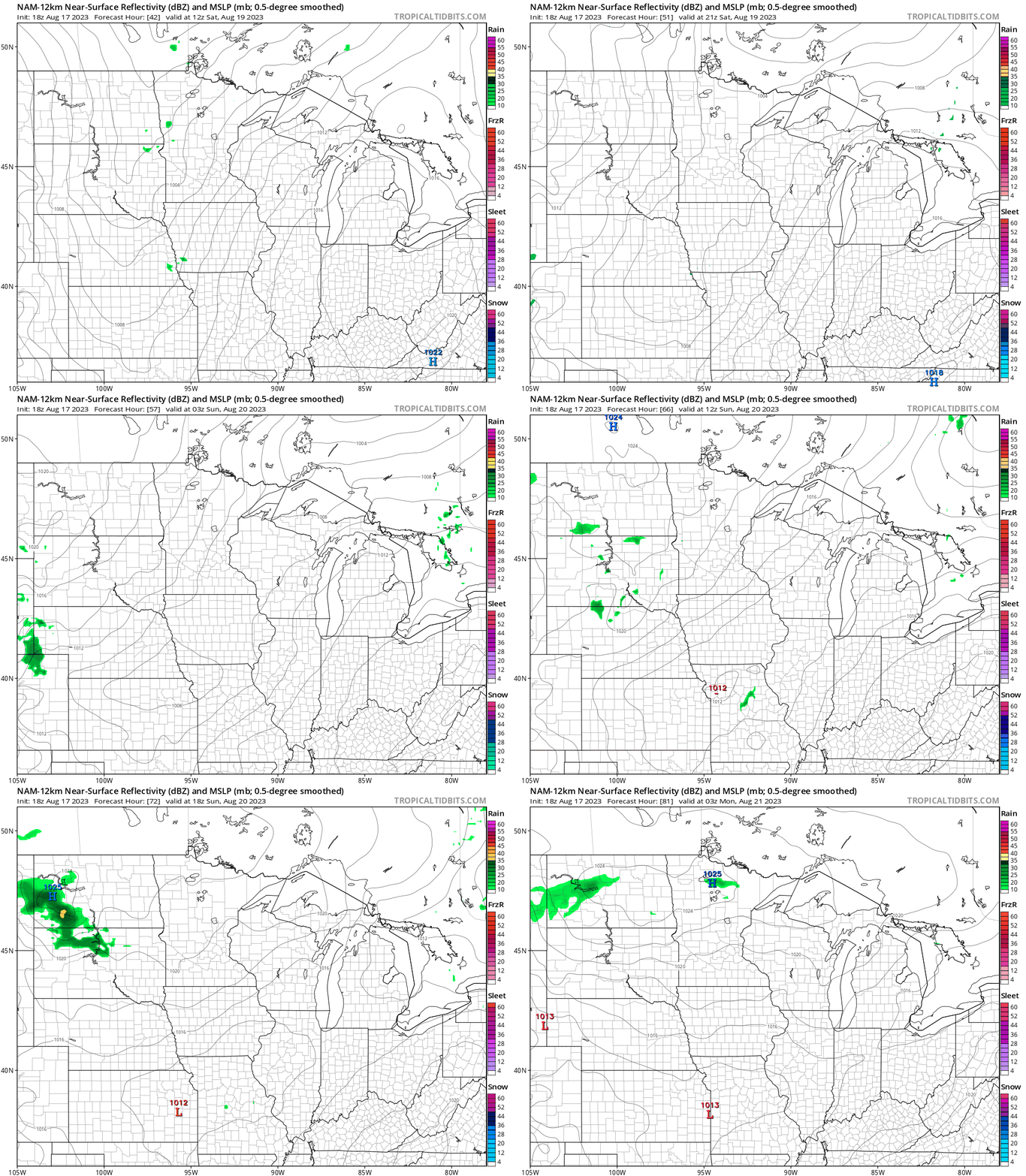
Dry weather is expected across Minnesota and western Wisconsin on Friday. Most of Saturday and Sunday will also be rain-free, with a stray shower possible in northwestern Minnesota late on Sunday.
The National Oceanic and Atmospheric Administration’s North American Mesoscale (NAM) forecast model shows the potential rain pattern from 7 a.m. Saturday to 10 p.m. Sunday:
You can hear updated weather information for Minnesota and western Wisconsin on the MPR News network. Also check out the MPR News display of National Weather Service radar.
Warming up
The Thursday high temperature at Minneapolis-St. Paul International Airport was 76 degrees. That was five degrees cooler than the average Twin Cities high for this date.
Metro area highs will be in the lower 80s on Friday. Most of Minnesota will reach the 80s Friday afternoon, with some 70s in the northeast:

Saturday highs will reach the 90s in most areas, with 80s in north-central and northeastern Minnesota:

Sunday high temperatures will range from 70s in far northern Minnesota to lower 90s in the far south.
Twin Cities metro area highs are projected to be around 90 degrees on Sunday, followed by lower 90s Monday and Tuesday then mid 90s on Wednesday.
Programming note
You can hear my live weather updates on MPR News at 7:35 a.m., 9:35 a.m. and 4:39 p.m. each Saturday and Sunday.

