
Minnesota law professor weighs in on Supreme Court's rejection of gay-marriage challenge
Go Deeper.
Create an account or log in to save stories.
Like this?
Thanks for liking this story! We have added it to a list of your favorite stories.


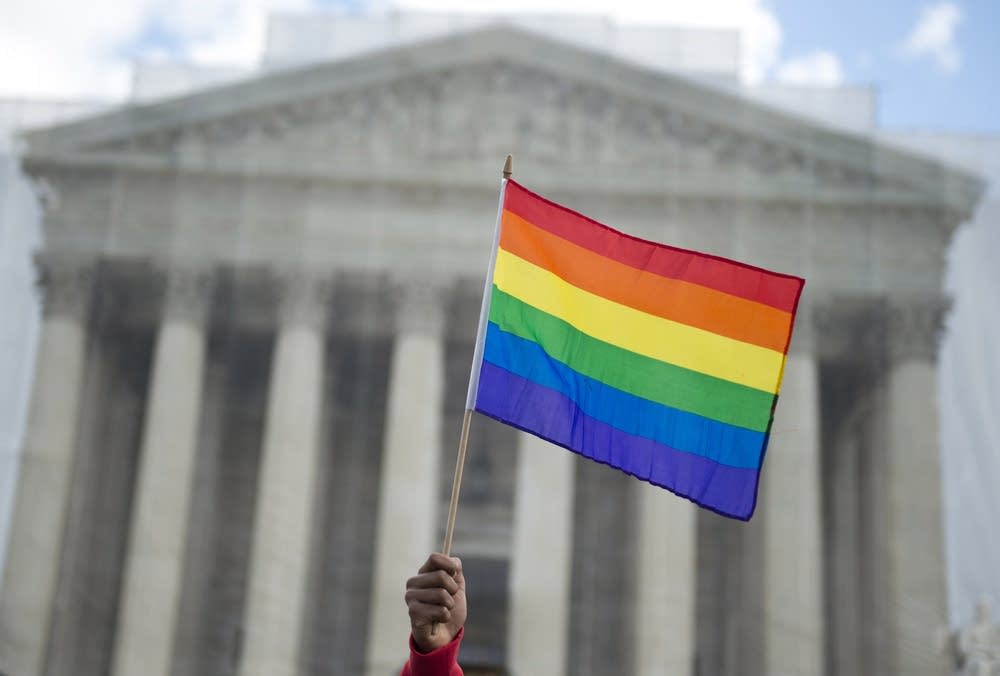
Gay marriage rights are intact across the U.S. today after the Supreme Court declined to revisit its landmark 2015 decision, Obergefell v. Hodges.
The 2015 decision recognized a constitutional right to same-sex marriage. But it was recently challenged by Kim Davis, a former Kentucky clerk who was jailed for refusing to issue marriage licenses.
For more context on all this and what it means for Minnesotans, MPR News host Clay Masters spoke with University of Minnesota law professor Jill Hasday.
Press play above to listen to their conversation, or read a transcript below, edited for clarity.
Turn Up Your Support
MPR News helps you turn down the noise and build shared understanding. Turn up your support for this public resource and keep trusted journalism accessible to all.
The Supreme Court currently has a conservative majority. Were you surprised by its refusal to even reconsider this case?
Yes and no. So, one reason to think the court might take the case is that three dissenters from Obergefell are on the court, and the court, if anything, has moved further to the right.
Another reason is that to bring a legal case, you have to have more than a dislike for the law or an intense loathing of the law. You have to have something called standing, which is just basically a fancy legal way of saying you have to show you have a particularized and concrete injury. And the thing about same-sex marriage is it doesn’t really injure anyone. So how would someone have standing to challenge the legality of same-sex marriage?
Arguably, Kim Davis, this marriage clerk, is one of the few, if only, people in America who might arguably have a standing claim, because she went to jail for her refusal to issue licenses to same-sex couples.
Minnesota legalized same-sex marriage in 2013, two years before the U.S. Supreme Court did. Is it correct that any decision from the nation’s highest court would not impact the legality of same-sex marriage in Minnesota?
Yes, Minnesota’s law does not turn on any U.S. Supreme Court decisions — just on state legislation. That said, if the Supreme Court was to overrule Obergefell, it would have practical impacts for same-sex couples living in Minnesota.
For instance, suppose they go on a trip to a state that no longer recognizes same-sex marriage, would they be recognized as married for federal purposes? Now, they would because there’s a Respect for Marriage Act as a federal statute. But if that statute was repealed, the only thing protecting those couples is Obergefell, the constitutional decision.
Are you anticipating further challenges to Obergefell?
There’s a reason Obergefell is more vulnerable than it was before Dobbs, the 2022 decision that overturned Roe v. Wade. Dobbs’ central argument was that the meaning of the equality protected by the 14th Amendment is frozen in time in 1868, when the men behind the 14th Amendment debated in Congress, and then when the men in the state legislatures ratified it.
Dobbs says, if something wasn’t protected then, it’s not protected now.
Well, same-sex marriage was not protected in 1868. A plaintiff bringing that kind of challenge wouldn’t have succeeded. I’m not saying the court will apply the logic of Dobbs to other cases, but Dobbs certainly sets out a framework for what the court is likely to say if it was going to overrule Obergefell.
When I started doing anti-discrimination work, I thought the main push was for more progress, and that we had had progress in America, but it had been too slow. Over time, I’ve come to realize that actually, it’s at least equally important for reformers is to fight against regression.
Obergefell was obviously a huge victory for the gay rights movement and more generally for the anti-discrimination project. It’s tempting to take past victories for granted, but I think that this case is a good reminder that you can’t. They’re always being continually fought over.
Correction (Nov. 11, 2025): An earlier version of this story included an incorrect hyperlink. The story has been updated.

