The 'Magical City' — An illustrated tour of George Morrison’s New York

Go Deeper.
Create an account or log in to save stories.
Like this?
Thanks for liking this story! We have added it to a list of your favorite stories.


For George Morrison, New York was the “magical city” — worlds away from his beginnings in Chippewa City on the North Shore. The acclaimed Minnesota Ojibwe artist, who died in 2000 in Grand Portage, is widely known for his abstracted horizon paintings and collages of Lake Superior — artworks that have become part of the state’s iconography.
What is less well known is that Morrison studied art in New York as a young man in the 1940s and would live in the city on and off throughout his life. The city shaped Morrison, and he went on to help shape major 20th-century art movements coming out of New York, like Modernism and Abstract Expressionism, alongside peers and friends Jackson Pollock, Willem De Kooning, Franz Klein, Robert Rauschenberg, Louise Nevelson and other giants of modern art. For the first time, the largest art museum in the U.S. is recognizing these contributions with a solo exhibition: The Metropolitan Museum of Art is hosting “The Magical City: George Morrison’s New York” through May 31, 2026, curated by Patricia Marroquin Norby, former associate curator of Native American Art at the Met.
MPR News reporters Alex V. Cipolle and Melissa Olson traveled to see the exhibition, and took a walking tour of Morrison’s New York with his family, his former partner and lifelong friend artist Hazel Belvo, and others in his legacy’s orbit.
“He got his dream. He said many times to me — that was his biggest dream, to go to New York, where the art is, and he made it,” said Briand Morrison, George’s only child.
Turn Up Your Support
MPR News helps you turn down the noise and build shared understanding. Turn up your support for this public resource and keep trusted journalism accessible to all.
Here is an abridged and illustrated guide to Morrison’s New York.
Penn Station

In September 1943, at the age of 23, George Morrison arrived in New York City for the first time at Penn Station.
“I went by train, tourist class. It was a big deal for me, traveling to New York,” Morrison said in his biography, “Turning the Feather Around: My Life in Art.” “When the train arrived in Penn Station, I might have checked my brown hat and suitcase or I might have taken them with me directly to the Art Students League.”
The Art Students League of New York
Morrison came to New York to study at the Art Students League, which was made possible by scholarships from his previous school, the Minneapolis School of Art (now the Minneapolis College of Design), as well as the League itself.

“One of the interesting things about George Morrison is that he did arrive in 1943 which was a really interesting moment in league history. It was the point at which the student body really emptied out,” said league historian and archivist Stephanie Cassidy. Many of Morrison’s peers had been drafted to World War II, but Morrison could not go to war because of a permanent limp caused by tuberculosis of the hip, which he contracted at a government boarding school as a child. Because of the war, Morrison also arrived in the city at a moment when artists were fleeing Europe and coming to New York, shifting the center of the art world.
Morrison found mentors in League teachers George Grosz and Morris Kantor; Kantor’s class, in particular, became a crucial incubator for Abstract Expressionist painters. It was in Kantor’s class that Morrison made a painting of a love triangle called “Three Figures,” which is now on view at The Met.
Artist Bruce Dorfman, the League’s longest-serving teacher, studied at the League in the 1940s, too, just a few years after Morrison.
“He’s an important artist, and I’m glad he's being paid attention to, really very important,” said Dorfman, while teaching in one of the studios where Morrison would have attended class.
Dorfman said the League’s unconventional, open structure encouraged experimentation, which would have influenced Morrison and other future Modernists and Abstract Expressionists who were beginning to leave traditional, representative art styles behind.
“Jumping from Minneapolis to New York and meeting those radical students like me, I felt very free. We were doing what we wanted to do,” Morrison said of joining the League in his biography. “We were always going into galleries and running around town to museums. We’d hop on a subway or a bus and go all over the city for a dime. We could easily take a bus from the League to the Metropolitan Museum of Art.”
P.J. Carney’s Pub

The dark wood and cozy atmosphere of the Irish pub has remained mostly unchanged over the last 100 years, says bar manager Philomena Coyne. It also remains a hub for students and faculty of the Art Students League, which is just around the corner.
“We all sorta’ congregate and have a beverage and relax, because after you paint a long time, you’re totally exhausted,” said Shelly Joy, a current League student whom we ran into at the pub.
In his biography, Morrison said Kantor would take students there.
“When classes were over, we often went around the corner to Carney’s pub. Kantor liked to eat with the students. We could have beer or whatever we wanted,” Morrison said.
“Then we would decide on a place for dinner somewhere in Manhattan. It was always a nice thing,” Morrison added. “One of our favorite places was Chinatown. That was the best Chinese food in America outside of San Francisco.”
Joy Garden

On one of her first trips to New York with Morrison, Hazel Belvo said he took her to the Joy Garden Cantonese restaurant in Chinatown, “where many artists gathered.”
Briand Morrison said, “It was a restaurant where we always went.”
Greenwich Village
As a young man, Morrison lived in many apartments around Greenwich Village, including 15 Leroy Street, one of his first homes in New York.

“It's a small, cute building about five stories high, and to me, it looks like a typical New York apartment,” said Briand Morrison, the only child of George Morrison and Hazel Belvo. Belvo and Morrison would live in other neighborhoods, too, after Briand was born in the 1960s, like an apartment at 445 E. 6th Street in the East Village.
Briand and partner, Roxann, and their kids and grandkids traveled to New York for the exhibition. This is their first time at the apartment, and many spots on the walking tour.
“I’m thrilled to see all the generations here,” Roxann says.

Briand says that Greenwich still felt like “a quaint little village within a city.” But at the same time, he recalls what the city did for his father: “There was a lot of people from all over the world, and he felt that he could be sort of anonymous. He could be himself, because nobody knew who he was.”
A few blocks away from the apartment at 15 Leroy Street is the site of the former Ashby Frame Shop and Gallery at 18 Cornelia Street, where Morrison had one of his first jobs in New York.
“During the school year, I worked at the frame shop run by [former League student] Carl Ashby,” Morrison recalled in his biography.
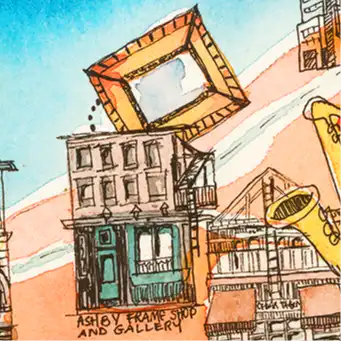
“Carl was tall and lanky, a little older than I, very intelligent and knowledgeable about art, and also very handy with frames. I was handy, too; frame-making came easy to me. I made a fairly decent hourly wage.”
Morrison added, “His shop had one room that served as a gallery where we all showed at one time or another.”
Washington Square Park was one of the main gathering spots in the neighborhood. George and Hazel Belvo even submitted works of art for an art fair in the park.
“You always think of the village as being a quaint place, going to the park in Washington Square, meeting a few characters, buying vegetables and fruits from the carts of Italian vendors on Bleecker Street. Lots of artists and art students lived in the Village. It was a nice place to be,” Morrison said in his biography.

Nearby, the Cedar Tavern was a haunt for Morrison and other art world figures like Jackson Pollock, Willem de Kooning and Franz Kline.
“The bar wasn’t a showy place with artwork on the walls. It was just a common bar. Dark wood and booths. Bland would be a good word for it,” Morrison said in his biography. “Though they were the ‘big boys,’ gestural painters at the height of notoriety, the camaraderie was such that they didn’t walk around and act superior. They were friendly to everyone.”
Morrison recounted how he first met Pollock at the Cedar through his black poodle Kobi, which Morrison took everywhere. “Pollock was attracted to the dog and began to ask questions,” he said.

“I know [Kobi] was a frequent visitor to the Cedar bar, and he would sleep under the table,” Belvo said.
Standing at the former spot of the tavern, which closed in 2006, Briand Morrison recalls this is where his dad would hang out with author Norman Mailer, “one of his best friends.”
Another favorite hangout of Morrison was the Five Spot Cafe, a legendary jazz club on the edge of Greenwich Village. Briand said his father loved jazz, which influenced him, as he is a jazz guitarist. At the Five Spot, Morrison saw horn player Gerry Mulligan and jazz pianist Thelonious Monk.

“In the mix of art and people that contributed to the camaraderie, drinking, and parties at Greenwich Village bars and clubs, there were a number of Jazz musicians who were moving in new directions too,” Morrison said in his biography. Near the Cedar was another one of my favorite places to go, a little jazz joint called the Five Spot. Thelonious Monk was starting to play there. That’s where I heard him, and that’s where I shook his hand one night.”
Standing at the former site of the cafe, Briand recalled a memory of his parents seeing Monk. “Somebody dared [Belvo] to sit on the bench with Thelonious Monk, not just for one song, but all night, and she did it!” Briand said, laughing.
Metropolitan Museum of Art

As an art student, Morrison used to take the bus from the League to the Metropolitan Museum of Art, which currently has the exhibition “The Magical City: George Morrison’s New York” through May 31, 2026.
Hazel Belvo, who is in her 90s, traveled to New York for the exhibition.
“I'm here because I think this is a spectacular thing for George, and all these paintings are my old friends,” Belvo said. “It's very moving, actually, to be here and to see work that I have watched come into being and lived with for many years, and to honor George, a very deserving artist.


Reporter Melissa Olson contributed reporting to this story. Reporter Jacob Aloi provided production support for the audio version.