Ojibwe artist George Morrison’s family relishes his first solo exhibit at The Met

Go Deeper.
Create an account or log in to save stories.
Like this?
Thanks for liking this story! We have added it to a list of your favorite stories.


At sunset on Tuesday in New York, Briand Morrison stood on the steps of the Metropolitan Museum of Art with four generations of his family. They ranged from his mother, the artist Hazel Belvo, to his grandchildren, some of whom had traveled from Sweden.
Behind them, a giant banner hung between the museum’s stone columns: “The Magical City: George Morrison’s New York,” printed over an image of an abstract painting glowing red, caramel and teal.
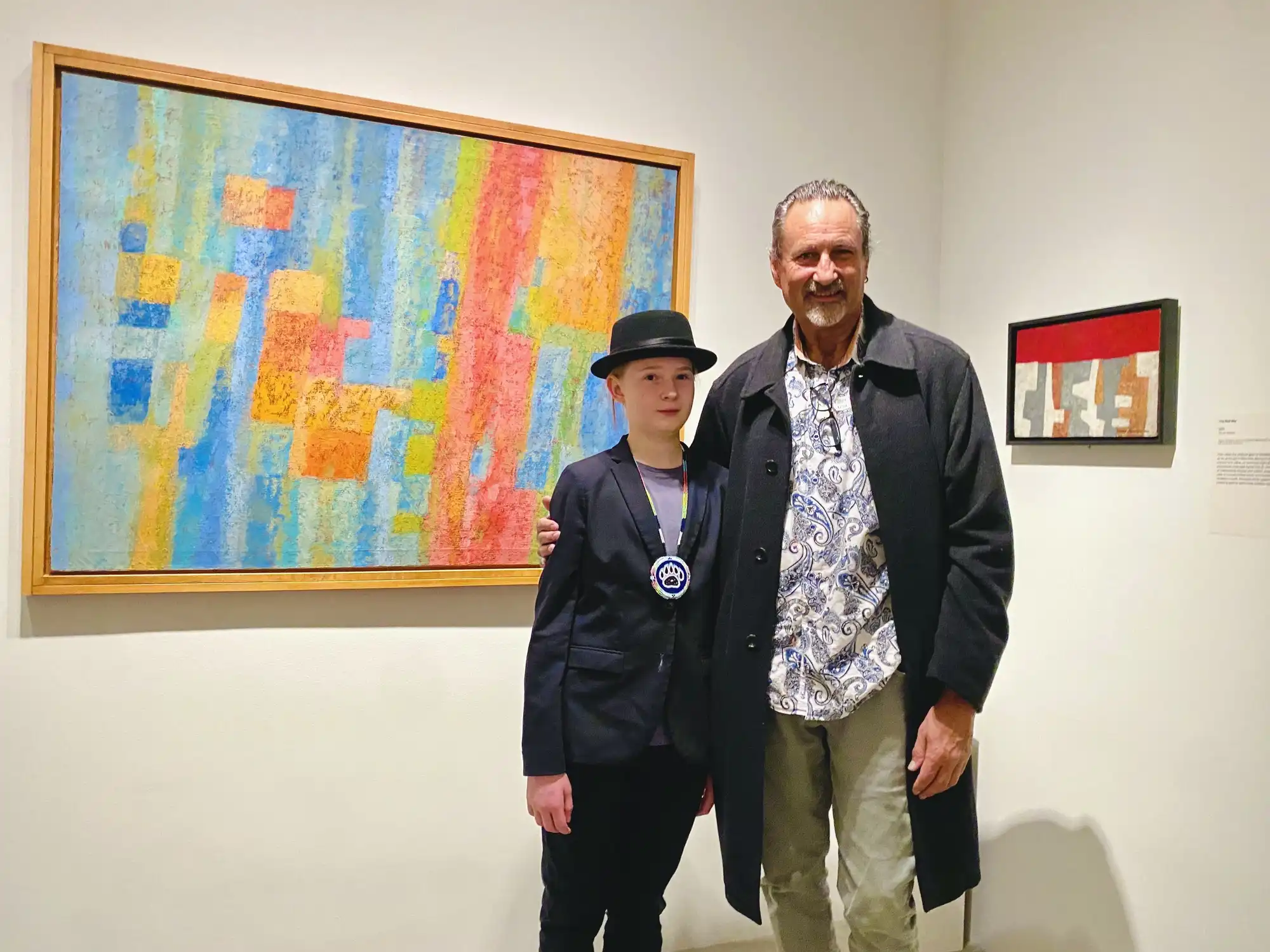
Briand Morrison is the son of George Morrison, the renowned Minnesota Ojibwe artist who died in 2000.
“I think he’d be happy, just so, so happy,” Morrison says. “I think he would have been truly satisfied. It was his dream to come to New York, he told that to me, because this is where the art was.”
Turn Up Your Support
MPR News helps you turn down the noise and build shared understanding. Turn up your support for this public resource and keep trusted journalism accessible to all.
A few dozen of the artist’s friends, family and fans flew in from Minnesota. They were joined by collectors, donors and other art world figures from New York and beyond for a private Oct. 21 reception celebrating George Morrison’s first solo exhibition at the Metropolitan Museum of Art — the most visited museum in the U.S. and one of the world’s most important art institutions.
“It’s the first major exhibition to really probe George Morrison's early years in New York, this formative time period in his production,” says Syvia Yount, who oversees the American Wing at the Met. “To be done by a major New York institution. It feels very significant and very momentous in a lot of ways.”
From the shores of Lake Superior to the heart of modern art
Morrison, who was a member of the Grand Portage Band of Lake Superior Chippewa, was born in 1919 in Chippewa City on the North Shore. He attended the Minneapolis College of Art and Design, which awarded him a scholarship to move in 1943 to study at the Art Students League of New York.
Morrison would live and create art in New York on and off during the following decades. And, 80 years after Morrison first walked the city’s streets with his sketchbooks, New York gathered to celebrate him.
After the Met closed to the public Tuesday night, the gathering moved from the steps into the American Wing, where a reception with live jazz music (a favorite of the artist) filled the soaring glass-roofed hall of the Charles Engelhard Court and guests were free to roam to the nearby gallery housing the Morrison exhibition.

Minnesota guests included Todd Bockley, of the Minneapolis Bockley Gallery that represents the George Morrison Estate; Howard Oransky, director of the Katherine E. Nash Gallery at the University of Minnesota and co-curator of “Dreaming Our Futures: Ojibwe and Očhéthi Šakówiŋ Artists and Knowledge Keepers,” the first exhibition of the George Morrison Center for Indigenous Arts; April McCormick, the secretary treasurer for the Grand Portage Band of Lake Superior Chippewa; and Kate Beane, the director of the Minnesota Museum of American Art, which was the single biggest lender of artwork to the exhibition.
“He inspires a lot of artists, whether you’re Anishinaabe or any other nationality, and he left an incredible mark on contemporary abstract art, and also represents who he is as an Anishinaabe person,” McCormick says.
Celebrating a legacy too long overlooked
Many at the celebration discussed how the exhibition is a long-overdue correction to art history.
While Morrison is acclaimed in the worlds of Native and Minnesota art, and collected in museums across the country, this exhibition places him in a broader context. It presents Morrison — alongside friends and peers like Franz Kline, Jackson Pollock, Willem de Kooning and Louise Nevelson — as an artist who helped shape the Modernist and Abstract Expressionist movements when the art world shifted from Europe to New York during World War II.
Belvo, Morrison’s lifelong friend and former wife (and MCAD professor emeritus), lived with him in New York, and it’s where their son, Briand, was born.
She says the exhibition is significant “because it’s the truth. He was instrumental in the Abstract Expressionist movement and it should be recognized.”

Belvo stands in the gallery looking at the 1948 still life “Whalebone,” a painting built of simplified shapes in reds, blues, yellows and whites. “Aren't those just beautiful, vivid colors,” she says.
Belvo describes Morrison as an honest artist.
“He was not derivative of anyone,” Belvo says. “The artist who produces honest work is not borrowing it from someone else, is not mannered from another place, [they have] a history of their own.”
Many credited curator Patricia Marroquin Norby — the Met’s first full-time associate curator of Native American Art — for organizing the exhibition. Marroquin Norby, who earned her doctorate from the University of Minnesota and serves on the board of the Minnesota Museum of American Art in St. Paul, helped bring together one of the largest collections of George Morrison’s work ever shown.
“I think that when people think of the American Abstract Expressionist movement, they think of Jackson Pollock, they think of Franz Klein, they think of Willem de Kooning. These were George Morrison's contemporaries, and they were looking to George,” Marroquin Norby says. “They had a very high respect for him and his influence on the movement.”
A curator’s perspective from afar
Marroquin Norby was unable to attend the reception but spoke to MPR News by phone from one of her homes in Wisconsin.
“What’s interesting to me is that so many people have said, ‘Why haven’t I heard about this artist?’ And it’s kind of shocking, because I’m from the Midwest,” Marroquin Norby says.
“Morrison is so beloved by Native American art communities, by his own Grand Portage community, by the Ojibwe community in general, and he’s highly celebrated here in the Midwest. One of my goals as a curator coming from the Midwest to New York City was to really highlight so many of the wonderful artists, Native American artists who come from Wisconsin, who come from Minnesota, that often get overlooked in these larger places.”
Yount says it was pivotal that Marroquin Norby led the effort to acquire the Met’s first pieces by Morrison, which led to organizing the exhibition.

“That is probably the most significant outcome of this project, because it’s a permanent addition, right? It's a very important moment for us,” Yount says.
Back in Charles Engelhard Court, Briand Morrison spoke to a crowd wearing ribbon skirts and suits surrounded by marble and bronze sculptures. He shared how he grew up with these paintings — some even hung over his bed as a child — and that he’s so proud they now hang in the Met to share with a larger audience.
“It’s so wonderful to see people loving my dad when they love his work,” he said.
Use the audio player above to listen to the story along with a conversation between MPR News reporter Melissa Olson and host Nina Moini on Minnesota Now.