
Group preserving George Floyd protest murals fights to survive

Go Deeper.
Create an account or log in to save stories.
Like this?
Thanks for liking this story! We have added it to a list of your favorite stories.


After the murder of George Floyd, many Twin Cities artists turned sheets of plywood into canvases for grief, anger and protest. The boards had been put up to protect Twin Cities businesses during the civil unrest.
Leesa Kelly of Minneapolis has spent the last six years preserving this artwork. Her effort has been a success. But her nonprofit, Memorialize the Movement, is fighting to survive and is planning an emergency fundraiser for Saturday, July 25.
Amid the pain and protest following George Floyd’s murder by police in 2020, artists known and unknown picked up brushes and spray cans. They created hundreds of murals on 4x8-foot plywood sheets covering windows and doors along Lake Street, in north Minneapolis and other places in the Twin Cities.
Leesa Kelly immediately realized the works’ historic and social value. She and her friends put up flyers telling collectors and museums “hands off”; Black artists made these paintings, and it’s up to the Black community to preserve them.
Turn Up Your Support
MPR News helps you turn down the noise and build shared understanding. Turn up your support for this public resource and keep trusted journalism accessible to all.
“That’s what these murals represent to me, is community control over the narrative of our own history, but not just our history because it’s still happening over our current lived experience,” said Kelly.

But what next? Kelly rounded up everyone she could find who had a pickup truck. Volunteers spent months collecting the heavy panels and schlepping them to the corner of an old industrial building. The space was grungy and dim, but it was dry.
Many of the murals feature large portraits of Floyd. Some include poems or other text, such as a three-panel work that reads “Until the color of your skin is the target, you will never understand.”
Kelly also knew early on that she needed a professional operation. The 33-year-old started a nonprofit called Memorialize the Movement. Art conservators shared their expertise. They categorized and photographed nearly all of the murals and moved around 1,000 panels to a much larger warehouse space in south Minneapolis.
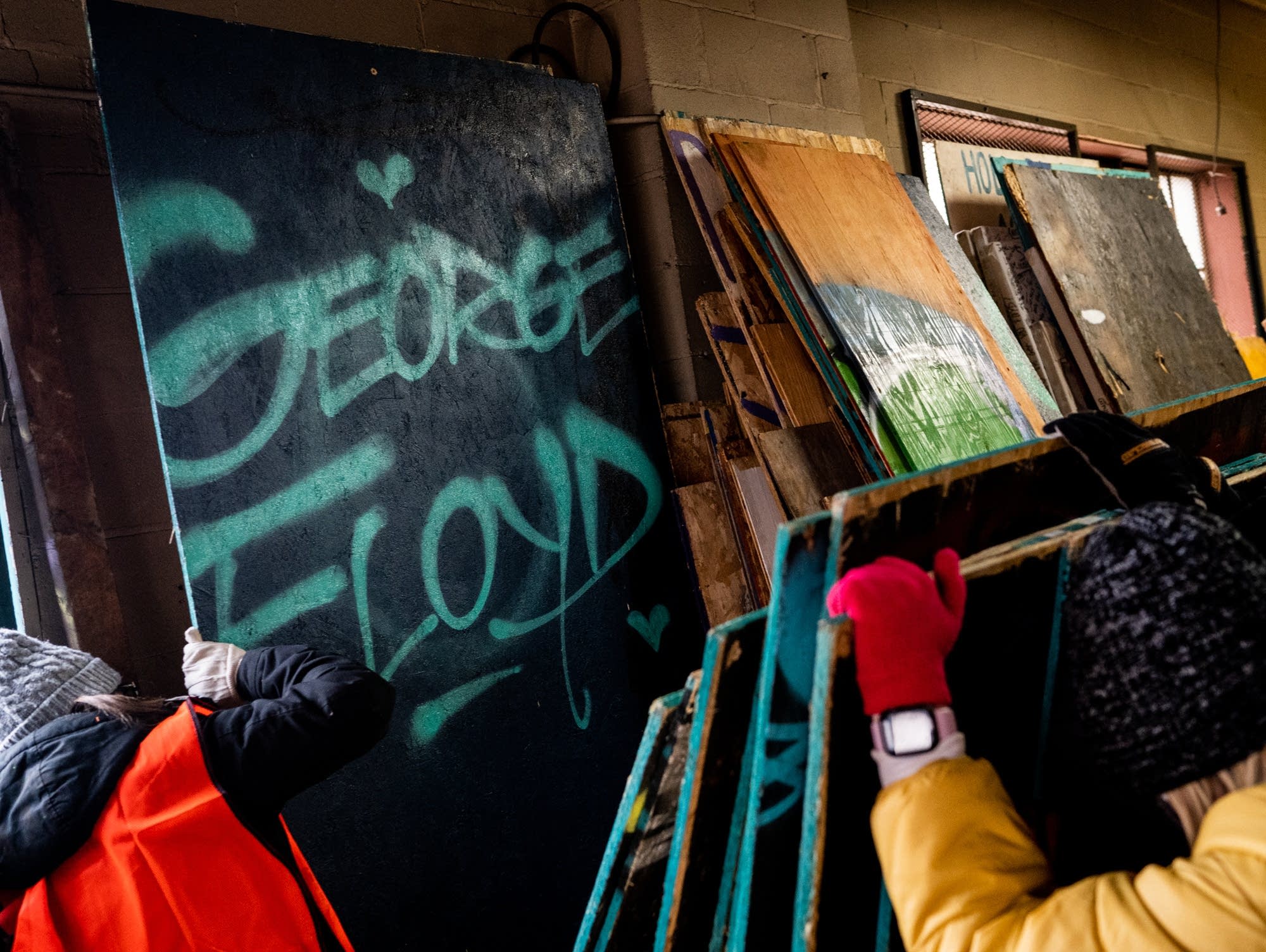
“It’s organized geographically,” said Kelly. “So we have south Minneapolis up front. And then we go over to St. Paul, Northeast, and this is a combination of downtown Whittier and Uptown. And then we’ve got this sort of miscellaneous section where we’re not quite sure where they’re from.”
Memorialize the Movement has an annual budget of less than $200,000, according to its most recent tax filings. Kelly said that the group never received government funding.
In the early years, Kelly said local foundations readily contributed. But now she says the Trump administration’s anti-DEI push may have scared away potential funders.
“Now to see that landscape sort of shift, and orgs like ours struggling to find funding anywhere is just really disheartening,” said Kelly. “It just begs the question of whether or not everything we saw and experienced in 2020 was performative.”

Kelly’s biggest concern now is raising the funds to cover six months of unpaid rent. Even without institutional support, she said she remains hopeful the community will step up.
Memorialize the Movement is holding a barbecue fundraiser Saturday, July 25 at its headquarters near 32nd Street and Snelling Avenue in Minneapolis.

