In Todd County, vaccine skepticism fuels measles surge

Go Deeper.
Create an account or log in to save stories.
Like this?
Thanks for liking this story! We have added it to a list of your favorite stories.


Quick Read
Measles, a highly contagious disease that was once declared eliminated from the U.S., is spreading again in parts of Minnesota.
Minnesota is seeing its highest number of measles cases in 36 years, with 80 cases reported so far in 2026.
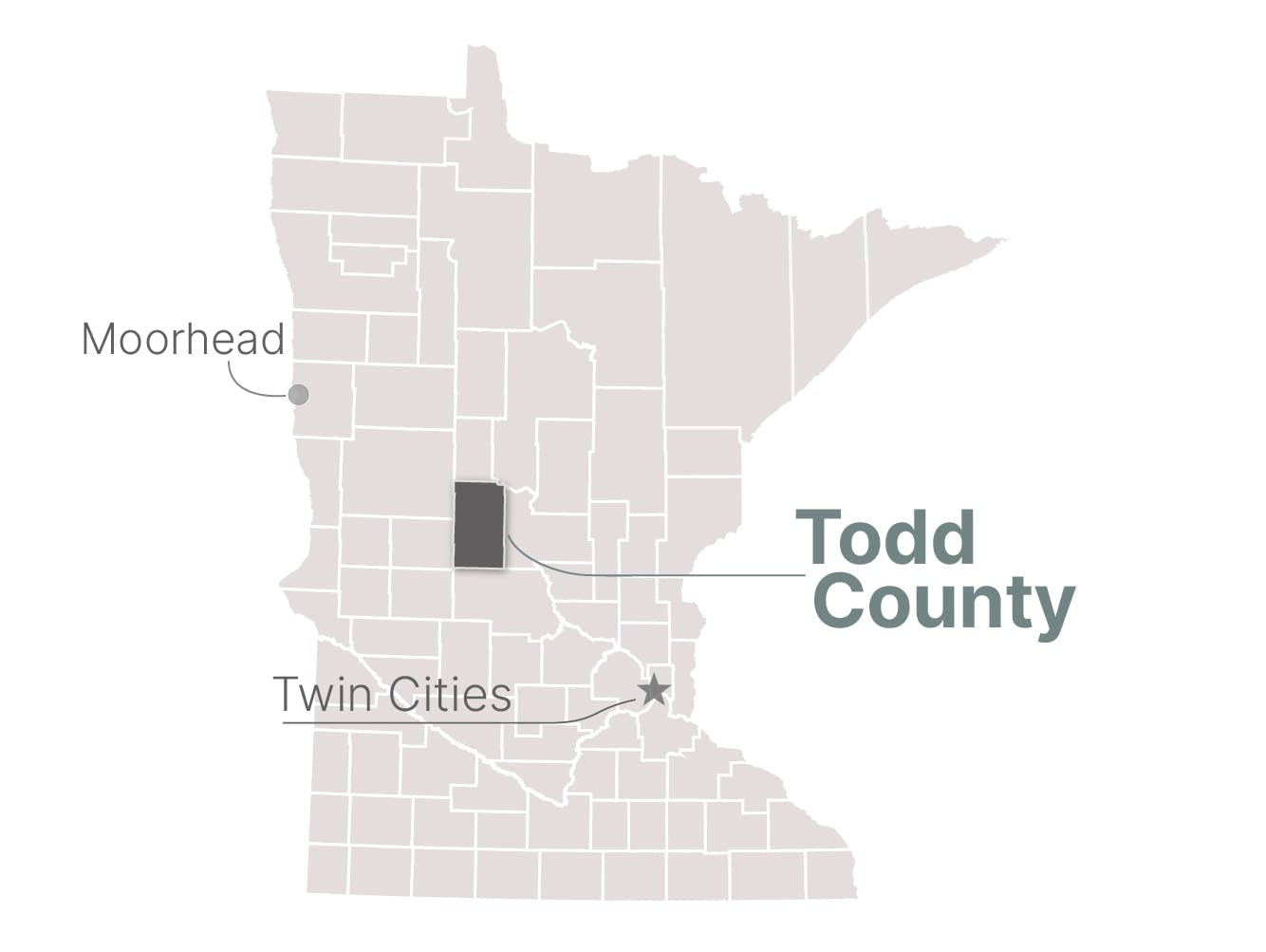
The largest cluster is Todd County, in central Minnesota, where 57 cases have been identified since mid-September. Health officials attribute the outbreak to a lower-than-average vaccination rate that has dropped even more in recent years.
In Bertha, about 50 miles west of Brainerd, parents bringing their kids to a school Halloween party last weekend shed light on why that’s the case.
Turn Up Your Support
MPR News helps you turn down the noise and build shared understanding. Turn up your support for this public resource and keep trusted journalism accessible to all.
Brandy and Dustin Elgin vaccinated their oldest child when he was a baby. But they said their second child broke out in hives after his shots.
"They couldn't really give us an answer on why he was so sick,” Brandy Elgin said. “After that, we kind of just stopped, and he's been fine since then."
The recent measles cases haven’t changed their minds, they said.
"After the whole COVID fiasco — and that was all just a bunch of baloney — it's hard to trust anything they say,” Dustin Elgin added.
Tim Zastrow, of nearby Browerville, said he’s not worried about his kids, ages 6 and 5, getting measles because they’re vaccinated. But he said he knows parents who question vaccine safety.
"They think something’s in there. You know how today’s world is,” Zastrow said. “But the measles vaccine's been around forever, and I'd just as soon have my kids be safe than sorry."
Todd County trails state average in vaccination rates
Distrust of government, fears over vaccine safety and limited experience with a disease that was virtually nonexistent 20 years ago are causing more parents to decline once-routine vaccinations for their children, officials say.
"We are not surprised that measles has come to Todd County,” said Katherine Mackedanz, the county’s community health manager. "Since COVID, we've seen a ton of anti-vaccine sentiment, a lot of hesitation in families."
Just 61 percent of Todd County children born in 2023 have received at least one dose of the measles, mumps and rubella vaccine, compared with 81 percent statewide. Public health officials generally recommend vaccination rates of at least 95 percent to prevent measles outbreaks.
“What people need to understand is how contagious this virus is,” Mackedanz said. “It becomes something that seems difficult to stop at a time when you have low vaccination rates.”

The MMR vaccine has been used in the U.S. since 1971. Two doses are about 97 percent effective against measles.
Most people don’t experience any side effects from the vaccine, but temporary soreness, fever or a mild rash can occur. Serious reactions are rare.
Still, Mackedenz said Todd County has seen an increase in parents requesting their children be exempt from school vaccination requirements due to their beliefs.
Nearly 15 percent of current kindergartners in the Long Prairie-Grey Eagle school district in Todd County have nonmedical exemptions for the MMR vaccine, according to the Minnesota Department of Health.
Some public health leaders worry the Trump administration’s policies have helped fuel anti-vaccine sentiments and a recent national measles surge.
In August, President Donald Trump signed an executive order calling for a revamping of childhood vaccine recommendations including breaking up the measles, mumps and rubella vaccine into individual doses given at separate doctor visits.
Administration officials including Health and Human Services Secretary Robert F. Kennedy Jr. also have promoted debunked claims linking vaccines to autism.
The measles virus spreads through the air when an infected person breathes, talks, coughs or sneezes. It can remain suspended in the air for up to two hours. An infected person can spread the virus for several days before symptoms start.
Most Americans younger than 50 have never been exposed to measles, so they don't have any natural immunity, Mackedanz said. And because it’s unfamiliar, they may not view it as a serious threat, she said.
"People don't realize the impact infectious disease can have on our communities,” Mackedanz said, particularly for young children, pregnant women and those with weakened immune systems.
Role of immigrant, religious communities
Todd County’s rolling farmland is home to a sizable Amish population. Their beliefs call for members to live together in tight-knit communities and reject many modern technologies.
While their religion doesn’t strictly ban vaccines, some Amish families decline routine childhood vaccinations, possibly due to fears of side effects, a preference for natural remedies or skepticism toward government mandates.

But health officials caution against attributing the county’s low vaccination rates to any one group. They have not confirmed whether Amish communities are affected by the outbreak.
Officials also warn against blaming Latino and Haitian residents, who contribute to the increasingly diverse population of Long Prairie.
Elizabeth Quillo is co-founder of WAVE Saludos Welcome Center, which helps newcomers access services. She said some immigrants have difficulty obtaining vaccination records from their home countries, but most are receptive to getting needed shots.
“People have a really high trust in medical professions, and for the most part, they’re willing to do what the doctors recommend,” Quillo said.

But distrust of government is common in Todd County’s wider population, Mackedanz said. She also thinks misinformation on social media is contributing to vaccine hesitancy.
“Unfortunately, healthcare providers aren't always that first place to get information about vaccines or public health,” she said.
‘This was never supposed to happen’
At CentraCare’s health clinic in Long Prairie, Dr. Junita Jose is working to answer parents’ questions about vaccines while brushing up on her knowledge of a disease she didn’t expect to encounter.
"This was never supposed to happen,” Jose said. “I think it comes from a place of great privilege that we were able to have that much protection. Now, we're unfortunately making choices that are taking us back in time.”
Jose and her colleagues are taking precautions to prevent the virus from spreading and protect other patients who are at risk. They clear space in the clinic when a patient who may have measles arrives.

Jose watches for symptoms, including fever, cough, red or watery eyes, runny nose and a telltale rash that starts at the hairline and spreads down the body.
She also counters misinformation, including false claims that the MMR vaccine contains mercury or causes autism. And some people underestimate the disease, thinking it’s little more than a childhood cold or flu, Jose said.
While that might be true for most people, she said, measles can cause serious complications – especially those who aren’t vaccinated, either by choice or because they can’t get the vaccine due to their age, pregnancy or a compromised immune system.
About 1 in 5 unvaccinated people who get measles requires hospitalization, according to the U.S. Centers for Disease Control and Prevention. As many as 1 in 20 children with measles will get pneumonia, the most common cause of death from measles in young children.
"Those families end up having to pay the price,” Jose said. “And not just those families, the communities that they live in.”
As a parent, she’s navigating the risks. Her youngest child is just 8 months old — too young for the first routine measles vaccine, which is usually given at 12 to 15 months. Jose plans to get him an early dose of the measles vaccine, which can be recommended for infants 6 to 11 months during an outbreak.
For now, she's keeping him out of daycare to limit his exposure, as health officials expect the virus to continue circulating in Todd County for weeks or months.
"I haven't seen the worst case scenario of measles, but I don't want to see it,” Jose said. “I've read a lot about it. I have seen pictures. But in real life, I'm not looking forward to seeing it.”