
Is a cross just a cross?
Go Deeper.
Create an account or log in to save stories.
Like this?
Thanks for liking this story! We have added it to a list of your favorite stories.


By the end of the day -- maybe -- we'll know whether the Supreme Court wants to answer the question, "is this a violation of the separation of church and state?"
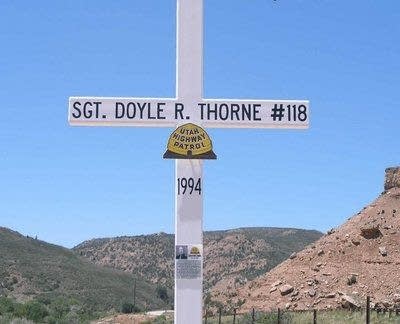
These are white crosses erected by a private group -- an association of state troopers from the Utah Highway Patrol -- on public land, the side of highways where officers were killed.
Of course, we see generic white crosses often where someone has died, as Nikki Tundel pointed out in her photo essay of makeshift memorials last year. If they're placed by the side of the road -- public land -- by private individuals, does that convey a government endorsement of a religion? The Supreme Court could settle that question once and for all.
Turn Up Your Support
MPR News helps you turn down the noise and build shared understanding. Turn up your support for this public resource and keep trusted journalism accessible to all.
The court is holding a hearing today to decide whether to accept an appeal of a 10th Circuit Court of Appeals decision that, at least in the Utah case, ruled the practice unconstitutional.
If the Supreme Court agrees to hear the case, it could overturn the test -- the "reasonable observer test," as it's known -- used to decide these things: does a symbol that is widely recognized as a religious symbol promote that religion.
Would a "reasonable observer" see it as promoting, in this case, Christianity? Or simply a spot where someone probably died?
In its request for the Supreme Court to take up the case, the Utah Highway Patrol Association says the cross is meant only to communicate, "the simultaneous messages of death, honor, remembrance, gratitude, sacrifice, and safety."
But in ruling the crosses do convey government endorsement of religion, the 10th Circuit Court of Appeals said a cross "is not a generic symbol of death; it is a Christian symbol of death that signifies or memorializes the death of a Christian.

