
Lawmaker says banning guns at Minnesota Capitol is a non-starter

Go Deeper.
Create an account or log in to save stories.
Like this?
Thanks for liking this story! We have added it to a list of your favorite stories.


Safety at the Minnesota State Capitol complex continues to be top of mind in the wake of recent political violence.
The Advisory Committee on Capitol Area Security met on Monday for the second time since the deadly attacks on Minnesota lawmakers in June — and the first since the assassination of conservative activist Charlie Kirk earlier this month.
An outside firm is due to complete a report examining security on Capitol grounds by the end of the year. Among the ideas the committee is weighing are limiting guns — even those legally permitted — and installing metal detectors.
One of the panel’s members, Republican Rep. Jim Nash of Waconia, joined MPR News host Cathy Wurzer on Morning Edition Tuesday with an update on safety improvement negotiations.
Turn Up Your Support
MPR News helps you turn down the noise and build shared understanding. Turn up your support for this public resource and keep trusted journalism accessible to all.
The following transcript has been lightly edited for clarity. Listen to the full conversation by clicking the above player button.
How safe do you feel at the Capitol right now?
I feel safe.
How so, given everything that’s happened?
We have a great security team there. The State Patrol does a really nice job. Even though I don’t have to, I have the opportunity to carry at the Capitol, so that’s one of the things that I rely on to also make me feel safe.
As the committee heard, 33 state capitols have metal screenings or detectors. A KSTP/SurveyUSA poll shows 79 percent of Minnesotans think they should be installed. What do you make of that?
As somebody who’s done polling and has looked at how to do statistical analysis, I’d like to take a look at that sample set. But I think right now, we are going to be receiving at the end of the year an assessment of our Capitol. Every Capitol is different, and I want to make sure that ours is treated as a standalone in many regards. You’ve commented on it before, just what a magnificent building Cass Gilbert created, and from my assessment of the building, it was created for access. And I don't ever want to make it so that it's inaccessible for the people of the state of Minnesota to come and meet with their lawmakers and have easy access. Based on what we’ll get from The Axtell Group, and based on deliberations, and based on what can be voted into law, we’ll have that conversation once we’ve received all that information.
What do you think about the larger support from your colleagues in the Legislature for having metal detectors installed?
We’re effectively in a tied Legislature, so I don’t know that it’s the majority of my colleagues. We don’t know where that is, and we won’t know where that is until we see the vote board or we look at things in committee.
You and I know each other pretty well, and you know that I'm kind of a stark realist. I won’t weigh in on something until we know where things are. And this is not a conversation that we’ve had as a full body of legislators, and that’s the wisest thing to do: Make sure that we have everybody in the room. Make sure we have everybody sharing their perspectives. And once we have that, then we can move forward with whatever the solution is going to be.
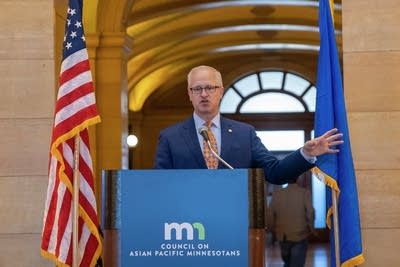
You are legally permitted to carry a gun. A lot of lawmakers are. And do you think that’s a non-starter to ban guns from the Capitol?
I do. I absolutely do.
However, there are some states with policies prohibiting firearms and that have lockers for individuals to store their guns. Would that not be a workable solution, perhaps?
And that’s a question that I asked on Monday in the committee. There are some Capitols that do have those. And it’s going to come down to, how does that work, and what does it cost? Because, as you know, these things are not free. You go to a building that has metal detectors — those have both a capital cost and an operational cost. So you’ve got people who are running the machines. You have the machines. If you have a locker, you have to buy the lockers, but you also have to have somebody who’s securing and watching the lockers. When we’re looking at a potential — well, a realistic structural deficit, the question becomes, where does that money come from?
Next steps — is there another meeting scheduled?
Yeah, there will be other meetings that we have. What you need to know is that everybody on that advisory committee is committed to securing our Capitol. I have been on it for 11 years, and my perspective is we need to provide the security and the safety for people who work there, are elected to serve there and come and visit there. And there are a lot of recommendations that have been made over the years that have not been implemented because the funding gets spent in other places. We’ve got a long laundry list of recommendations that have been in existence for a long, long time, and I hope that we look at those as well before we rush to implement some of these other issues. We’ve got a playbook, and the playbook has not been followed.

