More than half a century later, Edmund Fitzgerald’s final moments remain a mystery

Go Deeper.
Create an account or log in to save stories.
Like this?
Thanks for liking this story! We have added it to a list of your favorite stories.


It’s been 51 years since the Edmund Fitzgerald went down in the cold, murky waters of Lake Superior during an intense November storm — known as a November gale — on the evening of Nov. 10, 1975, taking with it the lives of all 29 crewmembers aboard.
A modern tragedy that’s still steeped in mystery, it has inspired a chart-topping ballad by Canadian singer-songwriter Gordon Lightfoot, countless books and essays, and even a Seinfeld reference. But for all the pop culture knowledge that surrounds the sinking of the largest ship ever lost on the Great Lakes, very little is known about the actual conditions during the final moments before its disappearance.
On the day after the disaster, MPR’s Claudia Hampston spoke with Erling Hansen, a former ship engineer who had experienced fierce storms on Lake Superior.
“The northwest storm, in that 75-mile wind sweeping down from the northwest, in that spot she was in, there’s nothing there that can help you. Not a thing, not a thing,” Hansen said. “And no doubt, we figured that he was trying to get behind Whitefish Point, get into Whitefish Bay.”
Turn Up Your Support
MPR News helps you turn down the noise and build shared understanding. Turn up your support for this public resource and keep trusted journalism accessible to all.
It was just 17 miles from Whitefish Point, Mich. — about 35 miles northwest of Sault Ste. Marie — where the Edmund Fitzgerald met its demise.

A U.S. Coast Guard Marine Board investigation concluded “that the most probable cause of the sinking was the loss of buoyancy resulting from massive flooding of the cargo hold.”
In his 2025 New York Times bestseller “The Gales of November: The Untold Story of the Edmund Fitzgerald,” author John U. Bacon describes how the lack of detailed weather information combined with poor communications likely contributed to the loss of the cargo vessel and its crew.

“With the limited forecasting and communication systems available to Great Lakes crews in 1975, the men aboard the Fitzgerald were privy to only a few pieces of the picture, and had little sense that two storm systems were about to collide overhead,” Bacon wrote.
Bacon, who spoke last year on the 50th anniversary of the incident with MPR News reporter Dan Kraker, said there are some clues in the radio transmission between Edmund Fitzgerald’s captain, Ernest McSorley, and Bernie Cooper, captain of the Arthur M. Anderson, another freighter that was trailing the Edmund Fitzgerald that fateful evening.
“So he calls Bernie Cooper. He’s got a fence railing down. He’s complaining to Cooper about all these things. And he mentions, kind of in passing, he’s got a starboard list. That means the ship is tilting constantly to the right side. And that’s a problem for a few reasons. It’s harder to steer that way. You're far more vulnerable to a big wave taking you down or cracking you at that point.”
It was the final exchange between the two veteran Great Lakes captains, however, that was perhaps the most chilling.
“At 7:00, he’s got real problems. He’s just trying to get to Whitefish Bay. And Cooper asks him, how are you making out with your problems? And Ernest McSorley says, and I quote, ‘We are holding our own.’ And those are the last words anybody knows from the Edmund Fitzgerald.”
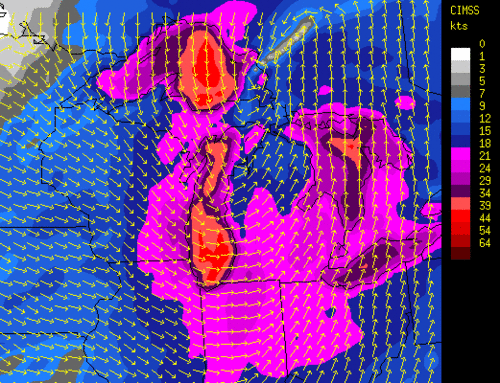
In 2006, meteorologists from the National Weather Service forecast offices in Marquette, Mich., and Cleveland, Ohio, along with an oceanographer from the NOAA Great Lakes Environmental Research Laboratory in Ann Arbor, Mich., published a paper in the Bulletin of the American Meteorological Society that reexamined the storm using modern technology. Among their conclusions were that a variety of factors that likely led to the sinking of the Edmund Fitzgerald, as well as the fact that storms of this size and strength continue to pose threats to ships on Lake Superior:
Rapidly worsening storm: On the afternoon of Nov. 10, 1975, weather conditions on Lake Superior deteriorated quickly as the Edmund Fitzgerald traveled south toward Whitefish Bay.
Extreme winds and waves: By evening, sustained winds reached 50 knots across southeast Lake Superior — with localized winds of more 60 knots. These winds created waves more than 7.5 meters high that hit nearly perpendicular to the ship’s path.
Tragic timing and location: The ship sank with its entire crew during the peak of the storm. Traveling the same route just six hours earlier or later would have allowed the ship to miss the worst weather.
Recurring Great Lakes hazards: Storms of this strength hit eastern Lake Superior every two to six years on average. Modern ships, including massive 300-meter freighters, still face these dangers today.
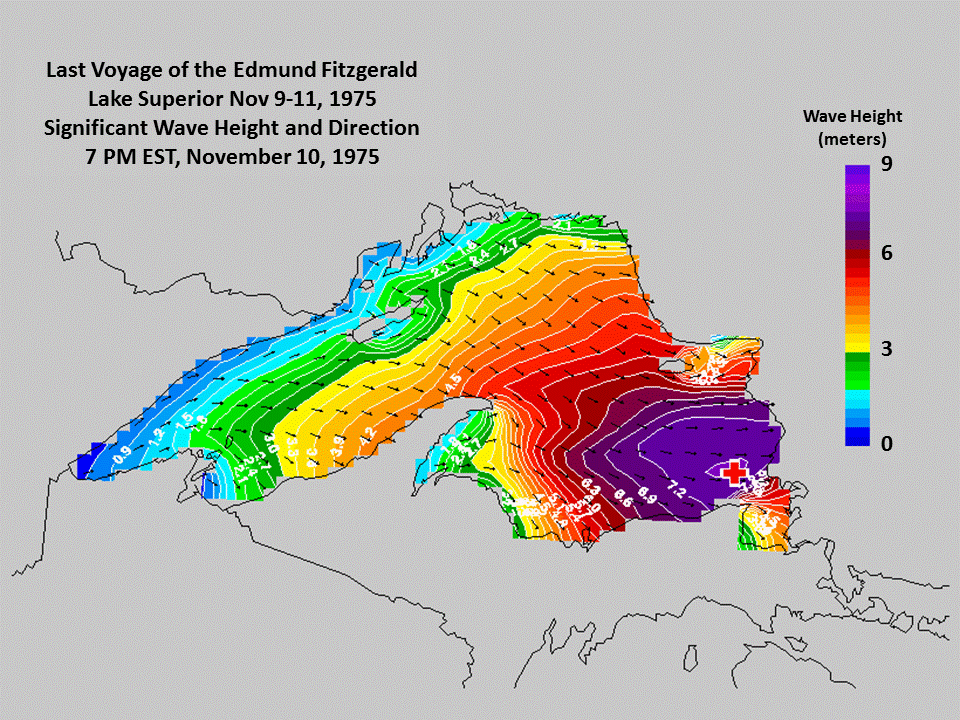
The authors noted that improved observation and forecast systems over the past 30 years now give ships earlier storm warnings, providing modern-day captains the ability to avoid severe weather instead of trying to survive it.
In the end, as Bacon told MPR’s Kraker, the exact cause of the tragedy will likely remain a mystery.
“Honestly, Dan, when you boil it all down, I go back to Ruth Hudson. She’s the mother of Bruce Hudson, one of the 22-year-old deckhands on the ship. That was her only child, also. It’s heartbreaking. She said, ultimately, only 30 know, 29 men and God, and nobody’s talking.”