
Grooming and child abuse: 6 questions, answered

Go Deeper.
Create an account or log in to save stories.
Like this?
Thanks for liking this story! We have added it to a list of your favorite stories.


Lawmakers in the Minnesota House voted unanimously on Monday to pass a bill designed to prevent grooming, the process where an adult deliberately gains the trust of a child with the intention of sexually abusing them.
The legislation would make grooming a felony and allow the state Education Department to investigate allegations older than three years. It also calls for more training for teachers and others around children. There’s a companion bill in the Senate.
While experts applaud the bills, they say more systemic changes are needed to prevent grooming and child abuse in schools, daycares, summer camps, sports organizations and other institutions.
As lawmakers finish their work, here are some answers to questions often asked about grooming and how to stop it.
Turn Up Your Support
MPR News helps you turn down the noise and build shared understanding. Turn up your support for this public resource and keep trusted journalism accessible to all.
1) What is grooming?
Experts say it’s important to think of grooming as a pattern and process, not a singular event.
“It is a deliberate and intentional pattern of abuse to really exploit that trust,” said Monica Rivera, vice president of education and research at SafeSport, a nonprofit created in the wake of sexual misconduct at USA Gymnastics.
“I think about, like, a VIP pass. For many of the adults in our kids’ lives, we give them a backstage pass to our kids because we trust them. And grooming is when somebody intentionally works very hard to get that backstage pass as a way to then be able to fly under the radar and cause harm,” Rivera told MPR News host Angela Davis.
“It’s a process (that) starts off with seemingly innocent boundary violations” that can build to abuse, she added.
“It often includes special attention, isolated one-on-one time, private communication, bending small rules in ways that seem harmless, giving preteens and teenagers a space to talk about things that are taboo, like sex and relationships. But it’s actually creating an environment where those boundaries are blurred.”
Rivera’s group offers a guide to help parents recognize grooming.
2) How can grooming be identified?
It’s not easy, and that’s a big part of the problem. Numerous studies show how difficult it is to identify grooming while it’s happening.
Rivera points to a list curated by her organization that identifies patterns of manipulation. Among them:
Engaging parents and children to build trust by offering special treatment
Isolating a child by setting up ways to be alone with them
Boundary testing by blurring the lines between appropriate and inappropriate behavior
Sexualizing interactions by introducing sexual topics and actions
But the process often happens slowly with no “ah-ha” moment when adults know they must take action to protect a child.
“We're just not good at predicting that. We think we are, but we're just not,” said Dr. Mark Hudson, a child abuse pediatrician and medical director of the Midwest Children’s Resource Center at Children’s Minnesota.
“We can identify in hindsight, but we're not very good at identifying it going forward.”
3) How does grooming affect its targets?
The pain created by grooming and abuse is long-lasting, Rivera said.
“It impacts our ability to trust our gut, knowing who to trust and when not, when to let your guard down. It impacts our nervous system,” Rivera said. “Even when I know I'm in a safe relationship, my nervous system might be telling me otherwise. And so yeah, there's absolutely life long material impacts for survivors.”
Hannah LoPresto, a former student at Eagan High School, one of the key voices pushing for the new legislation, spoke of her own experience with a band teacher who, according to a police investigative report, had a “pattern of predatory grooming behaviors” with numerous students going back a decade in two school districts.
“It was half a decade of psychological manipulation that harmed my understanding of healthy relationships, my own value and my ability to trust others,” she told lawmakers in a recent hearing. “Grooming is not just a precursor to abuse, it is abuse all on its own.”
In interviews with MPR News, LoPresto described the experience of grooming as feeling confused, isolated and drawn into a different reality.
“As a teenage girl, I wanted to be loved. I wanted to be told I was pretty and smart and could have this, like, magical fairy tale future with somebody,” she said. “So he crafted that for me and made me believe that that was real and that that was the only future that was going to exist for me.”
4) What can parents do to talk to their kids about safety?
Communication with kids is vital, Hudson said.
“That communication need not necessarily be about sexual abuse, may not necessarily be about grooming” he added. “But we know that kids who have caring adults in their lives just do better overall.”
He also recommends making sure children understand “how they should be interacting with adults” and recognizing behaviors that might make them uncomfortable, such as being alone with an adult.
It's a hard conversation again, because this is a relatively nebulous thing that we're talking about, and there's not necessarily perfect words, in my opinion, but making sure that we're having those conversations.”
For Rivera, talking to kids is about being present in “micro moments.”
“On the ride home from practice, it's asking questions around, you know, ‘So, how was your experience with your coach?’ Or, ‘Hey, I noticed that the coach was giving this kid a ride home. Does that happen often?’ So you're, you almost become kind of a detective, but without interrogating kids.”
5) What can be done to prevent grooming?
Rivera and Hudson say preventing abuse is less about individual education and more about designing safe boundaries around adults and children.
That includes creating “environments around children where one-to-one contact is very rare, it's observable and interruptible when it does happen,” Rivera said.
“Whether we're the auntie or the coaches, it's less about, ‘Would I harm a kid? Would this other person harm a kid?’ It's more that the environment we're creating around us makes it almost impossible for (inappropriate) access (to children),” she added.
Hudson believes the key to prevention is making sure environments like schools are safe.
“One of the things that is just so simple is that one-to-one contact, making sure that we're doing that in ways that are observable, interruptible. “Maybe it's a little bit more inconvenient, but when we get to sort of changing the norm, we can do it.”
6) Where can I learn more about this topic or report abuse?
A 24-hour statewide sexual violence and domestic violence hotline is available in Minnesota. You can call Minnesota Day One at (866) 223-1111 or text (612) 399-9995.
You can also contact the Midwest Children’s Resource Center at 651-220-6750. Emergency phone consultation is available 24 hours a day, seven days a week for concerned patients, parents, child protection and law enforcement agencies, physicians, therapists and attorneys.
SafeSport, Rivera’s group, posts information on how to identify, prevent and respond to grooming behaviors.
To report abuse in Minnesota, contact your county’s child protection agency.
Guests:
Dr. Mark Hudson is a child abuse pediatrician and medical director of the Midwest Children’s Resource Center at Children’s Minnesota, Minnesota’s largest pediatric hospital.
Monica Rivera is the vice president of education and research at the U.S. Center for SafeSport, a nonprofit created in the wake of sexual misconduct at USA Gymnastics.
Elizabeth Shockman is an MPR News reporter who covers K-12 education.
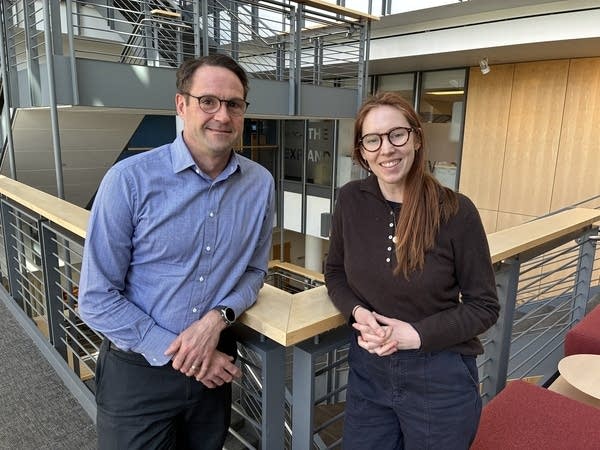 Dr. Mark Hudson (left), a child abuse pediatrician at Children’s Minnesota, and Elizabeth Shockman (right), an education reporter for MPR News covering K-12 education, posed at Minnesota Public Radio headquarters in St. Paul on Tuesday.Cari Dwyer

Subscribe to the MPR News with Angela Davis podcast on: Apple Podcasts, Spotify or RSS.
Use the audio player above to listen to the full conversation.

