Cecilia Rolando makes a card for firefighters at the Ely Community Response Hub on July 20.
Jon Stegenga for MPR News
Wildland firefighter dies. A crew member working to contain wildfires burning in the Boundary Waters Canoe Area Wilderness has died. Officials did not immediately share the cause of death or say if it was connected to fighting the fires.
Some 75 percent of BWCA campsites reopening. The Superior National Forest says more than 1,600 of the 2,000-plus Boundary Waters campsites will be open by Aug. 13.
The fight isn't over: Fire officials warned that the persistent dryness in the region, which is in a state of severe drought, could allow fires to flare up again and spread quickly.
The Target USA Cup youth soccer tournament — held at the National Sports Center in Blaine — suspended all games for the remainder of Thursday due to record poor air quality.
Air quality has reached hazardous levels for much of eastern Minnesota — including the Twin Cities metro.
USA Cup organizers say they will notify teams of the schedule for the remainder of the week later today.
Smoke blankets a shoreline on Shagawa Lake on Thursday, July 16, 2026, in Ely, Minn. Dense smoke from multiple wildfires burning across northeastern Minnesota and Ontario reduced visibility and created unhealthy air quality across the region as firefighters continued battling large fires near the Boundary Waters Canoe Area Wilderness.
Air quality has reached the maroon category for much of eastern Minnesota, including the Twin Cities metro, meaning it is hazardous for everyone, according to the Minnesota Pollution Control Agency.
The MPCA says anyone in the maroon or hazardous area should avoid any outdoor activity and stay inside.
Farther west in Minnesota, purple — very unhealthy — and red — unhealthy — alerts are in effect.
The MPCA says heavy smoke will remain across the state Thursday as existing smoke recirculates and mixes with new smoke from wildfires across northeastern Minnesota and southern Canada.
4 of 4
A hand-drawn sign thanking aerial firefighting crews is displayed on a fence outside the Shagawa Lake Seaplane Base on Thursday, July 16, 2026, in Ely, Minn. Fire crews and aircraft continued responding to multiple wildfires burning across northeastern Minnesota as smoke blanketed the region and reduced visibility.
Kerem Yücel | MPR News
1 of 4
A U.S. Forest Service floatplane sits at the Shagawa Lake Seaplane Base on Thursday, July 16, 2026, in Ely, Minn. Heavy smoke from multiple wildfires burning across northeastern Minnesota and Ontario severely reduced visibility and degraded air quality, limiting flight conditions as firefighters continued battling large fires near the Boundary Waters Canoe Area Wilderness.
Kerem Yücel | MPR News
2 of 4
Smoke shrouds Shafer Bay near the Shagawa Lake Seaplane Base on Thursday, July 16, 2026, in Ely, Minn. Heavy smoke from multiple wildfires burning across northeastern Minnesota and Ontario severely reduced visibility and degraded air quality across the region as firefighters continued battling large fires near the Boundary Waters Canoe Area Wilderness.
Kerem Yücel | MPR News
Heavy smoke remains possible beyond the alert expiration time across portions of northeast Minnesota, but the potential for rain Friday could greatly reduce smoke output and improve air quality, according to the MPCA. As for the rest of the state, a cold front is expected bring cleaner air on northwest winds through the day Friday.
The air quality alert includes northern, central and portions of southern Minnesota through 11 a.m. Friday.
A sign welcomes visitors to YMCA Camp Widjiwagan on Wednesday, July 15, 2026, near Ely, Minn. The wilderness education camp canceled and evacuated its summer programs as multiple wildfires burning across northeastern Minnesota prompted closures of the Boundary Waters Canoe Area Wilderness and threatened nearby communities.
Summer camps near Ely and other points in northern Minnesota are closing, and wilderness trips are ending early, as large wildfires burn in and around the Boundary Waters Canoe Area Wilderness.
The YMCA’s Camp Widjiwagan and Camp du Nord are evacuating campers, according to a Facebook post from the camps Wednesday afternoon. Neither site has reached “Go” status in the Ready, Set, Go wildfire evacuation protocols. However, YMCA officials say the camps start evacuating once they’re designated “Set” status, as a precaution.
“The most important update is that everyone is safe” the Facebook post reads. “Campers, guests and team members at both camps are following our evacuation plans, and our teams are working carefully to ensure a smooth and orderly process. We are grateful for the preparation, teamwork and care of our camp teams, emergency partners and local agencies who help us navigate situations like this.”
Camp Widjiwagan executive director Ben Hoffman confirmed the camp’s early closing and that all campers are all safe. He told MPR News that about 70 to 80 families and campers were affected.
“We’ve made the decision, just out of the abundance of caution, to send our current campers that came off the trail due to the closure of Quetico Provincial Park and the Boundary Waters home early to support them to be with their families,” Hoffman told MPR News late Wednesday, “and to be out of the [poor] air quality that we’re experiencing from the fires right now, which was two days earlier than originally planned.”
Smoke blankets Burntside Lake at YMCA Camp Widjiwagan on Wednesday, July 15, 2026, near Ely, Minn. Smoke from multiple wildfires burning across northeastern Minnesota and Ontario reduced visibility and degraded air quality across the region as firefighters continued battling several large fires near the Boundary Waters Canoe Area Wilderness.
Kerem Yücel | MPR News
It’s unknown how long the camp will be closed. Hoffman said the camp is in contact with the Forest Service to make decisions day by day as fire conditions are rapidly changing.
“We understand how disappointing this can be to our families,” Hoffman said. “And so, we’d much rather [be] sending our campers into the wilderness as scheduled. [But] we’re just really grateful for all of our staff that are here at Widji in the field and the trust that families have for us as we continue working to provide these experiences for them.”
Hoffman said there are group trips that are far beyond the wildfire zones still taking place, as well as other trips across North America that are also continuing to operate.
Parents were anxious to see updates on the fires and whether their kids were coming home safely. Laura Schacker, 37, of River Falls, Wis., said her 13-year-old daughter, who was backpacking in northern Wyoming and was supposed to return to Camp Widjiwagan at the end of the week. Shewill be headed home on a bus once she arrives back at base camp.
Schacker said she’s relieved and thankful for the camp’s response and planning, and is thinking of other parents with children out on the Boundary Waters or Quetico.
“I trusted Widji enough for them to take my kid and send her out into the wilderness of the mountains,” Schacker said. “I’m going to trust them to get her back home to me on a bus.”
Schacker is a Camp Widjiwagan alumna herself, so she told MPR News she is also bummed her daughter had to cut short what is usually an amazing experience. But she understands why the camp needed to make the call to close and hopes “Widji,” as staff and campers affectionately call it, comes out unscathed.
“What Widji is able to provide for kids is so incredibly life changing,” Schacker said. “I just want it to exist forever for everybody.”
Other groups have also been affected by the wildfire conditions. Northern Tier High Adventure has confirmed with a Facebook post that “Scouting America has safely evacuated all Scouts, adult leaders, volunteers and staff following wildfire-related evacuation orders.”
A sign marks the entrance to YMCA Camp Widjiwagan on Wednesday near Ely.
Kerem Yücel | MPR News
Canada has also helped with YMCA camper extractions. Gov. Tim Walz said during Wednesday’s press conference that he has been in contact with Ontario Premier Doug Ford about two groups of YMCA campers who were north of the Minnesota and Canada border, and that the Canadian Air Force helped with the extraction of two groups.
“It took one call, and over the night, all their forces were activated to go and rescue Minnesota campers from the Y, and that speaks volumes to our neighbors from Canada,” Walz said. “I am just incredibly grateful that, in conjunction with the incredible folks, with a thank you to our firefighters, to our teams that are out there, to all of the folks who are putting themselves at risk, that at this point in time we don’t have any injuries. And the fires, while they continue to burn, are being monitored and attacked in a proper way.”
Hoffman confirmed that neither groups were related to Camp Widjiwagan.
Editor’s note: The above story has been updated to clarify the location of the campers.
The Twin Cities are under a hazardous air quality alert due to wildfires in northern Minnesota. Smoke fills the air in the early morning on Thursday, July 16, 2026.
Much of eastern and central Minnesota from the tip of the Arrowhead to Red Wing is expected to see air quality through Friday considered hazardous, meaning all people should avoid outdoor activity and stay indoors, the latest Minnesota Pollution Control Agency says.
The MPCA alert posted late Wednesday night shows most of Minnesota expected to be under some kind of unhealthy air, with hazardous conditions now reaching deeper into the Twin Cities and southern Minnesota.
The poor air quality is being driven by smoke from wildfires in northeastern Minnesota.
Smoke from wildfires hangs over Fenske Lake on Thursday, July 16, 2026, near Ely, Minn. Smoke from multiple wildfires burning across northeastern Minnesota and Ontario reduced visibility and created unhealthy air quality across the region as firefighting efforts continued near the Boundary Waters Canoe Area Wilderness.
State and federal officials working to gain control of fires burning across northeastern Minnesota offered little hope Wednesday of a quick end to the battle. One said he expected the firefight to continue into the fall; another said “fires will be here until it snows.”
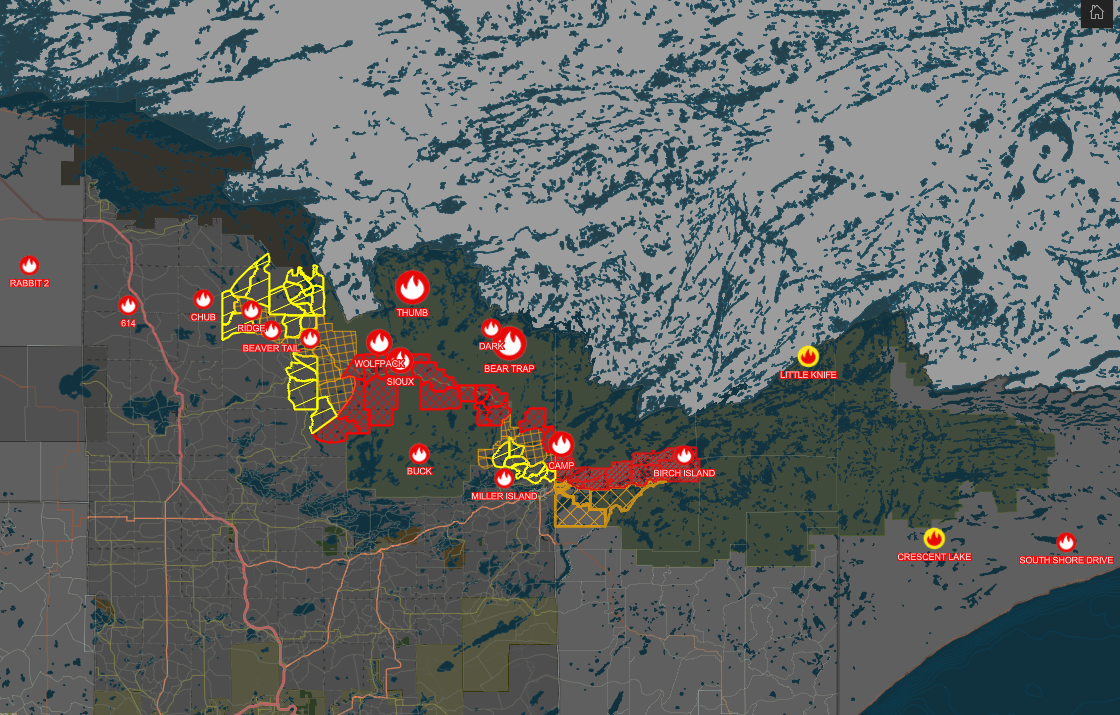
Briefing reporters early Wednesday afternoon, those officials also said a new fire was identified coming in from Ontario, Canada. Now known as the Little Knife Fire, it’s estimated at 28,000 acres with about 6,000 acres in Minnesota west of the Gunflint Trail.
Given the conditions and weather forecasts, “I highly feel like this is going on for a while,” Nick Petrack, fire management officer for the Superior and Chippewa National Forests, told reporters of the overall firefighting effort. “If we do see some rain, that does not mean the fire is out.”
Among the other updates Wednesday:
Officials raised alarm about a private drone seen in the airspace above the firefight. “Drones and firefighting do not mix,” said Jason Randall, safety manager for the National Incident Management Organization. If the air space isn’t secure, “we have no choice but to have our aircraft return to base.” No firefighters have been hurt.
National Weather Service meteorologist Phillip Manuel described current cloudy conditions as a “momentary pause” in the fire weather and said conditions wouldn’t ease meaningfully unless the area got a storm heavy enough to get its own name. “Odds are these fires will be here until it snows,” he said.
Evacuations from the Boundary Waters Canoe Area Wilderness are still taking place, said Tom Hall, agency administrator for the Superior National Forest. Two-person teams continue to cross the Boundary Water looking for campers who may not know they need to leave. He didn’t have an estimate of how many might still be in the BWCA.
Officials continued to caution that conditions were extremely fluid and urged residents to stay vigilant on “ready-set-go” orders for possible evacuations.
Petrack said in his 25 years in the Superior National Forest, this season had the most and number of fires in July that he’s seen. “I would say we would be in this until fall.”
Watch: Officials brief reporters Wednesday afternoon on fires in NE Minnesota
A vehicle is asked to turn around due to a road closure blocking access points to the Boundary Waters Canoe Area Wilderness along Fernberg Road Thursday, near Ely. Multiple wildfires are burning in northeastern Minnesota causing the U.S. Forest Service to temporarily close the Boundary Waters Canoe Area Wilderness.
As the wildfires up north continue to rage, and authorities expand evacuation orders, a temporary evacuation center has opened at the Babbitt Municipal building, about 20 minutes south of Ely.
The air conditioned center is open from 8 a.m. until 9 p.m., but those hours could change as needs evolve. It’s staffed with Red Cross volunteers and public health employees. Cots are available as well as a gym.
Dan Williams, executive director for the Red Cross of Northern and Central Minnesota, said it’s a great place to go and figure out what to do next and how to proceed after being evacuated from homes, cabins or campgrounds. And volunteers there can provide information to help make that decision.
4 of 4
Red Cross volunteer Elaine Johnson of International Falls, Minn. helps at an evacuation shelter set up Thursday, at the Babbitt Municipal Building in Babbitt. Multiple wildfires are burning in northeastern Minnesota causing the U.S. Forest Service to temporarily close the Boundary Waters Canoe Area Wilderness.
Erica Dischino for MPR News
1 of 4
An evacuation shelter for those impacted by the wildfires is available Thursday, at the Babbitt Municipal Building in Babbitt, Minn. Multiple wildfires are burning in northeastern Minnesota causing the U.S. Forest Service to temporarily close the Boundary Waters Canoe Area Wilderness.
Erica Dischino for MPR News
2 of 4
Red Cross volunteer Elaine Johnson of International Falls, Minn. helps at an evacuation shelter set up Thursday, at the Babbitt Municipal Building in Babbitt. Multiple wildfires are burning in northeastern Minnesota causing the U.S. Forest Service to temporarily close the Boundary Waters Canoe Area Wilderness.
Erica Dischino for MPR News
"People can go there — they can clean up, they can get information and even just figure out like, ‘what are we going to do? Are we going to go to our aunt's house in the cities? Are we going to get a hotel? Are we going to wait it out? What are they going to do?’ So it's giving people a safe place to decide what their next step is,” Williams told MPR News.
Williams said, at this time, the center does not need any more donations. If that changes, the information will be updated either on the United Way of Northeastern Minnesota or St. Louis County’s social media pages.
While relatively few year-round residents have been impacted by the evacuations so far, Williams said everyone is still very much feeling the impacts of the fires at large.
“This is a hugely anxious time for people,” Williams said. “It's important to give a little grace and give a little patience to people that are impacted by this because it's something that has so much uncertainty… people are going to be absorbing this differently.”
New evacuation orders in St. Louis County as of 2:40 p.m.
As several wildfires continue to burn and expand near the Boundary Waters Canoe Area Wilderness, St. Louis County authorities have issued new evacuation orders for the Echo Trail area north and west of Ely. People living along the trail between Big Lake and North Arm Road should evacuate immediately.
New “GO” evacuation orders have also been issued for parts of Forest Road. 20 in St. Louis County.
State and federal officials working to gain control of fires burning across northeastern Minnesota offered little hope Wednesday of a quick end to the battle. One said he expected the firefight to continue into the fall; another said “fires will be here until it snows.”
Briefing reporters early Wednesday afternoon, those officials also said a new fire was identified coming in from Canada. Now known as the Little Knife Fire, it’s estimated at 28,000 acres with about 6,000 acres in Minnesota west of the Gunflint Trail.
Given the conditions and weather forecasts, “I highly feel like this is going on for a while,” Nick Petrack, fire management officer for the Superior and Chippewa National Forests, told reporters of the overall firefighting effort. “If we do see some rain, that does not mean the fire is out.”
Among the other updates Wednesday:
Officials raised alarm about a private drone seen in the airspace above the firefight. “Drones and firefighting do not mix,” said Jason Randall, safety manager for the National Incident Management Organization. If the air space isn’t secure, “we have no choice but to have our aircraft return to base.” About 400 to 500 firefighters are on the ground, none have been hurt.
National Weather Service meteorologist Phillip Manuel described current cloudy conditions as a “momentary pause” in the fire weather and said conditions wouldn’t ease meaningfully unless the area got a storm heavy enough to get its own name. “Odds are these fires will be here until it snows,” he said.
Evacuations from the Boundary Waters Canoe Area Wilderness are still taking place, said Tom Hall, agency administrator for the Superior National Forest. Two-person teams continue to cross the Boundary Water looking for campers who may not know they need to leave. He didn’t have an estimate of how many might still be in the BWCA.
Officials continued to caution that conditions were extremely fluid and urged residents to stay vigilant on “ready-set-go” orders for possible evacuations.
Petrack said in his 25 years in the Superior National Forest, this season had the most and number of fires in July that he’s seen. “I would say we would be in this until fall.”
Watch: Officials brief reporters Wednesday afternoon on fires in NE Minnesota
The Ely water tower rises through wildfire smoke on Wednesday, July 15, 2026. Smoke from multiple wildfires burning across northeastern Minnesota and Ontario blanketed the region, reducing visibility and degrading air quality as firefighters continued battling several large fires near the Boundary Waters Canoe Area Wilderness.
The Minnesota Pollution Control Agency’s West Duluth air quality monitor measured a new state record for wildfire smoke concentration Wednesday morning.
The preliminary reading of 600.1 is the highest hourly fine particle concentrations from wildfire smoke measured by monitors in Minnesota since 2014, according to the MPCA.
New records were also set in Grand Portage (576.3) and Duluth (513.3) Wednesday.
An air quality alert remains in effect for much of the state through 11 a.m. Friday.
On Tuesday morning, Grand Portage had the worst air quality in all of America.
The highest hourly fine particle concentration on record in Minnesota is 657 and was set at 10 p.m. on July 4, 2020, in Minneapolis. This was the result of smoke from personal fireworks after municipal firework displays were cancelled because of the COVID-19 pandemic and poor atmospheric dispersion.
Minnesota Executive Council, made up of five statewide elected officials, meeting at the state emergency operation center in Blaine, Minn., on Wednesday.
Gov. Tim Walz called an Executive Council meeting Wednesday to extend the peacetime emergency for wildfires in and around the Boundary Waters Canoe Area Wilderness for 30 more days.
The extension allows the state to continue assisting communities impacted by wildfires in northern Minnesota.
Minnesota State Auditor Julie Blaha, a member of the Executive Council, said the extension of the executive order doesn’t just help with putting the fires out, but also with the recovery after.
“Just remember, when the smoke clears, this won’t be over,” Blaha said. “It will perhaps be the end of the beginning, and so we’re going to need to continue to make these communities whole.”
Canada helping with YMCA camper extractions
Walz said we has been in contact with Ontario Premier Doug Ford regarding two groups of YMCA campers that were north of the Minnesota and Canada border. The Canadian Air Force is assisting with the extraction of the campers and one group is expected to be removed this morning. The second group is in a more remote location. They are expected to be extracted later today.
“It took one call, and over the night, all their forces were activated to go and rescue Minnesota campers from the Y, and that speaks volumes to our neighbors from Canada.
“I am just incredibly grateful that, in conjunction with the incredible folks, with a thank you to our firefighters, to our teams that are out there, to all of the folks who are putting themselves at risk, that at this point in time we don't have any injuries,” Walz said. “And the fires, while they continue to burn, are being monitored and attacked in a proper way.”
Current wildfire status
Minnesota Department of Natural Resources Commissioner Sarah Strommen said there are 17 active fires burning in and around the Boundary Waters. Three of those are inside the Boundary Waters, and 14 are outside, primarily burning in northern St. Louis County and Lake County. The fires, she said, appear to have been caused by a July 6 lightning storm. The fires currently cover 55,000 acres.
“The weather conditions continue to be challenging,” Strommen said. “Extreme fire conditions continue in the northeast, with the past three days of red flag conditions prompted by extreme heat, dry conditions, in combination with very dry vegetation in the area.”
She said the firefighting environment is also very challenging, as firefighters are dealing with difficult remote access. Extremely dry vegetation, intense heat and wind are exacerbating the conditions the more than 150 firefighters are facing.
“I also want to note that while our focus today is on Northeast Minnesota, we have dry conditions across the state, so we're keeping an eye on all parts of the state and need to consider that in our planning,” Strommen said.
Minnesota Department of Natural Resources Forestry Division Director Patty Thielen said that while this isn’t the most wildfires Minnesota has had at one time, it is abnormal to have so many this time of year.
“For most of my career, we have spring fire season for six or eight weeks... and sometimes a fall fire season for a month or two,” Thielen said. “Over the last five or six years, we've begun to have more fires throughout more months of the year.”
"I certainly think the summer is going to be changed for a lot of people," Strommen said, referring questions to U.S. forestry officials about when and whether the BWCA would reopen to campers.
When it comes to staying informed in Minnesota, our newsletters overdeliver. Sign-up now for headlines, breaking news, hometown stories, weather and much more. Delivered weekday mornings.