Cecilia Rolando makes a card for firefighters at the Ely Community Response Hub on July 20.
Jon Stegenga for MPR News
Wildland firefighter dies. A crew member working to contain wildfires burning in the Boundary Waters Canoe Area Wilderness has died. Officials did not immediately share the cause of death or say if it was connected to fighting the fires.
Some 75 percent of BWCA campsites reopening. The Superior National Forest says more than 1,600 of the 2,000-plus Boundary Waters campsites will be open by Aug. 13.
The fight isn't over: Fire officials warned that the persistent dryness in the region, which is in a state of severe drought, could allow fires to flare up again and spread quickly.
Smoke rises in the Boundary Waters Canoe Area Wilderness on Tuesday near Ely, Minn. The wildfire was one of several burning across northeastern Minnesota. Officials closed the entire BWCA to visitors because of extreme fire danger.
As firefighters battle several large wildfires burning in northeastern Minnesota, evacuations are becoming more frequent for local residents near the fire zones.
Kate Tovsen and her family live about 20 miles outside of Ely in an area with many homes, cabins, lodges and resorts that were under evacuation orders early Tuesday. She evacuated ahead of the “go” order with her three young children.
“We're just trying to create some sort of fun for the kids throughout this.” said Tovsen, whose oldest child is 5. “It's just so surreal to have to to be a parent managing that situation and having trying to have that conversation and not scare them.”
Tovsen told MPR News she initially evacuated to a resort on White Iron Lake owned by her neighbor’s parents, but as the fires grew she and her children moved to a friend’s cabin in Babbitt.
Her husband stayed behind at their home an extra day to help pack up more and get the family cat ready.
“I'm constantly reminding myself that my job is to keep my kids safe, and I'm doing that, and that's that's all I can do,” she said.
Listen to the full conversation by clicking the player above.
Wildfire smoke blankets Embarrass Lake on Wednesday, July 15, 2026, in Biwabik, Minn. Smoke from multiple wildfires burning across northeastern Minnesota and Ontario reduced visibility and degraded air quality across the region as firefighters continued battling several large fires near the Boundary Waters Canoe Area Wilderness.
Seventeen wildfires are burning across northern Minnesota, most concentrated in the area northwest of Ely. In total, the fires have burned about 35,000 acres or 55 square miles, an area about the same size as the city of St. Paul.
Evacuations continue near the Fernberg Road corridor east of Ely, an area with many homes and cabins, along with parts of the Echo Trail northwest of Ely.
The winds are expected to be a little lighter today and temperatures about 10 degrees cooler than Tuesday, which is good news for the crews fighting the fires.
St. Louis County Sheriff Gordon Ramsay said fire officials are still concerned about how fast the fires have moved and the amount of fuel, such as dead trees, that remains in the forest.
8 of 8
Camp Fire evacuee Dr. Eric Bailey gets assistance at the U.S. Forest Service Ranger Station in Ely, MN.
Chuck Olsen for MPR News
1 of 8
Wildfire smoke creates an orange haze at the edge of the Fernberg Road evacuation zone in Winton, Minn., on Tuesday.
Chuck Olsen for MPR News
2 of 8
The Ely water tower is enveloped in wildfire smoke, as seen from Shagawa Lake.
Chuck Olsen for MPR News
Smoke rises in the Boundary Waters Canoe Area Wilderness on Tuesday near Ely, Minn. The wildfire was one of several fires burning across northeastern Minnesota that prompted officials to close the entire Boundary Waters Canoe Area Wilderness to visitors because of extreme fire danger.
As wildfires rage throughout northern Minnesota and around the Boundary Waters Canoe Area Wilderness, air quality continues to worsen — driving air quality health alerts well beyond the region.
Minnesota's North Shore experienced the worst air quality in America Tuesday. The U.S. Forest Service has closed the Boundary Waters through Friday at least because of the rapidly growing fires and the extreme heat, and Minnesota Gov. Tim Walz has deployed the National Guard to help in evacuation and fire mitigation efforts.
The Air Quality Index was at 226 in ElyTuesday afternoon — labeled “very unhealthy” — meaning those exposed could experience serious health effects.
Matt Taraldsen, meteorologist for the Minnesota Pollution Control Agency, told Minnesota Now on MPR News Tuesday that the state is seeing such intense air quality conditions because winds from the north have been pushing the smoke around Thunder Bay and then down into the Arrowhead. And on Wednesday, smoke will move into central Minnesota.
Taraldsen said Minnesotans should take caution in the smoky conditions and pay attention to updating air quality alerts. He predicts smoky conditions will arrive further south in the Twin Cities by Wednesday afternoon and into the Mississippi River Valley by the evening.
“The biggest thing is to avoid the outdoors if you can,” Taraldsen said. “If you cannot, you can wear an N95 [respirator] or a KN95 mask that will block those particles from getting into your lungs.”
He added that the combination of the extreme heat Minnesotans are seeing and the poor air quality can be a “one-two punch.” And people who are very young, very old, pregnant or outdoors for an extended period of time will feel the impacts fastest.
Taraldsen said that the warm temperatures, gusty winds, and dry conditions are fueling the wildfires and lofting more smoke deeper into the atmosphere.
Pollution from wildfire smoke can cause shortness of breath, wheezing, coughing, chest pain and fatigue and can aggravate conditions like asthma and heart disease.
“It's important to pay attention to what your body's telling you,” Taraldsen reminded Minnesotans. “Wear a mask if you can, and then limit your time outdoors and your exertion outdoors if you can.”
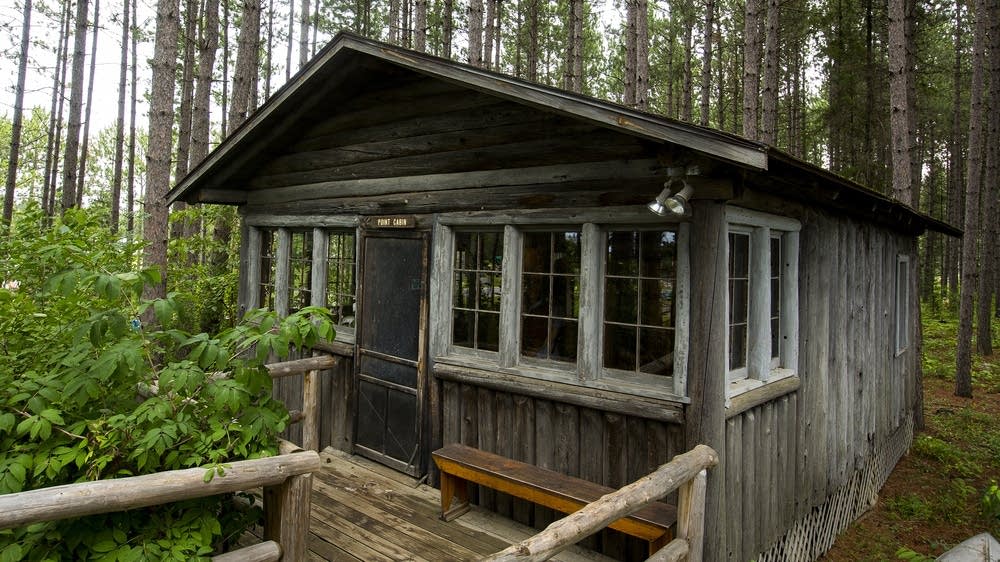
The point cabin near Knife Lake was one of the cabins at the Isle of Pines resort that Dorothy Molter operated and used until the time of her death in 1986. It was taken apart piece by piece and reconstructed at the site of the Dorothy Molter Museum in Ely, Minn. Here it awaits tour groups Aug. 29, 2013.
A museum on the edge of Ely, Minn., is working to preserve history in the face of wildfires near the Boundary Waters just miles away.
Dorothy Molter was the last non-Indigenous person to live in the Boundary Waters Canoe Area Wilderness legally. She’s something of a local legend and earned the name “Root Beer Lady” by selling her homemade root beer to guests and canoeists who stopped by her cabins.
“She holds a very special place in the hearts and minds of people that knew her,” said Jess Edberg, executive director of the Dorothy Molter Museum. “Preserving her memory helps us preserve the cultural and natural history of the area and the history of the Boundary Waters.”
The museum is about two miles away from the nearest evacuation zone, Edberg said. But staff have already moved some archives to a separate location in town, farther away from the fires. Archives include Molter’s guestbooks, photographs and correspondence.
“We will do everything we can to protect and save them,” Edberg said.
At the same time, the museum saw an influx of visitors Tuesday, as evacuees looked for ways to spend their time nearby and away from the wildfire smoke. But she and others in Ely are gearing up to evacuate if necessary.
“This time of the year, communities like ours are always a little bit mentally preparing for something like this,” Edberg said. “So, I think a lot of the folks that are accustomed to this potentially happening have a plan in place.”
Smoke rises in the Boundary Waters Canoe Area Wilderness on Tuesday near Ely, Minn. “The trees were basically going up so fast that pieces of bark, puzzle pieces, were falling from the sky on fire," said Eric Bailey, a paddler who spoke to MPR News.
When the U.S. Forest Service closed the entire Boundary Waters Canoe Area Wilderness early Monday because of several large wildfires, forest officials estimated there were 6,000 to 10,000 people canoeing and camping there.
Most evacuations were uneventful. But some were quite harrowing. Some paddlers coming out of the Boundary Waters Monday shared some of their nerve-racking moments as they worked to get themselves and their loved ones off the water ahead of the fires closing in.
MPR News caught up with some families as they came out and an outfitter who brought boats to get people out who said he could feel embers falling on him.
Bailey Shinn paddled into the Boundary Waters last Wednesday for a big, extended family trip with her husband, parents and kids. She did not bet on 100-degree heat, fire and smoke to come along on the adventure.
Bailey Shinn described her family’s hairy evacuation from Pipestone Bay on Basswood Lake, caused by the Camp Fire.
Dan Kraker | MPR News
Shinn and her husband are schoolteachers from Texas, but they spend their summers in Ely. After spending a few days on Fall Lake, her parents left with Shinn’s oldest child. Then, she and her husband and three youngest kids, ages 5, 5 and 6, paddled into Newton Lake and then into Pipestone Bay.
On Monday, "we were swimming. I turned my phone on — take some pictures — and my mom texted like, ‘Hey, tomorrow Boundary Waters is going to be closed through Friday,’” she recalled.
As conditions deteriorated Monday near Pipestone Bay on Basswood Lake, what started as a leisurely pack-up of the family campsite turned urgent and a little scary.
“It was about 2:30 in the afternoon. And next thing we knew — I mean, it was sudden — there was smoke, lots of dark, dark smoke billowing right towards us,” she recalled. “People who were paddling by us were yelling at us like, ‘The fire is coming for your campsite! You need to leave immediately.’”
They shoved gear in their packs, leaving behind a new tent and other equipment.
"We could feel the heat. We were breathing the smoke. Our throats were scratchy, we had three young kids, so we … got the kids, and we were out."
The paddle out was stressful, she said. Waves slammed broadside against their canoes.
"It was very windy, and whitecaps — and it was a relief to arrive at Fall Lake. And my mom was there, and it was like, tears. And ‘OK, we made it,’ you know."
‘Sky on fire’
Farther up Pipestone Bay, the raging Camp Fire was quickly closing in on other canoeists.
Eric and Jan Bailey from Buffalo, Minn., were camped with their daughter and son-in-law, two grandkids and three dogs. They're experienced paddlers with more than 40 years of experience in the Boundary Waters and across the Canadian boundary in Quetico Provincial Park.
They first noticed some wispy smoke on the horizon, then a plume, then “from 2 o'clock to 4 o'clock it basically turned into a big firestorm to our east, coming closer and widening up as it went.”
They were camped on the south shore. By about 4:30 p.m., the other side of the water was ablaze.
Smoke rises in the Boundary Waters Canoe Area Wilderness on Tuesday near Ely, Minn. The wildfire was one of several fires burning across northeastern Minnesota that prompted officials to close the entire Boundary Waters Canoe Area Wilderness to visitors because of extreme fire danger.
Courtesy of Eric Bailey
"We saw basically the north shore of Pipestone Bay fully engulfed in a crown fire. Trees were exploding,” Eric Bailey said. “The trees were basically going up so fast that pieces of bark, puzzle pieces, were falling from the sky on fire."
A paddleboarder fled to their campsite when she saw flames coming over the ridge line. And she had a satellite phone.
“When she got there, we got a phone call from the Forest Service, and were told to stay in place on that campsite for rescue."
Standing on the shore they watched aircraft scoop up water to dump on the fire.
The wait grew tense, Jan Bailey said.
"We were feeling the heat from the flames, and the smoke was getting really intense, and so we had decided if he didn't show up within 10 minutes, we were getting our canoes and just going."
Finally, at about 5:30 p.m., two Forest Service crew members picked them up in a boat. They motored north where the fire had jumped across Pipestone Bay.
“We had fire on both sides of us at that time,” she said. “So we're just weaving between the lakes. It's a little smoky. Campsites are going up. The forest is going up, and we're getting people who were in that area out."
‘Pretty imminent threat’
The Baileys finally made it across a portage to Back Bay on another part of Basswood Lake.
There they were met by outfitters from Moose Lake who brought 10 boats to help evacuate campers. Willy Vosburgh, a resort owner on Moose Lake, drove a fishing boat two hours to help.
"We ended up pulling out people that did not have any gear because the Forest Service had plucked them from campsites that were in pretty imminent threat of burning,” he recalled. “The places where they had been were then overtaken by the fire."
He said he had embers falling on him as he motored to pick up the campers.
He evacuated seven campers then came back and picked up six more who were packed onto tow boats operated by another resort owner.
"The three towboats that came off of Back Bay last with people had 11 people apiece. They were loaded at 33 people, plus three drivers. So they had 36 people split between three boats."
He didn't make it back to the boat landing on Moose Lake until after 10 p.m.
When MPR News talked to Vosburgh earlier Tuesday afternoon, he was still waiting on three groups still in the wilderness. Then, he motored back into the wilderness and evacuated four more campers.
When he returned, he had to evacuate the resort that's been in his family for four generations and hope that it stayed safe from the encroaching fire.
A U.S. Forest Service sign warns of extreme fire danger at an entrance to the Superior National Forest on Tuesday near Isabella. That extreme fire danger covered the entirety of the Boundary Waters, where numerous wildfires are burning.
Growing concerns about a wildfire burning near the Minnesota-Canada border are prompting officials in Cook County to warn residents and visitors near the end of the Gunflint Trail that they may need to evacuate.
Areas near the end of the Gunflint — beyond the Seagull Guard Station — have been moved from “ready” to “set” status, the Cook County Sheriff’s Office said Tuesday.
The fire causing concern near the Gunflint started in Canada and is known as FOR028.
“U.S. Forest Service personnel flew over the fire at around 10 a.m. and estimated the fire to be about 2,500 acres,” the sheriff’s office said in an update at 1 p.m. Tuesday.
“It had not crossed over to the U.S. side at that time but was burning near the west side of the Monument Portage and near Swamp Lake,” the sheriff’s office added. “They are expecting that it has crossed into that area by now.”
Authorities advised residents and visitors at the end of the Gunflint Trail — which includes many homes and cabins, and several lodges and campgrounds — to “prepare to leave at a moment’s notice.”
“Do final fireproof preparations for your house,” the sheriff’s office urged. “Check in with your neighbors to make sure they are prepared as well. Start packing your vehicle and back your car into the driveway to ensure a quick exit. If you feel threatened, don’t wait for the final evacuation notice and just go.”
Tuesday morning evacuations
To the west, “go” evacuation orders were issued Tuesday morning along and near the Fernberg Road east of Ely. That’s due to the Camp Fire, which grew rapidly to 2,200 acres as of Tuesday afternoon.
New “go” evacuation orders were issued Tuesday afternoon for parts of the Echo Trail northwest of Ely, including the Lake Jeanette Campground. That’s due to the Sioux Fire, estimated at just over 3,500 acres.
The largest fires currently burning in the Superior National Forest — the Thumb Fire and the Bear Trap Fire — were each estimated at more than 12,000 acres in size as of Tuesday afternoon. They are in remote areas of the Boundary Waters Canoe Area Wilderness, northwest of Ely. Forest Service officials said they have crossed the border into Canada.
The entire BWCA remains closed to visitors due to multiple wildfires, and concerns that they will continue to spread amid hot, dry weather conditions.
Some Boundary Waters campers had to be rescued Monday — rather than paddling out on their own — after they were caught in the path of the expanding Camp Fire.
“With the winds and the fire moving rapidly, they got caught up on an island where they needed to be rescued,” St. Louis County Sheriff Gordon Ramsay told MPR’s Morning Edition on Tuesday. “Fire Service was able to get some boats together and rescue those folks and get them out of any danger.”
A towering plume of smoke rises in the Boundary Waters Canoe Area Wilderness on Tuesday, near Ely, Minn. The wildfire was one of several fires burning across northeastern Minnesota that prompted officials to close the entire Boundary Waters Canoe Area Wilderness to visitors because of extreme fire danger.
Two nonprofit groups have had their plans cut short due to the wildfires near the Boundary Waters.
The Tofte Lake Center was evacuated Tuesday morning because of an encroaching wildfire. According to organizers, the art center is located about 8 miles from the Camp Fire in the Boundary Waters Canoe Area Wilderness.
The center's founder and executive director, Liz Engelman, said all 11 people were evacuated without incident.
"From the other side of the lake, you could see clouds of smoke, dark orange black clouds kind of hovering,” she said. “It was a windy night last night, so the wind was blowing them, and so it was quite a scene visually."
Boundary Waters Canoe Area Wilderness wildfire
8 of 8
Smoke rises in the Boundary Waters Canoe Area Wilderness on Tuesday, near Ely, Minn. The wildfire was one of several fires burning across northeastern Minnesota that prompted officials to close the entire Boundary Waters Canoe Area Wilderness to visitors because of extreme fire danger.
Courtesy photo of Eric Bailey
1 of 8
A towering plume of smoke rises in the Boundary Waters Canoe Area Wilderness on Tuesday, near Ely, Minn.
Courtesy photo of Eric Bailey
2 of 8
A firefighting aircraft drops water on a wildfire burning in the Boundary Waters Canoe Area Wilderness on Tuesday, near Ely, Minn.
Courtesy photo of Eric Bailey
Engelman says this is the first time the Tofte Lake Center has ever been evacuated. It's located about 15 miles northeast of Ely.
Also on Tuesday morning, wildfires sent about 30 middle schoolers on a canoe adventure home early.
Project Success is a youth organization based out of Minneapolis that helps students build life skills. The last of their five trips to the BWCA this summer was set to conclude later Tuesday. But guides were told to return to camp early Monday, said Laura Garcia, senior director of programs.
"Students and our leaders were able to get out of the heat, get back to camp, and then evacuate the the camp this morning at about 9:30,” she said.
While the students are physically unharmed, Garcia said staff are making sure to talk with students who are processing the emergency to help them feel safe emotionally.
A towering plume of smoke rises in the Boundary Waters Canoe Area Wilderness on Tuesday near Ely, Minn.
The expanded alert now runs through Friday morning. Along with areas where wildfires are burning in northeastern Minnesota, it now also includes Duluth, Moorhead, Brainerd, St. Cloud, the Twin Cities and Winona.
An air quality alert has been issued for east central, central, west central, southeast, north central, northwest, and northeast Minnesota due to wildfire smoke for Tuesday, July 14, through Friday, July 17.
Minnesota Pollution Control Agency
“Very heavy smoke is expected across the Arrowhead today, as large wildfires continue to spread. Hot temperatures, when combined with the air pollution, will exacerbate health impacts,” the Minnesota Pollution Control Agency reported Tuesday.
“A frontal boundary will then spread heavy smoke further south this evening into Wednesday morning as it moves across northern and central Minnesota. The onset of smoke will be rapid. This boundary eventually passes through the Twin Cities and into southeastern Minnesota on Wednesday or Wednesday evening, bringing heavy smoke even further south.”
The MPCA said additional rounds of heavy smoke are possible Thursday into Friday.
Forecasters said fine particle levels in the air may reach the maroon category — meaning hazardous for everyone — closest to the fires, in Lake and Cook counties as well as northern St. Louis County.
“In the maroon area, everyone should avoid any outdoor activity and stay indoors,” the MPCA reported.
Air quality may reach the purple category — meaning very unhealthy for everyone — for the Iron Range, Duluth, and the Interstate 35 corridor between Duluth and Pine City. In those areas, the MPCA said people should “avoid prolonged or heavy exertion and stay indoors.”
Minnesota wildfire
3 of 3
Canoes are loaded onto a trailer as a Boy Scout troop from Texas evacuates from Agassa Lake near the Boundary Waters Canoe Area Wilderness on Tuesday, near Isabella, Minn. The troop left the wilderness after officials closed the Boundary Waters Canoe Area Wilderness because of extreme fire danger and nearby wildfires.
Chuck Olsen for MPR News
1 of 3
Wildfire closure maps are posted at a Boundary Waters Canoe Area Wilderness trailhead on Tuesday, north of Ely, Minn. Officials closed the entire Boundary Waters Canoe Area Wilderness to visitors because of extreme fire danger and ongoing wildfires, posting maps and notices at entry points throughout the region.
Chuck Olsen for MPR News
2 of 3
A U.S. Forest Service sign warns of extreme fire danger at an entrance to the Superior National Forest on Tuesday, near Isabella, Minn. Persistent hot, dry conditions and ongoing wildfires prompted officials to close the Boundary Waters Canoe Area Wilderness to visitors beginning July 14.
Chuck Olsen for MPR News
The rest of the alert area — including the Twin Cities — may see air quality in the red category, meaning unhealthy for everyone.
“In the red area, sensitive groups should avoid prolonged or heavy exertion and limit time spent outdoors. Everyone should limit prolonged or heavy exertion and time spent outdoors,” the MPCA said.
Smoke rises in the Boundary Waters Canoe Area Wilderness on Tuesday, July 14, 2026, near Ely, Minn. The wildfire was one of several fires burning across northeastern Minnesota that prompted officials to close the entire Boundary Waters Canoe Area Wilderness to visitors because of extreme fire danger.
News of the growing wildfires and evacuations left some people waiting anxiously to hear from loved ones Tuesday who entered the Boundary Waters Canoe Area Wilderness before it was closed the day before.
Pam Tilly of Oklahoma City awaited word of her 74-year-old brother, her brother’s son and daughter-in-law and their two daughters, ages 5 and 7. They entered the BWCA at Birch Lake on July 10.
Tilly said the group has been visiting the BWCA for years and are experienced wilderness campers. But as she watched news of the fires expanding late Monday, she grew worried.
“This is the one thing they look forward to every year. But it’s very nerve-racking,” Tilly said. She said she hasn’t been able to reach her brother by cell phone, which is common in the BWCA where there’s limited or no cell service.
Her brother’s outfitting company contacted Tilly, who was listed as an emergency contact, and has been providing her with updates. The group is believed to have headed east to Knife Lake. Tilly said Forest Service staff will be sweeping that area by canoe today.
Depending on the direction of the wind, the group might not even see smoke or be aware of the fires, Tilly said. She said she’s hopeful that they’re well away from any danger.
“I think they're just having a great time and have no awareness of what's going on around them,” she said.
UPDATE: Shortly after 5:30 p.m., Tilly told MPR News she had received a text from her brother’s daughter-in-law saying they were all off the water and safe — welcome news after a long day of worrying.
Bear Trap Fire column on the Superior National Forest in the Boundary Waters Canoe Area Wilderness on Saturday, July 11, 2026.
Gov. Tim Walz says Minnesota should brace for an active wildfire season, and that he expects more fires to break out in the Boundary Waters Canoe Area Wilderness in the coming days.
Dry conditions combined with winds and other factors have triggered a fast-spreading set of fires in the Boundary Waters. State and federal firefighting crews are working to contain the fires.
"I just kind of think we're on the front end of what's going to be a pretty long summer on on the wildfire front,” Walz said Tuesday.
He says dry, windy and hot conditions combined with acres of dead trees have created the perfect conditions for fires to start.
The BWCA is closed until at least Friday morning, and Walz deployed the National Guard to help in evacuation and fire mitigation efforts earlier this week.
Local officials say they're rescued at least 17 people, but Walz says no injuries have been reported so far.
More information is expected as the state begins to hold wildfire briefings tomorrow Wednesday at the State Emergency Operations Center in Blaine.
News you can use in your inbox
When it comes to staying informed in Minnesota, our newsletters overdeliver. Sign-up now for headlines, breaking news, hometown stories, weather and much more. Delivered weekday mornings.